
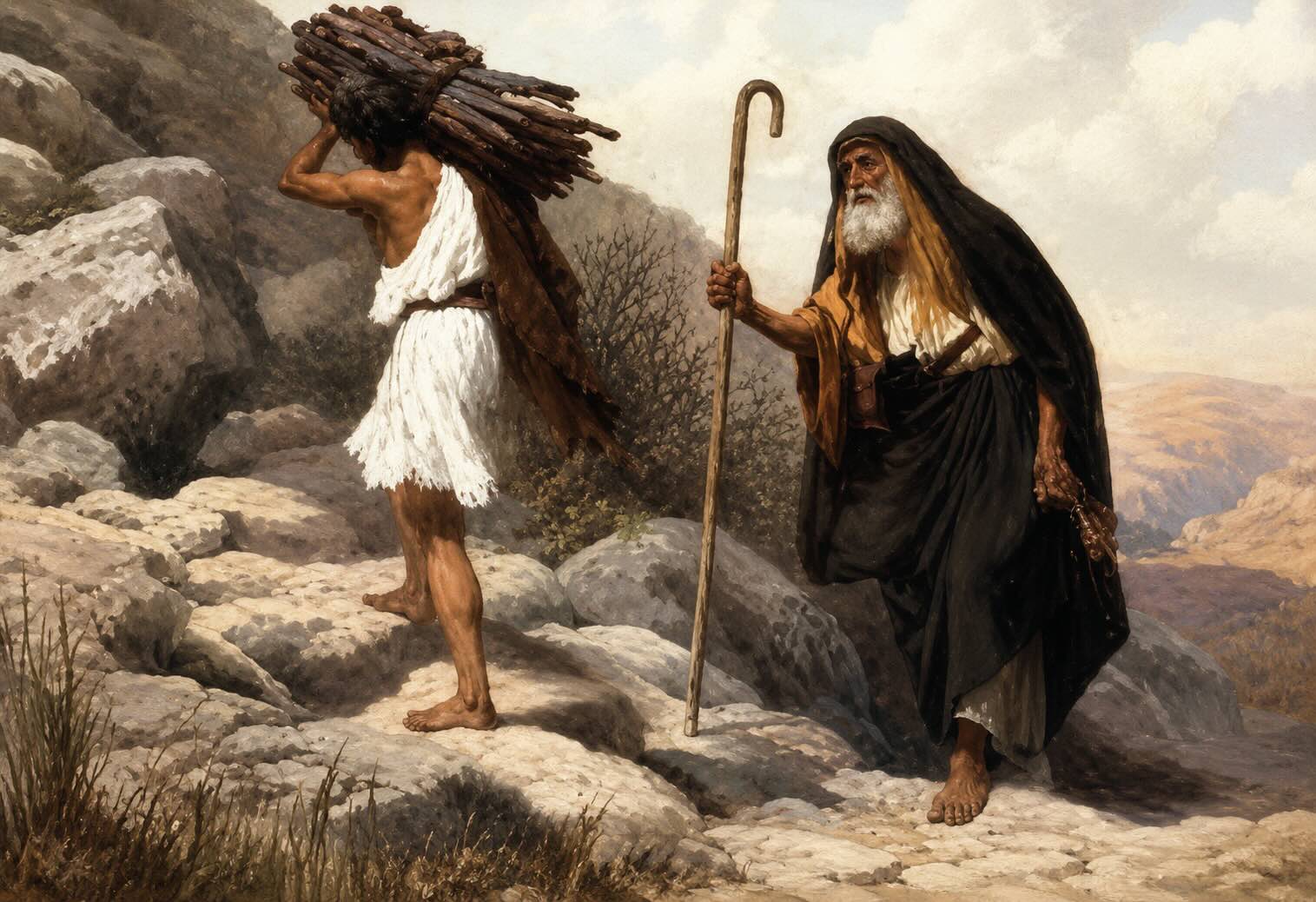
Every year, millions of Muslims across the world gather before sunrise for prayers marking Eid ul-Adha, the Festival of Sacrifice. Families dress in new clothes, livestock is slaughtered, meals are shared, and charitable giving takes centre stage.
But beneath the celebrations lies an ancient story that reaches far beyond Islam.
It is the story of Abraham or Ibrahim in Arabic, a figure deeply revered in both Christianity and Islam. His willingness to sacrifice his son in obedience to God remains one of the most powerful narratives in the Abrahamic faiths.
For many Christians, the account is familiar from the Bible’s Book of Genesis. For Muslims, it is central to Eid ul-Adha and closely linked to the annual Hajj pilgrimage in Mecca.
Though the two faiths differ on some details, the core message is strikingly similar: faith demands trust, obedience and sacrifice.
In the biblical account, God commands Abraham to offer his son Isaac as a sacrifice.
“Take now thy son, thine only son Isaac, whom thou lovest.” — Genesis 22:2
In Islamic tradition, many scholars identify the son as Ishmael, though the Quran does not explicitly name him in the passage describing the sacrifice.
The Quran recounts the moment this way:
“O my son! I have seen in a dream that I am sacrificing you, so see what you think.” — Quran 37:102
What makes the story extraordinary is not simply Abraham’s obedience, but also the response of the son.
According to the Quran, the boy replies:
“O my father! Do as you are commanded. If Allah wills, you will find me among the steadfast.” — Quran 37:102
The Bible records a similarly haunting exchange as father and son walk together toward Mount Moriah carrying wood for the sacrifice.
“Behold the fire and the wood: but where is the lamb for a burnt offering?” — Genesis 22:7
Abraham responds:
“God will provide himself a lamb.” — Genesis 22:8
The age of Isaac is not specifically stated in the Bible, although many Jewish and Christian scholars believe he may have been a teenager or young adult at the time. Abraham, meanwhile, was already elderly.
That detail has fascinated theologians for centuries.
If the son understood what was happening, he could likely have resisted or fled. Instead, both biblical and Islamic traditions portray a profound act of submission and trust between father, son and God.
At the final moment, according to both traditions, God intervenes and provides a ram to be sacrificed instead.
For Muslims, this moment is commemorated during Eid ul-Adha through Qurbani — the ritual sacrifice of livestock such as sheep, goats or cows by those who can afford it. The meat is traditionally divided into portions for family, friends and the poor.
The festival also marks the culmination of Hajj, the pilgrimage to Mecca that is one of Islam’s five pillars.
But beyond ritual, scholars say the deeper meaning of Eid ul-Adha lies in sacrifice for the sake of others and devotion beyond self-interest.
That message resonates far beyond religion.

In modern societies increasingly shaped by consumerism and individualism, the story of Abraham presents a difficult question: what are people willing to give up for faith, principle or community?
Religious leaders often draw parallels between Abraham’s sacrifice and everyday acts of devotion, parents sacrificing for children, healthcare workers serving through crisis, or communities supporting vulnerable neighbours during hardship.
For Christians, the story also carries theological significance because it foreshadows the New Testament portrayal of Jesus as a sacrificial lamb.
For Muslims, Ibrahim represents the ideal believer: one who submits fully to God’s will.
Despite theological differences, both faiths regard Abraham as a patriarch of faith and moral courage.
That shared heritage is often overlooked in a world where religious identity is frequently framed through division rather than common ground.
Yet in cities across Africa, the Middle East and beyond, Christians and Muslims routinely celebrate milestones together, share neighbourhoods and support one another during religious holidays.
Eid ul-Adha, at its heart, is not only about sacrifice.
It is about compassion.
It is about generosity.
And perhaps most importantly, it is about a story that still binds billions of people across two of the world’s largest religions.