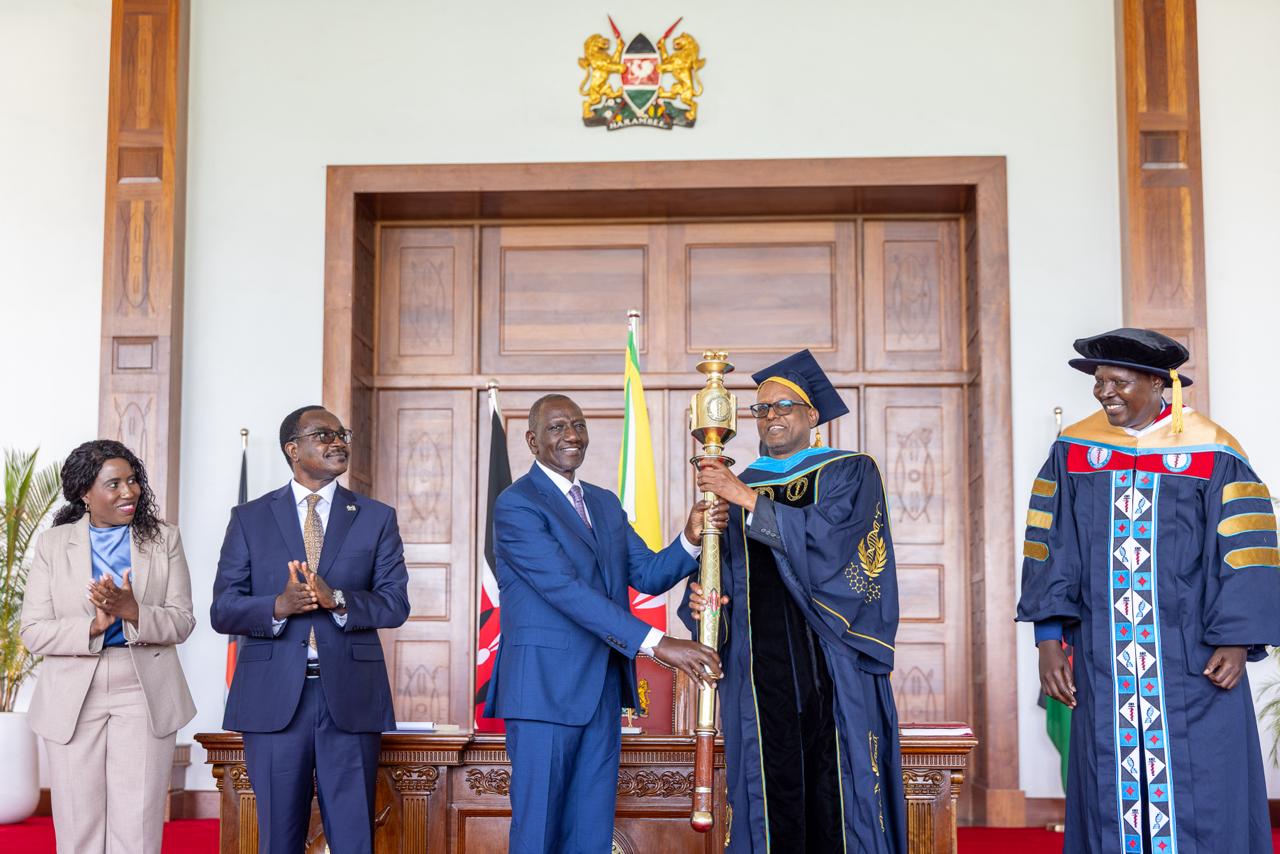
Nairobi, Kenya – On a sunlit morning at State House Gardens on May 14, 2026, President William Ruto signed into history a document that officially transforms the Kenya Medical Research Institute (KEMRI) from a public research body into a fully fledged, specialized degree-awarding university .
For the scientists in white coats who have spent decades battling malaria, HIV, and Covid-19, it was a moment of vindication. For the government, it was the laying of a “strategic pillar” for a knowledge-driven economy . But for the millions of Kenyans relying on a fragile healthcare system, the ceremony raises a critical question: Will this charter fix the funding gaps that have historically crippled the country’s ability to detect, treat, and prevent disease?
A Graduation from Mentorship
Under the new charter, granted under Section 24(1)(a) of the Universities Act, KEMRI can now award its own postgraduate degrees . Previously, the institute operated a long-standing partnership with Jomo Kenyatta University of Agriculture and Technology (JKUAT), where students could earn degrees in public health and biomedical sciences, but KEMRI acted as the mentor rather than the master .
Now, programs in biochemical sciences, biodefense, epidemic intelligence, and molecular medicine will be run directly by the research institute . The focus is purely on high-level specialization—Doctorates and Master’s degrees designed to produce what the government calls "world-class health scientists."
In his State House address, President Ruto was emphatic that this is not just about education. “Health security is national security,” he said, referencing the painful lessons of the COVID-19 pandemic where the nation scrambled for reagents and vaccines . He argued that just as the US relied on MIT and Stanford, and South Korea on its advanced institutes, Kenya must invest in its own science hubs to build a "first-world economy" .
The Crisis Beneath the Celebration
However, the celebratory mood at State House stands in stark contrast to the financial reality that has plagued KEMRI for the last twelve months.
Just one year before the charter was awarded, People Daily reported that KEMRI was facing an existential threat due to a complete lack of government funding for research in the 2025/2026 budget . While the government allocated Sh2.7 billion for salaries and recurrent expenditure, exactly zero shillings were earmarked for actual research activities.
At the time, the institute’s leadership warned that the zero allocation was jeopardizing Kenya’s disease surveillance, vaccine development, and diagnostic capacity. "Every researcher we fail to train is a vaccine we may not develop, or a disease we may not detect," Health CS Aden Duale warned during the charter ceremony, echoing the same sentiments raised by KEMRI directors during the budget crisis.
The institute has historically survived on donor funding. People Daily reported that of the 4,000 staff, the government only pays for 850; the rest depend entirely on project-based funding from foreign partners . When the US withdrew support for certain projects recently, the institute was "left struggling," raising fears that the new university status might create more classrooms without equipping the laboratories.
Filling a Dangerous Gap
The need for this charter is undeniably urgent. According to CS Duale, Kenya has approximately 250 researchers per million people compared to a global average of 1,500 . This shortage has real-world consequences.
Recent studies have highlighted systemic failures that a stronger research body could address. In March 2026, a KEMRI-Wellcome Trust study revealed that non-communicable disease (NCD) programs in Kilifi face a 94 percent funding gap, with frequent drug shortages and staff deficits hampering hypertension care . Essentially, while KEMRI can conduct the research to identify solutions, the health system often lacks the capacity or political will to implement them.
The new charter aims to close the gap by training the epidemiologists and public health experts needed to forecast these shortages and design better policies. President Ruto referenced this directly, noting the nation's goal of moving from being "consumers of global knowledge" to "creators" .
The 2 Percent Solution
For the charter to translate into better health outcomes, it requires cash—specifically, a commitment to the 2% of GDP target for research and development.
In his speech, President Ruto committed to "fully operationalise the national target of allocating at least two percent of GDP to research and development" . Currently, Kenya's investment hovers below 1%, a figure that scientists argue is insufficient for the expensive work of genomic sequencing and vaccine trials.
There is also the matter of political will. In a lighter moment during the ceremony, President Ruto revealed that he is "already developing a private laboratory on my farm," having acquired equipment because he believes "research becomes front and center of everything" . While this was received with applause, health stakeholders will be watching to see if the same passion for private lab equipment translates into budget lines for the public institution.
A University of Solutions
Despite the financial clouds, the potential impact of the charter is transformative.
For the health sector, it promises a shift from "brain drain" to "brain gain." Instead of sending a handful of elite scientists abroad for advanced training—where they often stay—KEMRI can now retain that talent locally. The proposed doctoral studies in Health Products and Technologies and Molecular Biomedical Sciences could theoretically lead to the creation of a home-grown vaccine manufacturing industry.
Furthermore, the charter allows KEMRI to retain its identity as a research powerhouse while expanding its teaching mandate. It will not become a conventional university offering humanities; it remains a strategic national asset focused on the "wazito" (heavyweights) of science.
The awarding of the charter to KEMRI is arguably the most significant structural change in Kenya's medical landscape since the advent of devolution. It legitimizes the scientist and places research on the same pedestal as clinical care.
However, a university charter is just a piece of paper unless it is backed by a checkbook. As KEMRI prepares to admit its first independent cohort of PhD students, the government faces a choice: either fund the institute to the level of a Stanford or an MIT, or watch a world-class facility continue to depend on the shifting priorities of foreign donors.
For now, the health sector waits to see if the rhetoric of "scientific sovereignty" will survive the reality of the budget-making process.