
Bondo, Siaya County — October 19, 2025
Kenya came to a standstill on Sunday as thousands gathered at Jaramogi Oginga Odinga University of Science and Technology (JOOUST) in Bondo to bid farewell to the late former Prime Minister Raila Amolo Odinga — a man many called Baba.
From dawn, mourners streamed into the university grounds under tight security. The crowd included governors, senators, MPs, and diplomats, alongside ordinary Kenyans who had travelled from every corner of the country to witness a defining moment in national history.
Among the first to arrive were Kilifi Governor Gideon Mung’aro, Embakasi East MP Babu Owino, and Nairobi Woman Representative Esther Passaris. The ceremony — sombre yet dignified — began with hymns and prayers as anticipation built for the arrival of Odinga’s body.
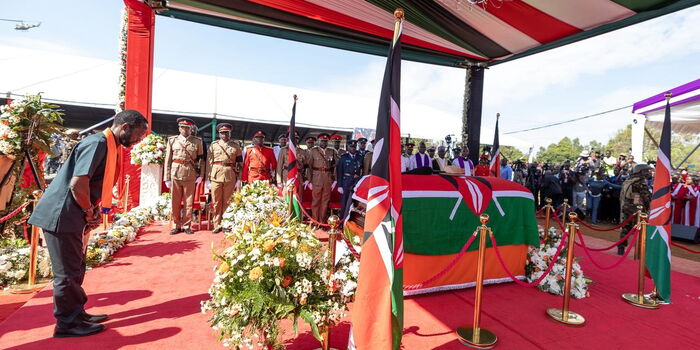
At 9:18 a.m., a hush fell over the field as a military convoy entered the university gates. The casket, draped in the Kenyan flag, was carried in under strict military guard. Soldiers in ceremonial uniform stood at attention as a brass band played the national anthem.
“It was a moment that felt both national and deeply personal,” one mourner whispered, her eyes glistening.
Earlier, Interior Cabinet Secretary Kipchumba Murkomen described Odinga as “a unique leader whose life redefined service and sacrifice.”
“Raila embodied the principle that leadership is not a position, but the service you give,” Murkomen said. “It is because of that service that we have come to appreciate who he was.”
The funeral programme began shortly after the arrival of President William Ruto, who led government officials in paying tribute to a man once his political rival, now remembered as a national statesman.
Odinga’s family — led by Mama Ida Odinga, Winnie Odinga, Rosemary, and Raila Junior — delivered deeply emotional tributes.
“They wrote for me a speech, but I have nothing to say other than to thank the staff of Baba and President Ruto,” said Winnie Odinga. “The king is dead, but long live the crown.”
Her words drew tears from many in the audience.
When Mama Ida Odinga took the podium, silence swept across the crowd. Dressed in a flowing black gown, she spoke slowly, her voice steady but heavy with emotion.
“Thank you, the people of Kenya, Africa and the world, for helping me mourn the father of my children,” she said. “I accept the will of God.”
Reflecting on her life with Raila, she added with a faint smile, “I swore to marry a calm, professional man — not one who loved politics. Little did I know I was marrying a political engineer.”
The congregation laughed gently, easing the tension for a moment.
Odinga’s elder brother, Dr. Oburu Oginga, also took time to thank President Ruto for what he called “a gesture of friendship beyond politics.”
“I would like to thank His Excellency the President, who stood with us from the time I told him Raila was sick,” he said. “He organised his treatment in India and followed up daily until the very end.”
The tributes continued well into the afternoon. Homa Bay Governor Gladys Wanga proposed renaming the Talanta Stadium in Nairobi to honour the late leader.
“Mr President, I ask you to rename it Raila Odinga Talanta Stadium,” Wanga said. “And when it’s complete, invite Arsenal to play Harambee Stars in his honour — since both you and Raila were loyal Arsenal fans.”
As the choir sang It Is Well With My Soul, the casket rested before the crowd — a reminder of a life that had loomed large over Kenyan politics for half a century.
Raila Odinga, who passed away in India on October 15, will be laid to rest at his Opoda Farm in Bondo, beside his father, Jaramogi Oginga Odinga — the nation’s first Vice-President.
For many Kenyans, the day marked not just the end of an era, but the closing of a chapter written in struggle, resilience, and hope.
 Facebook
 Twitter / X
 WhatsApp
 LinkedIn
 Telegram
 Reddit