
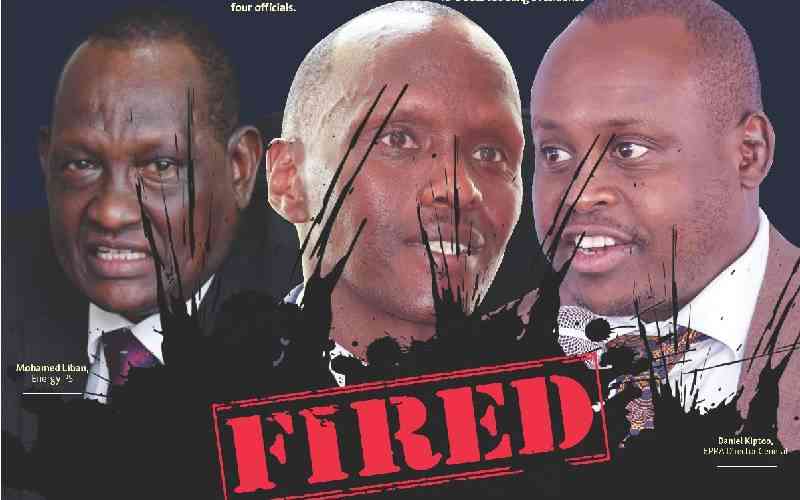
Nairobi — A covert effort to bypass Kenya’s multibillion-shilling fuel import system has erupted into a high-level political and economic scandal, forcing the resignation of three senior energy officials and raising fresh concerns about governance, market manipulation, and consumer exposure to inflated fuel prices.
At the center of the controversy is an alleged scheme to sidestep the government’s official Government-to-Government (G2G) fuel importation framework — a system introduced under President William Ruto to stabilize supply and pricing through structured bilateral agreements. Instead, officials are accused of orchestrating emergency fuel imports outside this framework, relying on manipulated data to justify the move.
Those implicated include Daniel Kiptoo, head of the Energy and Petroleum Regulatory Authority (EPRA); Joe Sang, managing director of the Kenya Pipeline Company (KPC); and Mohamed Liban, the principal secretary for petroleum. All three were arrested on Thursday in a coordinated operation that reportedly uncovered nearly half a billion Kenyan shillings in cash.
By Saturday, the Office of the President confirmed that the officials had resigned.
In a statement, Felix Koskei, Chief of Staff and Head of Public Service, said investigators had established that petroleum supply data had been deliberately falsified to create the impression of an imminent shortage. This, he said, enabled the irregular procurement of fuel cargo at significantly inflated prices and of questionable quality.
The shipments — imported by private firms Oryx Energy and One Petroleum — were described as “emergency consignments,” despite what the government now characterizes as a stable supply environment. Each shipment carried approximately 60,000 tonnes of fuel.
“The misrepresentation appears to have been designed to exploit rising global prices and public anxiety,” Koskei said, adding that the actions constituted a “serious breach of public trust” and may amount to economic crimes.
The episode has exposed fractures within Kenya’s powerful energy sector, particularly between dominant oil marketing companies and factions within government. Industry sources say established players — some believed to be aligned with senior state officials — resisted the parallel import arrangement, triggering a confrontation that culminated in the arrests.
Critics, however, argue that the scandal reflects not only regulatory failure but also internal elite rivalries. Ndindi Nyoro, a legislator and former ally of the president, described the arrests as “a fight among elites,” suggesting that commercial interests — rather than public welfare — were at stake.
A similar account was offered by Rigathi Gachagua, who claimed that the disputed imports may have been an attempt to source cheaper fuel outside the G2G structure, potentially mitigating anticipated price increases driven by geopolitical tensions in the Middle East.
Yet even that defense underscores the systemic opacity surrounding Kenya’s fuel supply chain. The G2G program, initially presented as a stabilizing reform, has increasingly come under scrutiny for concentrating market power among a small group of firms and limiting competitive pricing.
Meanwhile, operational failures within the supply chain have begun to affect consumers directly. Over the past two weeks, sporadic fuel shortages have been reported across parts of the country, with some stations running dry amid allegations of hoarding in anticipation of higher prices.
Investigators are now examining whether substandard fuel may have entered the domestic distribution system after being discharged into KPC infrastructure — a move that could have broader implications for engine safety and regulatory compliance.
Beyond the immediate legal consequences for the three officials, the case raises deeper questions about institutional accountability and the governance of Kenya’s energy sector. The government has referred the matter to investigative agencies for a full inquiry, with additional administrative action already initiated against mid-level officials within the State Department of Petroleum and KPC.
As the investigation unfolds, the scandal threatens to erode public confidence in a sector already strained by volatile global markets and domestic policy disputes — and to test the credibility of reforms intended to shield Kenyans from precisely such shocks.
*******************************
Kenya fuel scandal, EPRA arrests, Kenya Pipeline Company, G2G fuel deal Kenya, William Ruto fuel policy, petroleum corruption Kenya, fuel prices Kenya, energy sector Kenya crisis, oil import scandal Kenya, Ndindi Nyoro, Rigathi Gachagua, Felix Koskei, Kenya oil supply chain, fuel shortages Kenya, economic crimes Kenya
 Facebook
 Twitter / X
 WhatsApp
 LinkedIn
 Telegram
 Reddit