
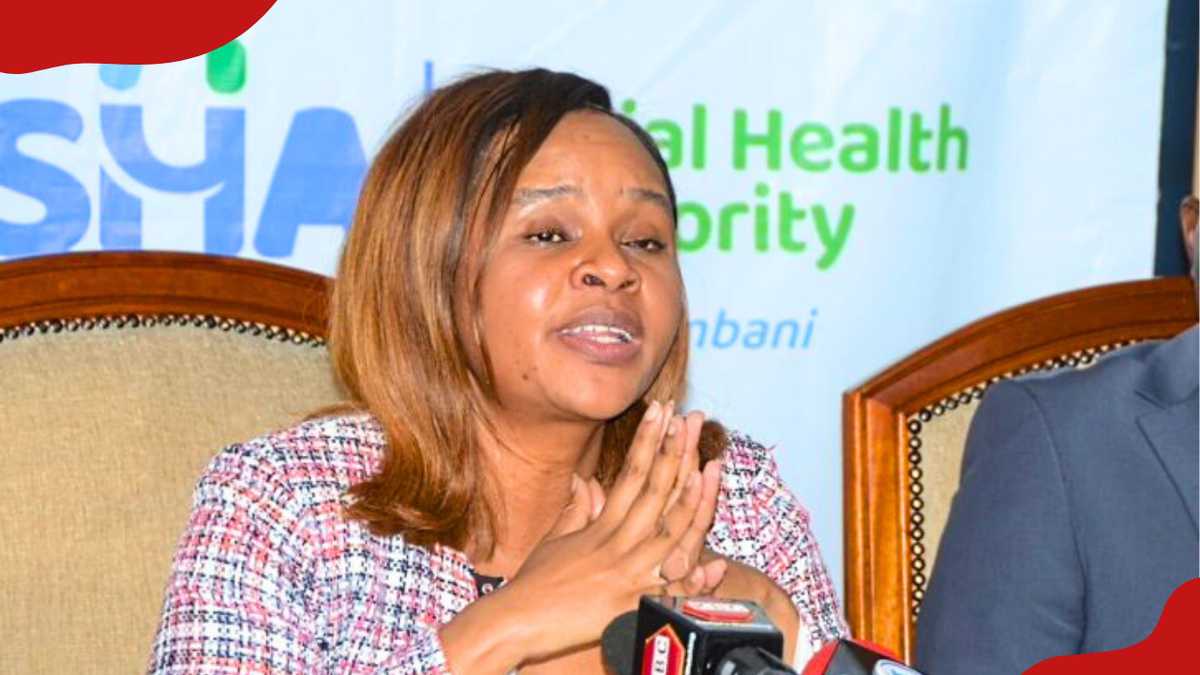
The Social Health Authority says it has recovered Sh300 million linked to fraudulent activity and has 15 cases before the courts, as it steps up scrutiny of health insurance claims.
SHA chief executive Mercy Mwangangi made the disclosure on Tuesday during a media town hall in Nairobi. She said the authority was pursuing suspected fraud through internal investigations, administrative measures and criminal proceedings.
The announcement comes as SHA continues to shift healthcare claims fully online, a move the authority says should make suspicious transactions easier to identify and investigate.
Mwangangi said Sh200 million had been recovered from healthcare providers, while cases involving a further Sh28 million had been referred to the Director of Public Prosecutions (DPP). She did not provide a full breakdown of the Sh300 million recovery.

“We have Sh300 million recovery of fraud and we are still recovering,” Mwangangi said.
She added that 15 cases had already reached court, while other matters remained under investigation or were being handled administratively.
SHA turns to digital claims to catch fraud
Mwangangi said fraud was not confined to one part of the healthcare system.
Healthcare providers, officials and members of the public can all contribute to fraudulent claims, she said.
She cited an incident reported by a private facility in which a civil servant allegedly used her SHA card to have her sister admitted for treatment. The patient later left the facility, according to Mwangangi.
“This is fraud by Kenyans,” she said, arguing that tackling the problem requires responsibility from everyone who interacts with the system.
Her remarks highlight one of the biggest tests facing Kenya's new health insurance system: protecting public funds without making it harder for legitimate patients to access care.
SHA has been moving away from the paper-based processes associated with the former NHIF system. Mwangangi said claims are now handled digitally, with no manual claims documents being used.
“We struggle with this, but our digitisation has come to support us,” she said.
The Ministry of Health has also previously said SHA is strengthening oversight of contracted healthcare facilities and improving communication with beneficiaries. In April, the ministry announced measures requiring contracted facilities to comply with SHA tariffs and prohibiting unauthorised out-of-pocket charges under the civil servants' medical scheme.
But technology is only part of the answer
Mwangangi identified change management and public education as another major challenge.
The transition from NHIF to SHA has altered how Kenyans register, access benefits and interact with healthcare providers. For the system to work, she said, patients and other stakeholders need to understand the changes.
“One of the things that when you introduce a reform or project you must deal with is if stakeholders understand the reform and that they are able to push forward,” she said.
She also acknowledged that SHA needs to do more to explain its services to the public.
That could prove important as the authority tries to build confidence in a system that has faced questions over claims processing, provider payments and the handling of fraudulent claims.
The government has previously taken steps against suspected irregularities in the health insurance system. The Ministry of Health has also been working with SHA and the Digital Health Agency on broader reforms, including emergency response systems and digital health services.
A bigger question for SHA
The latest recovery figure is significant, but it is only one measure of whether the fraud crackdown is working.
The more difficult test will be whether SHA can prevent fraudulent claims from entering the system in the first place, recover money when they do, and ensure genuine patients and healthcare providers are not caught in the same net.
Mwangangi said Kenya could look to countries such as the United States, where specialised teams investigate medical insurance fraud.
“We need to go and look at the FBI special unit for medical fraud, just like America,” she said.
For SHA, the challenge is therefore moving beyond detecting losses after they occur.
Its digital claims system gives the authority more data to work with. But technology alone will not settle questions of accountability, public awareness and trust.
As the authority expands its investigations, the 15 cases already before the courts will also offer an important test of whether suspected fraud can ultimately translate into successful prosecutions and recovery of public money.
For millions of Kenyans relying on the new health insurance system, that outcome matters as much as the headline recovery figure.
Related Stories
- Edwin Sifuna Rallies Support in Busia as Linda Mwananchi Brigade Intensifies 2027 Campaign
- BioTank Africa Takes Fundi Forum County by County as Kenya Faces Major Sanitation Skills Gap
- Kenya’s Mandatory Health Cover for Foreign Visitors Raises Tourism Competitiveness Questions
Category: Health · Related Topic: Social Health Authority (SHA)
Related Video: How a tweet cost Idris Mukhtar a job with CNN | Globe Traktion Ep# 11
About the Author
Maureen Onyango is a journalist passionate about storytelling, life coaching and spiritual lessons. She studied at the Kenya Institute of Management and enjoys telling stories that inform, inspire and empower communities.
 Facebook
 Twitter / X
 WhatsApp
 LinkedIn
 Telegram
 Reddit