
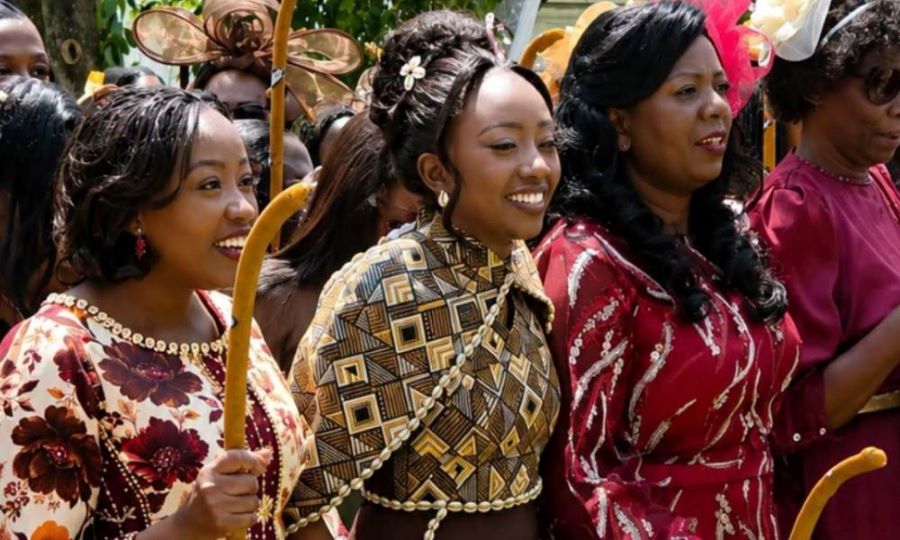
The choice of Kilgoris rather than Sugoi for Charlene Ruto's traditional engagement ceremony has become almost as intriguing as the ceremony itself.
President William Ruto and First Lady Rachel Ruto hosted their daughter's Koito at Intona Heritage Farm in Naserian Village, Kilgoris, Narok County, bringing together the Ruto and Yunge families ahead of Charlene's marriage to Tanzanian technology entrepreneur Isaya Yunge.
At the heart of the occasion was a distinctly Kalenjin tradition. But the venue also offered a glimpse into how the President's private life has increasingly shifted beyond his better-known home in Sugoi.
What is Koito?
For the Kalenjin, Koito is a formal stage in the marriage process. It brings the two families together and provides an opportunity for elders to discuss the union, negotiate bridewealth and give the couple their blessings.

The ceremony is traditionally led by family representatives and elders rather than the couple themselves.
Among its cultural elements are advice to the bride and groom, the exchange of gifts and, in many families, the sharing of mursik, the traditional fermented milk associated with Kalenjin ceremonies.
The exact customs can differ between Kalenjin communities and families. But the central idea remains the same: marriage is not viewed simply as a union between two individuals. It is also a relationship between families.
That made Charlene's ceremony significant beyond its guest list.
It brought together the Ruto family and relatives of Yunge, who comes from Tanzania, in a ceremony that placed Kalenjin customs at the centre of a cross-border family union.
Traditional performances, elders' blessings and cultural dress formed part of the celebrations.
The gathering was also attended by senior political figures, including Deputy President Kithure Kindiki, Cabinet secretaries and parliamentary leaders, giving the otherwise private family occasion a distinctly public profile.
So why Kilgoris?
Sugoi is perhaps the location most closely associated with Ruto's personal story.
It is where he grew up and where he has maintained a longstanding rural home and agricultural interests in Uasin Gishu County.
But Kilgoris has quietly become another important base for the President and his family.
The Intona property, sometimes referred to as Intona or Intonnah Ranch, is a large private estate in Narok County that Ruto acquired in 2015. Public reports place its size at roughly 900 acres. The property was previously associated with Kenya's former Vice-President Joseph Murumbi.
It has since become a private retreat and a venue where Ruto has hosted both family gatherings and high-profile visitors.
In December 2024, for example, Ruto received Ghana's then President-elect John Mahama at the property. The meeting was followed by renewed public attention on the Kilgoris residence.
The President has also spent holiday periods there with his family, further establishing the ranch as an important part of the family's private life.
More recently, in July 2026, Ruto appeared at a grassroots football tournament held at the farm and organised by his son George Ruto. The tournament brought together 24 teams from Kilgoris.
A private family occasion with a public backdrop
The decision to hold Charlene's Koito in Kilgoris therefore appears less unusual when viewed against the family's growing use of the property.
Unlike State House, Intona provides a private family setting away from the formal environment associated with the presidency.
Its size also makes it suited to a large traditional ceremony involving extended families, elders and invited guests.
There is another important cultural point.
Koito is fundamentally a family ceremony. Holding it at a family residence rather than an official government venue is consistent with that character.
The presence of senior politicians does not change the basic nature of the event. At its core, this was a meeting of two families preparing for a marriage.
Kilgoris is becoming part of the Ruto family's story
The growing prominence of the Intona property reflects something broader than a change of venue.
For years, Sugoi was the dominant image of Ruto away from Nairobi. Kilgoris is now increasingly appearing in the family's public and private story.
The ranch has hosted dignitaries, family activities and community events. Its location in Narok also places the family closer to the Maasai Mara region and the wider Trans Mara area.
For Charlene, however, the meaning of the location was likely much simpler.
Her Koito was held at a place where her family could bring relatives together, allow elders to perform their traditional role and formally welcome the family of her fiancé.
The ceremony was therefore both deeply personal and culturally significant.
And while the photographs and guest list may have drawn national attention, the central message of Koito remains an old one: two people may marry, but two families are joining the journey.

Related Stories
- Inside the rising cost of Ruto’s State House meetings as thousands stream in
- Behind the Fence: Raila Junior’s Moment With Locals Outside Charlene Ruto’s Ceremony
- Inside Charlene Ruto’s Kilgoris Koito: A President’s Daughter, a Tanzanian Groom and a Tradition Bigger Than Politics
Category: Entertainment · Related Topic: William Ruto
Related Video: What President William Ruto Prayed for at first Cabinet meeting
About the Author
Maureen Onyango is a journalist passionate about storytelling, life coaching and spiritual lessons. She studied at the Kenya Institute of Management and enjoys telling stories that inform, inspire and empower communities.
 Facebook
 Twitter / X
 WhatsApp
 LinkedIn
 Telegram
 Reddit