
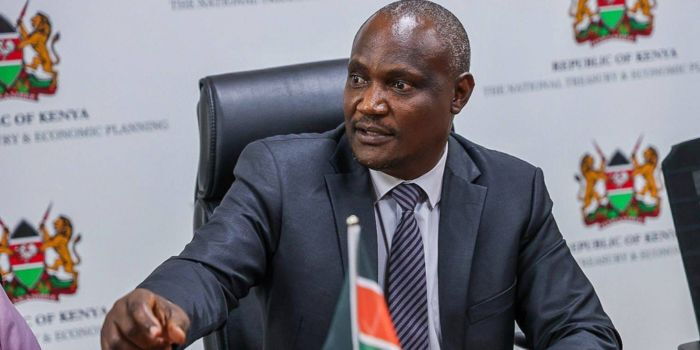
NAIROBI — Kenya’s long-running promise of free education is on shaky ground. Treasury Cabinet Secretary John Mbadi told lawmakers on Wednesday that the government could no longer afford to fully fund free primary and secondary schooling.
Appearing before the National Assembly’s Budget and Appropriations Committee on 24 July, Mbadi cited growing enrolment figures and limited fiscal space as the main culprits.
“The number of students in our schools has gone up significantly,” he said. “But the resources to support them haven’t kept pace. As it stands, this model is not sustainable.”
Sharp Cuts in Capitation
The government’s capitation grant—funds sent to schools to cover basic learning costs—will be slashed. Secondary school students will now receive Ksh16,900 per year, down from the current Ksh22,244.
For primary learners, the state provides Ksh1,420 annually. Junior secondary schools currently receive Ksh15,042 per child, and senior secondary schools Ksh22,244.
“Due to constrained fiscal space and other emerging priorities within the education sector, updating these rates might be untenable,” Mbadi said. “The government will, however, consider reviewing this rate should revenue performance improve.”
Examination Fees Back on the Table
In a move likely to stir further concern among parents, Mbadi also revealed the government is considering reinstating national examination registration fees for learners.
This would reverse a policy introduced to ease the financial burden on families, particularly in poor communities.
Education Cabinet Secretary Julius Ogamba backed the remarks, saying: “The number of students has steadily increased over the past five years, yet the budget figures have largely remained the same.”
Ogamba added that the Ministry of Education had taken administrative measures to ensure funds are disbursed efficiently—50% in first term, 30% in second, and 20% in the third.
A Shrinking Piece of a Giant Pie
During his budget presentation last month, CS Mbadi announced Ksh702.7 billion for the education sector out of Kenya’s Ksh4.29 trillion national budget—roughly 28%.
“The education sector plays a vital role in economic development,” he said. “It drives innovation, improves productivity, and enhances human capital.”
Out of the Ksh702.7 billion:
-
Ksh7 billion goes to free primary education
-
Ksh51.9 billion supports free day secondary schools
-
Junior secondary schools will receive Ksh28.9 billion
-
TVET institutions are allocated Ksh4 billion
-
Ksh5.9 billion is earmarked for national exam administration
-
Ksh3 billion supports the school feeding programme
Growing Pressure on Parents and Schools
The warning from Mbadi and Ogamba has reignited debate on the government’s ability to uphold its promise of free basic education—a cornerstone of Kenya’s development agenda since the early 2000s.
“I’m afraid we’ll soon go back to a system where only the well-off can access quality education,” said Mary Atieno, a parent from Kisumu. “This will hurt rural and slum children the most.”
School administrators are also bracing for leaner times. “We’re already struggling with infrastructure and teaching materials,” said a secondary school headteacher in Bungoma, who asked not to be named. “Further budget cuts will just worsen things.”
While the Treasury has pledged to review funding if revenue improves, for now, Kenya’s education system finds itself at a critical crossroads—caught between ambitious goals and the hard maths of a strained national budget.