Nairobi, Kenya — June 25, 2025
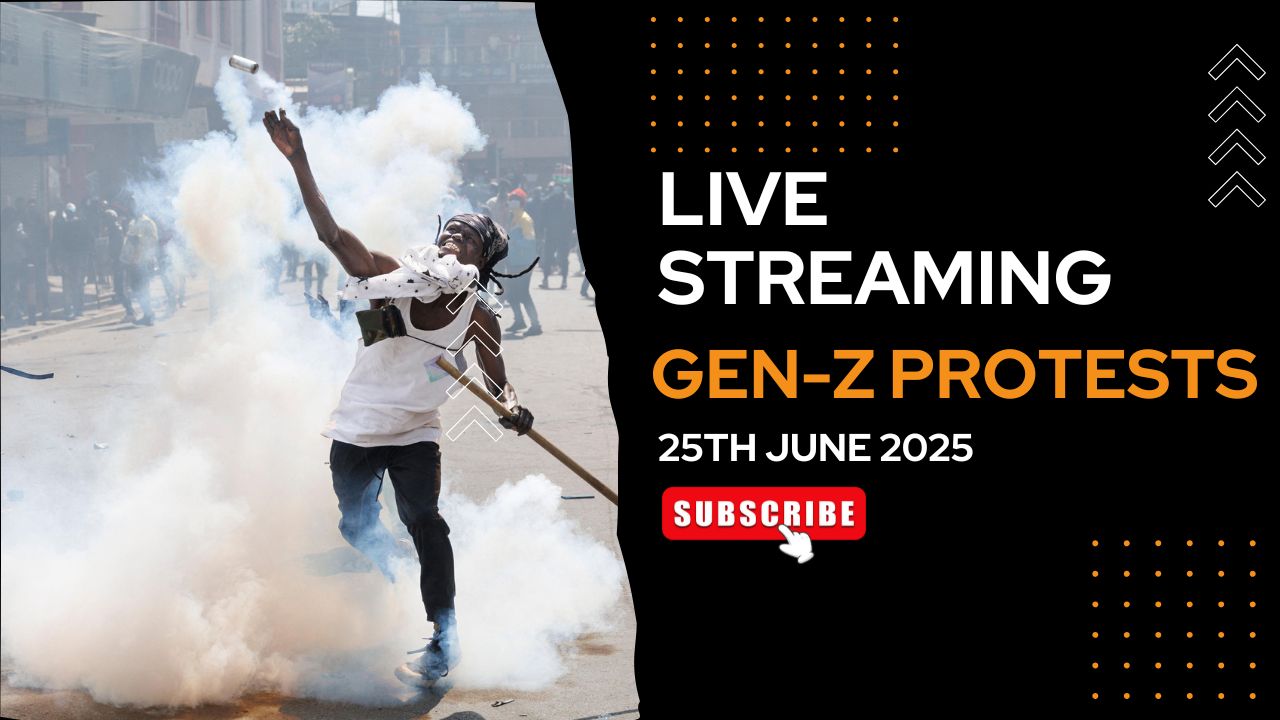
In a sweeping move that has stirred national debate, Kenya’s top media regulator has ordered all television and radio stations to cease live coverage of today’s nationwide protests led by young demonstrators, many identifying with the Gen-Z movement.
The directive, signed by David Mugonyi, Director General of the Communications Authority of Kenya (CA), warns broadcasters against airing real-time footage of the demonstrations taking place across the country, including in the capital, Nairobi.
“The live coverage of the June 25th, 2025 demonstrations are contrary to Articles 33(2) and 34(1) of the Constitution of Kenya and Section 46I of the Kenya Information and Communications Act, 1998,” the letter states.
The communication, dated June 25 and marked Ref. No. CA/CE/BC/TV 90A, was sent to all television and radio stations across the country on Tuesday morning. It directs broadcasters to halt all live transmission of the protests “forthwith,” warning of unspecified regulatory action for those who fail to comply.
The directive comes as thousands of young Kenyans take to the streets in protest against rising taxes, growing inequality, and alleged government opacity in public spending. Social media platforms have been flooded with livestreams and videos under hashtags like #GenZRevolution and #OccupyParliament, showing crowds marching and, in some areas, clashing with police.
Growing Tensions, Shrinking Space
The government’s order raises questions about press freedom and public access to information during a major moment of civic unrest. Critics argue it risks suppressing transparency at a time when citizens are demanding more of it.
“This is deeply concerning,” said Wanjiru Njoya, a constitutional law scholar based in Nairobi. “Live coverage plays a vital role in accountability. Blocking it shuts out the country and the world from knowing what is really happening.”
Others, however, have supported the decision, citing fears that real-time broadcasts could escalate tensions or be used to incite violence. A senior official at the Ministry of Interior, who requested anonymity due to the sensitivity of the matter, said the live streams were “risking national security by fuelling misinformation and panic.”
A Pattern of Restriction?
This is not the first time Kenya’s media has come under pressure during protests or politically tense moments. In 2018, several broadcasters were temporarily shut down after airing coverage of opposition leader Raila Odinga’s controversial “swearing-in” ceremony.
Today’s order may set another precedent.
While the CA’s letter claims the broadcasts are unconstitutional, media and legal experts have called for clarity on how the cited constitutional provisions apply to the public interest role of the press during protests.
Kenya’s Constitution protects both freedom of expression and freedom of the media, but these rights can be limited where public order and national security are at risk.
“It’s a delicate balance,” said Eric Mutua, former chair of the Law Society of Kenya. “But it must be handled within the bounds of legality and fairness. The public deserves both safety and the truth.”
What Next for Broadcasters?
As of early afternoon, some mainstream media stations had already pulled their live feeds, while others appeared to be proceeding with caution, offering delayed updates and recorded footage.
Meanwhile, citizen journalists and activists continue to broadcast live on TikTok, Instagram, and X (formerly Twitter), complicating efforts to control the information flow.
The Communications Authority has not specified what penalties may be imposed for defying the order, but under the 1998 Act, regulatory measures can include fines or suspension of licences.
For now, the protests continue — as does the battle over who gets to show them.