
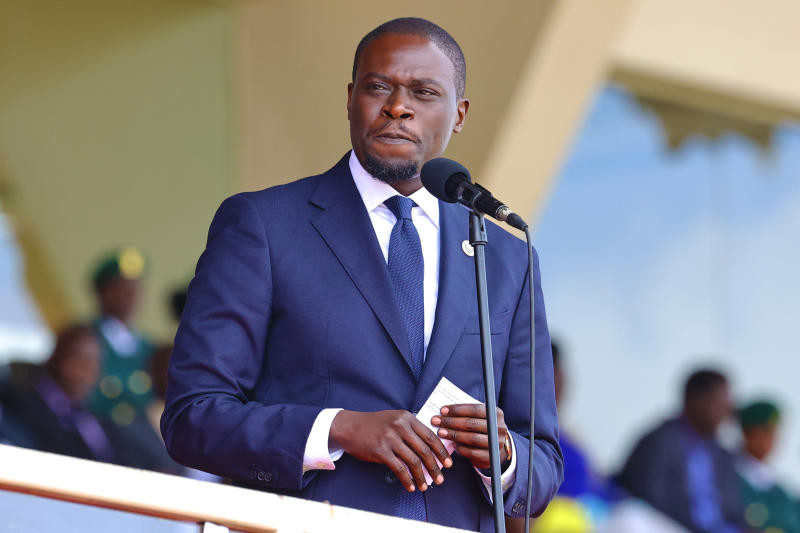
Just days ahead of planned demonstrations on 25 June, Governor Johnson Sakaja finds himself at the centre of a storm—accused of presiding over a crumbling city, alienating allies, and, most explosively, being linked to gangs that attacked protesters last week.
The chaos followed outrage over the death of teacher and blogger Albert Ojwang’, who died in police custody at Nairobi Central Police Station. A protest held in his memory turned violent, as gangs armed with crude weapons roamed the city centre, beating demonstrators and looting shops.
They shouted the governor’s name. “Sakaja tumelinda jiji,” they chanted—“Sakaja, we’ve protected the city.”
The optics were damning. Sakaja, however, denied any involvement.
“I strongly condemn those who take advantage of protests to incite violence,” he said in a statement. “We dissociate from any gangs or politically-sponsored groups exploiting public demonstrations.”
Still, the video evidence and timing raised questions. Especially since Sakaja had, only days earlier, vowed to meet protesters “head on.”
“Let them come,” he warned during a rally in Uasin Gishu. “Let them try. We will protect the city.”
Critics argue that protection has come at the cost of intimidation and bloodshed.
From ‘Super Senator’ to Political Lone Ranger
When Sakaja was elected governor in 2022, many hoped his charm and charisma would bring fresh energy to City Hall. His campaign slogan, Lazima Iwork, painted him as a reformer ready to tackle Nairobi’s long-standing challenges.
He had made his name in the Senate, earning the nickname “Super Senator.”
But that shine has dimmed.
“He’s all dimples and no delivery,” said one Nairobi resident, echoing a sentiment that has gained ground over his two and a half years in office.
A Catalogue of Controversies
Sakaja’s troubles didn’t start with the protests.
He came into office under a cloud, forced to defend the legitimacy of his degree from Team University in Uganda. A Kenyan court eventually ruled there was no evidence of forgery, but suspicions lingered.
More recently, Sakaja found himself at the centre of a bizarre standoff with Kenya Power. In February, Nairobi County dumped garbage at the entrance of Stima Plaza over unpaid bills. Sakaja denied ordering the trash to be dumped, but admitted he authorised the blockade.
“I reprimanded the staff,” he said, “They were told to block, not dump.”
Leaders Turn on the Governor
Several Nairobi Members of Parliament have gone public with their frustrations.
Westlands MP Tim Wanyonyi said he had “tried everything” to reach Sakaja on urgent city matters, but received no response.
“He doesn’t pick up,” said Wanyonyi. “We had one meeting where he promised to share his calendar. That never happened.”
Embakasi East MP Babu Owino was more direct. “Sakaja’s actions show weakness, fear, and disregard for the rule of law,” he said. “He has hurt people with the goons he unleashed.”
Lang’ata MP Phelix Odiwuor, known as Jalang’o, criticised the city’s poor lighting and collapsing infrastructure. “Nairobi shuts down at 8 p.m. It’s just darkness,” he said. “For every working streetlight before the Expressway, I’ll give you Sh1,000.”
A Rogue Inspectorate?
Behind the scenes, a more troubling picture has emerged of Sakaja’s enforcement unit.
Last month, the County Assembly learned that over 700 unqualified recruits had been deployed as “intern askaris,” some operating in plain clothes without identification. Traders reported extortion and abuse—including, in some cases, sexual coercion in exchange for bribes.
Mugumo-ini MCA Jared Akama, chair of the Justice and Legal Affairs Committee, warned that the inspectorate was spinning out of control.
“If they can get handcuffs, what’s to stop them getting pistols?” he asked. “Are we building a militia?”
A recent viral video showed eight plainclothes officers manhandling a civilian on a Nairobi street. The footage reignited public concern over rogue enforcement.
Discontent from Within
Embakasi Central MP Benjamin Gathiru accused Sakaja of “betraying” the hustler manifesto he campaigned on.
“He’s not uplifting the mama mboga or the boda boda,” said Gathiru. “He’s using goons to disrupt rallies and paying them Sh500 to Sh1,000. This is politics from another era.”
That accusation echoed across party lines. Sakaja is now seen as politically isolated, having strained ties with key allies. Even President Ruto’s inner circle has grown critical.
Last week, presidential aide Farouk Kibet publicly challenged Sakaja to prevent the upcoming protest. “Will they burn the country when we’re around?” he asked.
In response, Sakaja promised to defend the city, only to later condemn the violence that followed.
Broken Promises
From garbage and water shortages to collapsing health systems, Nairobi residents say the city is in decline.
County health facilities have been called “death traps” by MPs. Babu Owino claimed patients are only offered antihistamines and painkillers while county staff run private pharmacies nearby.
A damning Auditor General report cited financial mismanagement, including ghost workers and suspicious building approvals. Lawmakers say the governor’s office is riddled with corruption.
“It’s the worst leadership crisis in City Hall’s history,” said Dagoretti South MP John Kiarie. “The dream sold to us during campaigns has turned into a nightmare.”
What Now?
Protests are expected to resume next week, and pressure is mounting.
Rights groups and political observers are calling for investigations into the events of 17 June. Others want Parliament to summon the governor.
But Sakaja remains defiant. “We will not allow criminal elements to hijack our democratic space,” he said.
Whether that message calms a restless city—or further inflames it—will become clear in the days ahead.
For now, Nairobi waits, wary and wounded.