
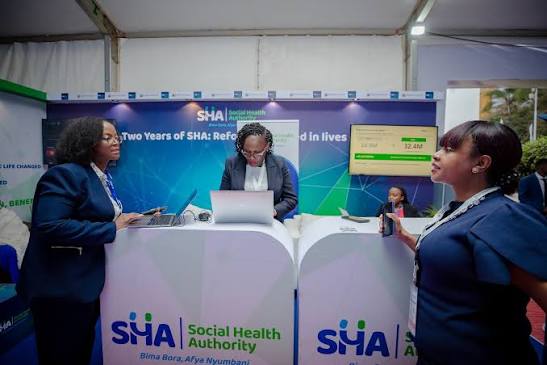
NAIROBI — Kenya’s health insurance revolution has crossed a major milestone, with more than 32 million people now registered under the Social Health Authority (SHA).
But as the government celebrates the numbers, a more difficult test is emerging: registration is not the same thing as access to care.
The question facing Kenya nearly two years after SHA replaced the National Hospital Insurance Fund (NHIF) is increasingly about what happens when a patient walks into a health facility.
Can they get the treatment they need? Is the medicine available? Is the hospital able to process the claim? And can a family afford any costs that fall outside the SHA package?

Those questions are becoming central to the country's push for Universal Health Coverage (UHC).
At the inaugural Kenya Health Summit in Nairobi, President William Ruto said the debate had moved beyond whether Kenya should pursue universal healthcare to whether the new system can deliver for patients consistently.
“The ultimate measure of reform is not the laws we pass or the numbers we register, but the experience of every patient in terms of dependable, affordable and dignified care,” Ruto said.
That distinction could prove crucial as the government seeks to turn SHA from a large registration exercise into a health system Kenyans can rely on.
32.3 million registered — but who is contributing?
The latest government figure puts SHA registration at more than 32.3 million people, a sharp increase from the roughly 29.6 million reported earlier in 2026.
The government says the growth represents significant progress towards UHC.
SHA replaced NHIF on October 1, 2024, under the Social Health Insurance Act, 2023. Unlike the old NHIF model, the new framework is built around three funds — the Social Health Insurance Fund, the Primary Healthcare Fund, and the Emergency, Chronic and Critical Illness Fund.
The government says the system is intended to move healthcare financing away from an employment-centred model and towards one that covers Kenyans regardless of how they earn a living.
But there is an important gap between being registered and making regular contributions.
This is particularly relevant for millions of Kenyans working in the informal economy, where income can change from one month to the next.
Registration therefore gives a useful measure of reach. It does not, by itself, show how many people are consistently contributing or how easily they can access every service in the benefits package.
That is one of the central challenges SHA must now address.
From NHIF to SHA: a new system, new problems
The government has presented SHA as a fundamental change in how healthcare is financed.
The aim is to strengthen primary healthcare, reduce the amount families pay directly for treatment and provide greater protection against large medical bills.
There are signs of progress.
The Ministry of Health says more than 32.3 million people are now registered, while the government has reported billions of shillings in SHA claims payments and expanded access to services.
The government is also putting more emphasis on primary healthcare.
The official benefit framework provides for outpatient services at designated Level 2, 3 and 4 facilities, including consultations, diagnosis, treatment, prescribed laboratory tests, basic radiology and medicines within the approved package.
The bigger idea is simple: treat people earlier and closer to home rather than waiting until illnesses become expensive emergencies.
But implementing that idea across 47 counties is a much harder task.
Digital healthcare is promising — but it has to work
SHA has also brought a major shift in the way hospitals submit and process claims.
The government is moving towards digital systems, including the SHA Health Management Information System. The Ministry of Health has been consulting healthcare providers as the new system replaces earlier arrangements.
The Digital Health Agency is also working on wider digital health infrastructure, including interoperable health information systems.
In theory, this could mean that a patient's information follows them from one facility to another rather than being trapped in paper files.
But digital reform brings its own risks.
Facilities need functioning devices, connectivity, trained staff and systems that work when patients actually need them. A digital system that fails at a busy public hospital can be just as frustrating to a patient as a missing paper file.
And there is another concern: health data is deeply personal.
The government says it is putting safeguards in place for health information and data storage, but public confidence will depend on how well those protections work in practice.
Fraud is another battle
SHA is also confronting a problem that has affected health financing systems for years: fraudulent claims.
Health officials have acknowledged fraud involving different actors, including providers, members of the public and people working within the system.
The government says it has recovered substantial sums linked to fraudulent claims and is pursuing other cases.
The fight against fraud matters because every shilling lost to a false claim is money that cannot be spent on a genuine patient.
But the answer cannot simply be tighter controls.
If verification becomes too complicated, genuine patients and hospitals can also face delays.
The challenge is finding a system that protects public money without creating another barrier between patients and treatment.
Primary healthcare is the bigger test
One of the government's most important bets is to shift attention towards prevention and primary care.
More than 107,000 Community Health Promoters have been incorporated into the national health system, while 277 Primary Care Networks have been established, according to government figures.
The logic is straightforward.
A community health promoter who identifies a health problem early can help a patient seek treatment before the condition becomes severe.
That could reduce pressure on hospitals while making healthcare more accessible to people who live far from major facilities.
But community healthcare cannot succeed on personnel alone.
Promoters need supplies, supervision, referral systems and functioning facilities to which patients can actually be sent.
If the health centre has no medicine, equipment or staff, an effective community referral still leaves the patient with nowhere to go.
The medicine question remains
This is where the experience of SHA meets the reality inside hospitals.
Kenya has continued to face challenges around the availability of medicines and medical supplies.
At the Kenya Health Summit, the government highlighted efforts to strengthen supply chains and improve availability. KEMSA has also reported significant improvement in its ability to fill orders from public facilities.
But national supply figures can hide major differences between facilities.
A hospital in one county may have adequate stocks while another struggles with shortages.
For patients, the question is rarely how well the national supply chain is performing.
It is whether the medicine prescribed to them is on the shelf when they need it.
Health workers remain central to the reform
No insurance system can deliver care without healthcare workers.
Kenya's health reforms continue to unfold against disputes involving nurses, clinical officers and other healthcare workers.
The disagreements have included pay, promotions, working conditions and implementation of collective bargaining agreements.
The issue matters beyond labour relations.
A hospital can have a new digital system, modern equipment and a functioning insurance arrangement. If there are not enough trained workers to provide care, patients will still wait.
The government and county governments therefore face a parallel challenge: financing the system while keeping enough health workers in facilities across the country.
SHA's biggest promise is also its biggest test
The government has invested heavily in the new health financing model.
It has expanded registration, increased attention to primary care and introduced new digital systems.
There are also genuine examples of facilities reporting improvements under the new financing arrangements. At the Kenya Health Summit, health workers shared cases of facilities using SHA reimbursements to strengthen services and supplies.
But the national picture is not uniform.
Some Kenyans continue to report difficulties understanding the system, making contributions, navigating services or knowing what their cover includes.
Some benefits remain subject to specific tariffs, eligibility rules and referral requirements.
That means the success of SHA cannot ultimately be judged by registration figures alone.
The next phase should be about the patient
The government itself appears to recognise this.
Ahead of the health summit, Health Cabinet Secretary Aden Duale urged journalists to go beyond official figures and examine what is happening inside health facilities and communities.
That is an important challenge.
The most revealing SHA story may not be found in a ministry presentation.
It may be found in a mother arriving at a health centre at 6am, a patient waiting for cancer treatment, a farmer trying to make a contribution after a difficult month, or a community health promoter walking from one household to another.
For Kenya, the transition from NHIF to SHA was never supposed to be simply a change of name.
It was meant to change how Kenyans experience healthcare.
With more than 32 million people now registered, the government has demonstrated that it can build a system at scale.
The harder task is proving that the system works at the point where it matters most — between a sick Kenyan and the treatment they need.
That is where Kenya's Universal Health Coverage promise will ultimately be won or lost.
Related Stories
- Can Kenya really make its own medicines? The race to end a costly dependence on imports
- Ebola outbreak in DRC: How prepared is Kenya as cases surge across the region?
- Endometriosis in Kenya: The pain behind the silence — and why a new campaign is putting it back in the spotlight
Category: Health · Related Topic: Social Health Authority (SHA)
Related Explainer: Fact Check: Did elephants save people during Nepal’s floods?
 Facebook
 Twitter / X
 WhatsApp
 LinkedIn
 Telegram
 Reddit