
By Staff Writer
For President William Ruto, political opposition is nothing new.
But an increasingly uncomfortable problem is coming from an unusual direction: a former deputy president who appears to know what the government is about to announce before the president takes the stage.
Rigathi Gachagua has repeatedly appeared to anticipate major government announcements, policy positions and security developments, raising questions about how information from within government reaches a politician who is no longer part of the administration.
The latest incident came shortly before President Ruto delivered his State of the Nation Address.
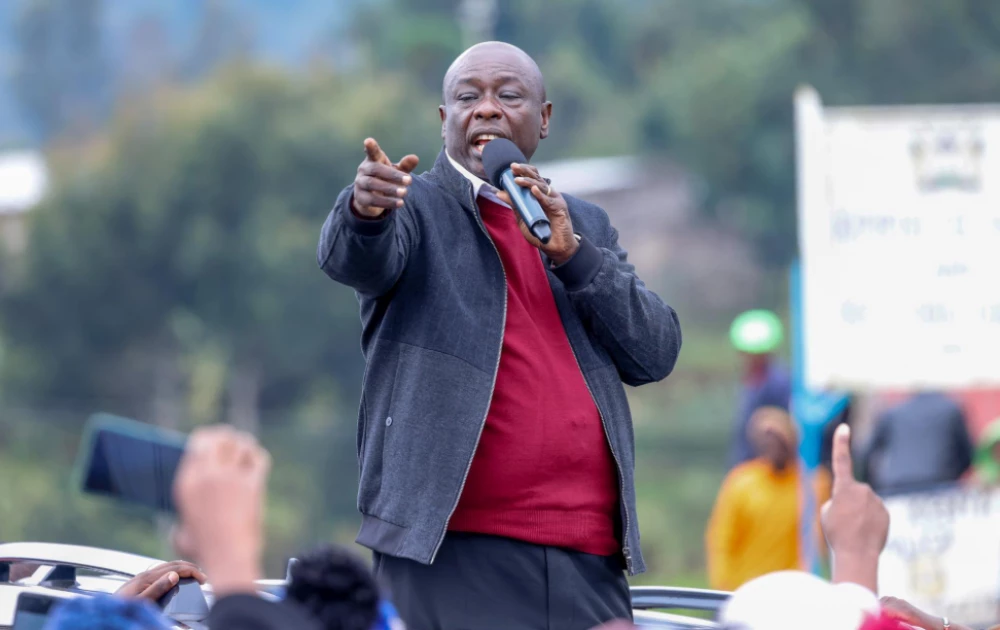
About an hour before the president was due to speak, Mr Gachagua addressed a gathering of pastors and their spouses from the Mt Kenya region and told them that the president was preparing to unveil a long-term development blueprint extending to 2060.
He also claimed that former President Uhuru Kenyatta would be brought in to lead its implementation.
When Mr Ruto eventually addressed the nation, he did not launch a formal "Vision 2060" blueprint as such, nor did he specifically announce an appointment for Mr Kenyatta.
But the president did devote significant attention to the future beyond Kenya's Vision 2030 and invited Kenyans to participate in what he described as a major national conversation about the country's next long-term development strategy.
The coincidence was striking enough to reignite speculation over whether Mr Gachagua has access to people close to the presidency.
A pattern that is becoming difficult to ignore
The latest episode is not isolated.
Mr Gachagua has previously made predictions or allegations about government actions that were subsequently followed by events broadly corresponding to his claims.
In April, for example, he warned that fuel prices were about to rise sharply, predicting an increase of more than KSh40 per litre and accusing the government of using international conflicts to justify higher prices.
Days later, the Energy and Petroleum Regulatory Authority increased the price of diesel by KSh40.30 per litre and super petrol by KSh28.69.
The former deputy president's comments have also extended to political violence and security operations.
Ahead of the Ol Kalou by-election, he claimed that the government was preparing to disrupt opposition activities and had deployed armed and masked individuals to create chaos.
A planned Linda Mwananchi gathering was subsequently moved from Ol Kalou to Nyahururu.
Violence later broke out during the Nyahururu rally, with suspected armed men disrupting the meeting, throwing stones and causing injuries. Among those reportedly injured was the driver of Murang'a Governor Irungu Kang'ata.
On polling day, Mr Gachagua again held a press briefing at his Wamunyoro residence in Nyeri.
He alleged that masked men had been deployed to cause disorder at several polling stations, naming AC Comprehensive School, Munyeki, Huruma and Nyakiambi Primary School among the locations he said were at risk.
According to the account supplied, roughly an hour later, masked men appeared at some of the named locations, where tear gas was fired and gunshots were heard.
Those events have strengthened the political narrative around Mr Gachagua's access to information, although the incidents themselves do not establish who, if anyone, supplied him with advance intelligence.
He was doing it even while in government
Mr Gachagua's apparent ability to get ahead of government messaging is not entirely new.
On 26 June 2024, while still serving as deputy president, he addressed the country at around 5:30pm, ahead of President Ruto's scheduled 7pm address.
The country was in the midst of the protests against the Finance Bill, with violence having led to deaths and destruction.
Mr Gachagua publicly condemned the violence and criticised the National Intelligence Service, accusing its Director-General, Noordin Haji, of failing to provide adequate intelligence and advice to the president.
He called on Mr Haji to take responsibility and resign.
The events that followed demonstrated the political pressure facing the administration.
President Ruto subsequently declined to sign the controversial Finance Bill, saying he had listened to the message coming from Kenyans.
The episode was significant because it showed Mr Gachagua using his position at the heart of government to publicly challenge the administration's handling of a rapidly developing crisis.
Today, he is making similar interventions from outside government.
That makes the latest claims considerably more politically sensitive.
'I am a smooth operator'
Mr Gachagua himself has offered an explanation for his access to government information.
In a recent interview with KTN, he claimed that he retains extensive support within the security services and civil service.
He claimed that 75% of the National Intelligence Service, 90% of the National Police Service and the entire civil service support him.
Those figures have not been independently established.
But Mr Gachagua says government officials and security officers are increasingly unhappy with the administration and are therefore willing to share information with him.
He has even encouraged public servants to continue providing him with information.
Describing himself as a "smooth operator", he said he had established mechanisms through which sources could communicate with him without exposing their identities.
He also said his long experience in government gave him an understanding of how state institutions operate.
"I know what is government," he said, according to the account provided.
The former deputy president has therefore not presented his access to inside information as accidental.
Instead, he has portrayed it as evidence of continuing relationships within government and the security establishment.
That claim, however, raises another question: how much of the information he receives is genuine intelligence, political speculation or information that becomes public through other channels?
A security concern for State House
For the presidency, the identity of any alleged source may be less important than the fact that the perception of leaks exists.
A presidential address is carefully prepared.
The timing, language and announcements are intended to allow the president to set the national agenda and define the government's message.
If a political rival can reveal significant elements of that message beforehand, the impact of the presidential announcement is weakened.
Political analyst Ngunjiri Muiruri argues that this is precisely what makes Mr Gachagua's interventions damaging to the administration.
A president's address, he says, is designed to control messaging and shape public perception. When an opponent gets access to its contents in advance, that strategic advantage is diminished.
The problem extends beyond one speech.
Repeated leaks can create the impression of a government unable to control sensitive information within its own institutions.
That perception can be politically damaging even when the source of the information remains unknown.
It can also raise questions about loyalty and morale among government officials.
Is this rebellion from within?
Pauline Njoroge, a former Jubilee Party National Executive Council member, offers one explanation for why officials might share information with Mr Gachagua.
She argues that some public servants have become frustrated by what she describes as the misuse of power, disregard for professional advice, discrimination and concerns about their welfare and pay.
If that frustration is widespread, she suggests, resistance may take place quietly inside government institutions.
That could include withholding cooperation, slowing processes or leaking information.
But these remain political interpretations rather than independently established explanations for the alleged leaks.
There is also an important distinction between ordinary political information and classified intelligence.
Knowing the broad theme of a presidential speech does not necessarily mean that sensitive security systems have been compromised.
A political network can obtain information through advisers, civil servants, political allies, contractors, journalists or informal conversations.
Determining whether there is an actual security breach would require an investigation that has not publicly established the source.
Gachagua's political advantage
For Mr Gachagua, however, the effect is clear.
Every successful prediction strengthens his image as someone who remains connected to the machinery of government despite having left office.
That gives him an unusual political position.
He can portray himself as both an outsider challenging the administration and an insider who knows what is happening behind closed doors.
It is a powerful combination.
Professor Gitile Naituli of Multimedia University argues that Mr Gachagua's influence stems partly from his ability to frame political conversations before the government does.
Once he establishes the subject and narrative, he argues, government leaders are forced to respond to the frame already created.
That gives Mr Gachagua political influence beyond the size of his formal organisation.
He does not necessarily have to make the most polished speech or command the largest political coalition.
If he can force the presidency to respond to him, he has already achieved a political objective.
The former deputy president's unusual position
Mr Gachagua's political transformation is remarkable.
He entered office in 2022 as Mr Ruto's deputy and one of the most important figures in the Kenya Kwanza administration.
His relationship with the president later deteriorated dramatically.
He was eventually removed from office and has since positioned himself as a leading critic of the government he once helped run.
That history gives his current claims an added political weight.
He is not an ordinary opposition politician.
He has sat inside the presidency.
He knows how government decisions are made, how information moves and how presidential communications are prepared.
That experience makes it easier for him to interpret government signals — even without necessarily receiving confidential information.
But if his claims of receiving regular insider briefings are accurate, the implications would be much more serious.
It would suggest that the political battle between the former allies extends into the institutions of government themselves.
A bigger problem than Gachagua?
The controversy also presents President Ruto with a difficult political equation.
The administration is already dealing with opposition pressure, economic frustrations and growing political competition ahead of the 2027 election.
A former deputy president who can repeatedly seize the narrative before the government does adds another layer to the challenge.
The issue is therefore not simply whether Mr Gachagua has a "mole".
The bigger question is whether the government is losing control of its own political narrative.
If government announcements can be anticipated by opponents, the presidency loses some of its ability to surprise, define the debate and command the news cycle.
And if public servants really are deliberately sharing sensitive information with political opponents, then the problem goes beyond communications.
It becomes a question of institutional confidence.
What happens next?
The government has not publicly established the identity of any person allegedly leaking information to Mr Gachagua.
Nor has there been public evidence proving that every prediction he has made came from a source inside State House.
That distinction matters.
Political intelligence can come from many places, and politicians routinely make predictions based on their understanding of government policy, public statements and political signals.
But the frequency of Mr Gachagua's interventions has made the issue impossible to ignore.
For President Ruto, the challenge is now twofold: protect sensitive government information while rebuilding confidence among officials responsible for carrying out his agenda.
For Mr Gachagua, every accurate prediction offers another opportunity to reinforce his image as a politician with access to the inner workings of government.
And as Kenya moves towards the 2027 election, information itself is becoming a political weapon.
The former deputy president may no longer sit inside State House.
But if his claims are to be believed, he has managed to retain something almost as valuable: a window into what is happening behind its doors.
Whether that window is being opened by disgruntled officials, political sympathisers, old government networks — or simply Mr Gachagua's ability to read the political tea leaves — remains unanswered.
For the presidency, however, the political damage may already have been done.
A government that is repeatedly anticipated by its opponents risks looking less like the author of the national agenda and more like a government reacting to one.
 Facebook
 Twitter / X
 WhatsApp
 LinkedIn
 Telegram
 Reddit