
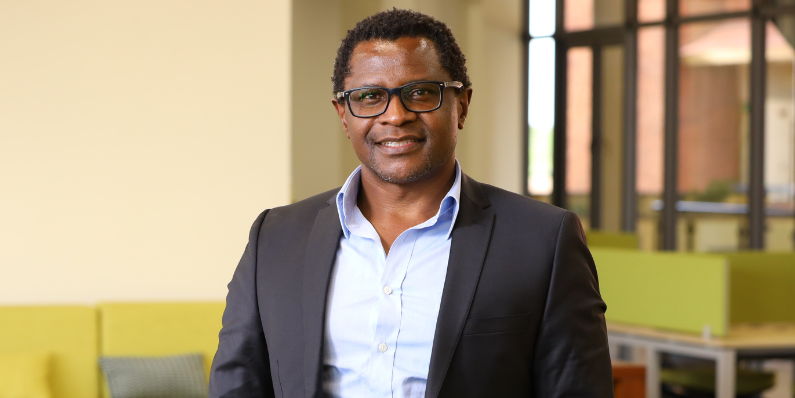
By Prof George Nyabuga
There was a time when journalism education could afford to move at the pace of the newsroom.
Those days are gone.
Technology is changing journalism faster than many journalism schools can rewrite their curricula. News is now gathered on smartphones, distributed through social media and consumed on platforms whose algorithms can determine what millions of people see.

And artificial intelligence is taking the disruption a step further.
AI can transcribe interviews, analyse documents, generate summaries, translate content, produce images and assist with the production and distribution of news. Newsrooms are experimenting with these tools even as educators grapple with a basic question: are we preparing tomorrow's journalists for the newsroom they will actually enter?
The answer, in some cases, is uncomfortable.
Many journalism programmes remain heavily influenced by traditional models of reporting and production. Students are taught the fundamentals of news writing, interviewing, ethics and media law — all essential — but may not always receive sufficient exposure to data journalism, multimedia production, mobile reporting, audience analytics, digital storytelling and artificial intelligence.
That gap matters.
A journalism graduate who cannot navigate today's digital environment will struggle to compete. Employers increasingly expect journalists to be versatile: able to write, shoot, edit, publish, engage audiences and understand the performance of their work.
The modern journalist may have to be a reporter, producer, photographer, videographer, social media editor and data analyst — sometimes all in the same day.
But there is a danger in taking this argument too far.
A university is not a newsroom
The growing demand for "industry-ready" graduates is understandable. Media organisations want people who can contribute immediately. Universities, under pressure to demonstrate employability, are consequently being encouraged to produce graduates who require little additional training.
But should that become the principal purpose of journalism education?
I think not.
A university is not simply a recruitment centre for the media industry.
Journalism is not merely about operating cameras, writing scripts, editing videos or posting stories online. It is a profession with enormous consequences for society.
Journalists investigate those in power. They expose corruption. They scrutinise government. They amplify the voices of citizens. They explain complex issues. They influence public debate and, at their best, help societies make informed decisions.
That requires more than technical competence.
It requires curiosity, judgement, scepticism, historical understanding, ethical awareness and the ability to make sense of complicated social, political and economic realities.
A journalist who knows how to use the latest AI tool but cannot recognise misinformation is a danger.
A journalist who can produce a compelling TikTok video but cannot distinguish allegation from fact is equally problematic.
And a journalist who understands the mechanics of digital publishing but has no appreciation of ethics may cause more harm than good.
AI makes the question more urgent
Artificial intelligence has made this debate unavoidable.
For decades, technology has changed journalism. But AI is different because it increasingly touches the intellectual processes at the heart of journalism.
It can summarise documents. It can identify patterns in data. It can generate text. It can assist with translation and research. It can help news organisations understand audiences and personalise content.
This presents journalism schools with an important choice.
They can resist the technology, hoping that traditional approaches will survive unchanged.
Or they can teach students how to use AI responsibly while ensuring they understand its limitations, risks and ethical implications.
The latter is the better approach.
Students should know how AI works well enough to question its output. They should understand hallucinations, bias, copyright, privacy and the dangers of synthetic content. They should know when a machine can assist their journalism — and when human judgement must take over.
The objective should not be to produce journalists who compete with machines.
It should be to produce journalists who know how and when to use machines without surrendering their professional judgement to them.
What is the value of knowledge?
There is, however, a deeper issue behind the debate about journalism education.
Increasingly, universities are being asked to justify programmes in terms of employment and economic returns. If a degree does not appear to lead directly to a job, its value is sometimes questioned.
This is a dangerous way to think about education.
Knowledge does not become worthless simply because it cannot immediately be converted into income.
History helps us understand the present. Philosophy teaches us to question assumptions. Sociology helps us understand society. Literature exposes us to different experiences and perspectives.
And journalism needs all of these forms of knowledge.
Consider a journalist covering an election.
Knowing how to interview a politician is not enough. The journalist must understand political institutions, electoral systems, history, economics and the interests of the people involved.
Consider a journalist covering a public health emergency.
The ability to write a story is important, but so is the ability to understand scientific evidence, recognise misinformation and explain uncertainty responsibly.
Consider an investigation into corruption.
The journalist needs more than recording equipment and interviewing skills. They need to understand public finance, law, institutions and how power operates.
In other words, good journalism requires knowledge.
The danger of producing technically brilliant journalists who cannot think
The temptation to make journalism education entirely practical is understandable.
The media industry is under financial pressure. Newsrooms are shrinking. Employers want graduates who can hit the ground running.
But if journalism schools respond by becoming little more than technical training centres, they risk producing graduates who know how to use the tools without understanding the purpose of the work.
Technology changes quickly.
The tools students learn today may be replaced tomorrow.
Critical thinking, ethical judgement, curiosity and the ability to interrogate evidence are much harder to make obsolete.
That is why journalism education must combine the old with the new.
Students must learn how to produce digital content while understanding the principles that distinguish journalism from content creation.
They must learn social media without confusing virality with public interest.
They must learn data journalism without assuming that numbers are automatically objective.
They must learn AI without treating machine-generated information as truth.
And they must learn multimedia storytelling without forgetting that journalism ultimately depends on accuracy, verification and public trust.
The journalism school of the future
So, is journalism education still fit for purpose?
Yes — but only if it is willing to change.
The answer is not to abandon traditional journalism education. The fundamentals remain essential: reporting, verification, interviewing, writing, media law and ethics.
What must change is how these fundamentals are taught and applied.
Journalism schools need stronger connections with industry, more practical exposure and curricula that reflect the realities of digital journalism.
Students should graduate understanding cameras and computers, but also algorithms and audiences.
They should be able to report from the field using a smartphone, analyse data, produce a podcast, livestream an event, edit video, engage audiences and use AI tools responsibly.
But above all, they should be able to think.
That may ultimately be journalism education's most important responsibility.
The future journalist will operate in an environment where information is abundant but trustworthy information is scarce; where content can be produced instantly but verification takes time; and where artificial intelligence can generate convincing material without necessarily understanding truth.
In such an environment, society will need journalists who can do more than produce content.
It will need journalists who can make sense of the world.
The challenge for journalism schools is therefore not simply to produce graduates who are employable.
It is to produce journalists who are technologically capable, intellectually curious, ethically grounded and socially responsible.
The tools will keep changing.
The platforms will come and go.
AI will become more powerful.
But the fundamental question will remain the same:
Can journalism education produce professionals capable of telling the truth, questioning power and helping citizens understand the world in which they live?
That is the standard against which journalism education should ultimately be judged.
Story Courtesy of the Kenya Journalism Review (KJR) 2026 by the Kenya Editors Guild
Category: Features
Related Video: Beyond Aid: How Japan Is Shaping Kenya’s SME Future | JICA Training Experience
Related Explainer: Explainer: What happened to milk in Kenya?
 Facebook
 Twitter / X
 WhatsApp
 LinkedIn
 Telegram
 Reddit