
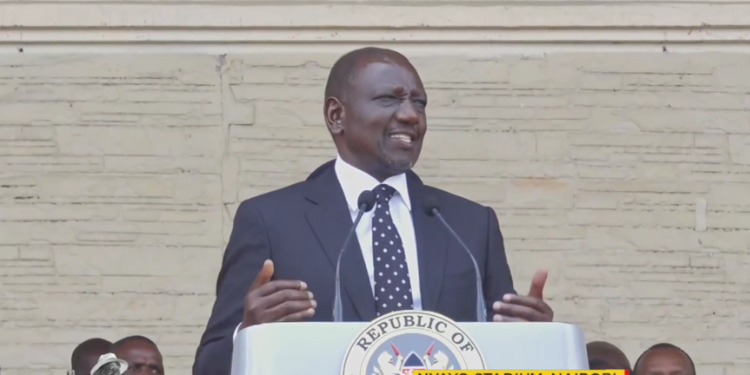
In a rare moment of tenderness and unity, President William Ruto moved thousands of mourners to tears on Friday after performing one of Raila Odinga’s favourite songs during the late leader’s State Funeral at Nyayo National Stadium.
As the stadium fell silent, the President began to hum softly the opening lines of Harry Belafonte’s “Jamaica Farewell.” His voice, low and reflective, carried across the arena:
“Down the way where the nights are gay,
And the sun shines daily on the mountain top…”
The crowd listened intently as Ruto sang, his tone reverent, the words evoking memories of a man who had sung that very tune at countless family gatherings, political rallies, and quiet moments among friends.
Midway through, Ruto paused. The DJ at the venue then played Belafonte’s original recording, and soon, the entire stadium joined in. The melody—melancholic yet beautiful—rose into the open sky.
“Sad to say, I’m on my way, won’t be back for many a day…” the crowd sang, their voices merging into a collective farewell for the man many called “Baba.”
When the music faded, the President spoke again, his voice steady but laced with emotion.
“Today, those words ring with profound meaning,” he said. “Our elder statesman, the Honourable Raila Odinga, is sailing in a ship — not to Jamaica, but to a home beyond.”
He paused, then continued: “He will not be back with us for many a day, but he leaves behind many little girls and boys, not in Kingston Town, but here in Nairobi, Kisumu, Mandera, Vihiga, Mombasa, Kakamega, and every village and valley across our land.”
The crowd broke into applause.
Ruto concluded his tribute with a prayerful tone:
“Baba has finished his race. He has served his people and humanity. May the soil of the land he so tirelessly served embrace him with grace. May the nation he sacrificed for eternally cherish his memory, and may the people for whom he fought carry his dream forward.”
For those who knew Raila well, the moment was deeply personal. His fondness for “Jamaica Farewell” was legendary. Friends recall how he often sang it with a distant look in his eyes — reflective, nostalgic, and full of warmth.
It was a song about parting, about journeys and longing — fitting for a man whose own life was defined by both struggle and hope.
As the final notes of Belafonte’s voice faded from the stadium speakers, there was no mistaking the mood: a nation, united in grief, singing its last farewell.