
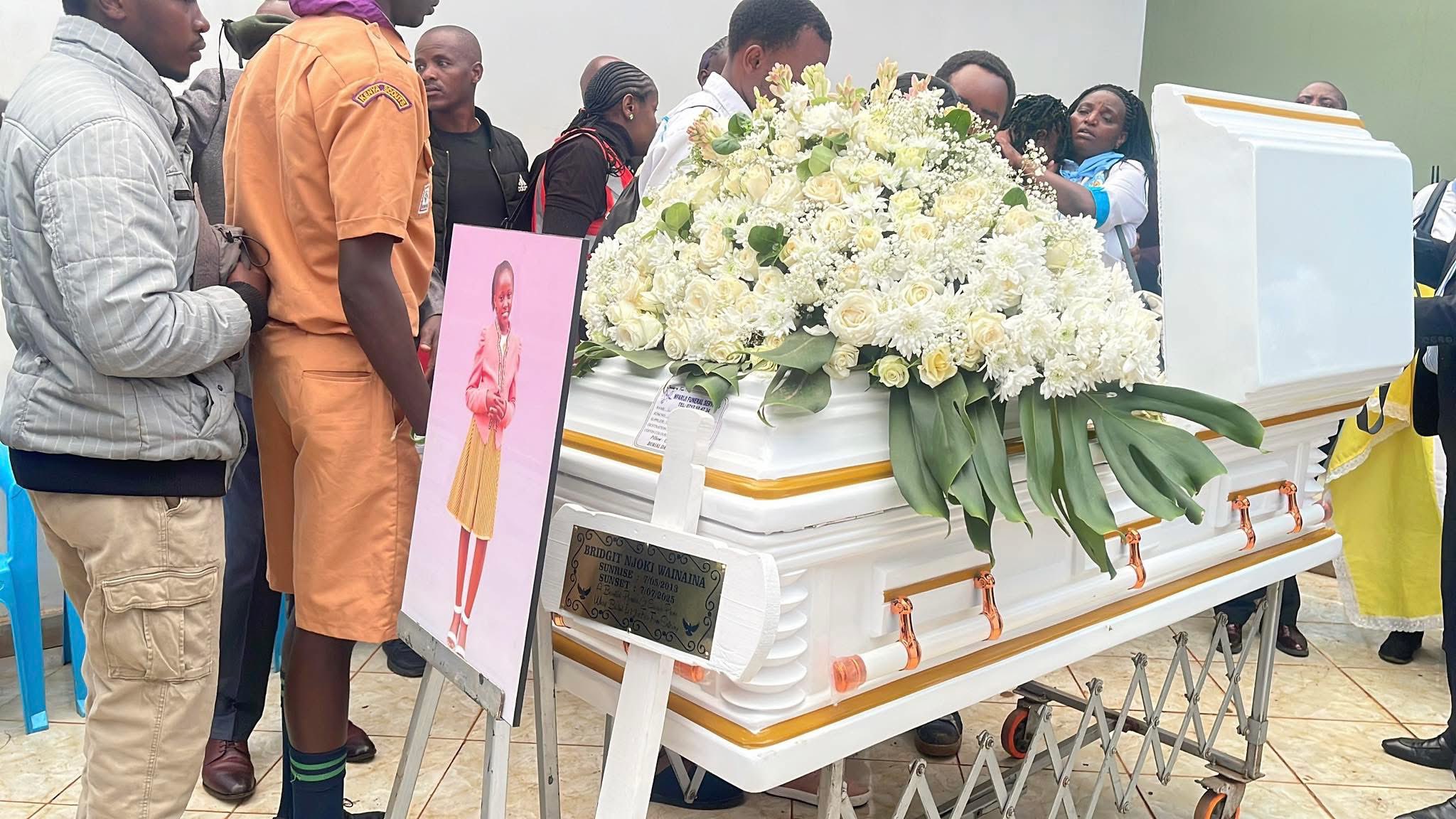
On what should have been an ordinary evening, 12-year-old Bridgit Njoki Wainaina lay beside her mother in the family’s living room. By nightfall, she was gone—killed by a stray bullet that tore through the wall during anti-government protests on Saba Saba Day.
“She will forever be 12,” her mother, Lucy Ngugi, said through tears at the funeral mass held in their Githunguri church on Monday. “That bullet has shattered my dreams—the doctor you would have become, the accountant you would have been. You’ll never grow beyond 12.”
Bridgit’s death has become one of the most gut-wrenching images of the recent unrest in Kenya, as families mourn not only lost lives but a nation seemingly losing its grip on peace.
A Day Like Any Other, Until It Wasn’t
Earlier that day, Bridgit had woken up in good spirits. Schools were closed amid fears of violence during the Saba Saba demonstrations. She spent the day at home, safe—or so it seemed.
That night, as she sat quietly beside her mother, a bullet entered the house. It struck her in the head. She died almost instantly.
“You were too innocent to even understand the demonstrations,” Lucy told the mourners. “We thought we were safe inside our home.”
‘The Bullet Didn’t Just Come—Someone Pulled the Trigger’
Though the police have yet to acknowledge responsibility, Bridgit’s family is clear on where they believe blame lies.
“The bullet didn’t just come—someone pulled the trigger,” Lucy said. “Whoever did, I may never know their name. But God is full of justice.”
She also rejected the idea of compensation. “No money will bring my daughter back. I leave it all to God.”
A Childhood of Promise Cut Short
Bridgit, a pupil at Benson Njau Primary School, was described by teachers as bright, kind-hearted, and multi-talented. She sang in the church choir, played chess, served as a prefect, and loved her classmates.
Her Grade 7 peers were transported to the funeral by the school to bid her a final farewell. Teachers and relatives spoke of a child who brought joy to others and showed signs of future leadership.
“She was helpful, humble, and full of peace,” one teacher said.
No Speeches from Politicians, Only Silence
Several national leaders attended the funeral, including former Vice President Kalonzo Musyoka, ex-CS Fred Matiang’i, and Githunguri MP Gathoni wa Muchomba. But in a poignant decision by the family, none were allowed to speak.
“Though you may not have had an opportunity to speak, your presence speaks volumes,” said Fr Paul Maichuhie, who led the mass.
In his message to the mourners—and to the nation—he warned: “Peace is expensive. And once it’s lost, it’s very hard to regain.”
A Mother’s Plea
As the casket was lowered, Bridgit’s mother clung to the last words her daughter had spoken. She had asked the church to play a recording of Bridgit reading from the Bible. Her voice, though faint and childlike, echoed through the sanctuary—a final trace of the life that was.
“My heart bleeds,” Lucy said. “But her memory will remain. She was simply the best.”
Bridgit’s death has added to a growing national conversation about the cost of policing protests and the rising toll of innocent lives caught in the crossfire.
As protests continue to simmer, her name will likely be among those remembered not just in grief, but as a symbol of what Kenya stands to lose when bullets replace dialogue.