
A mango tree became an unlikely lifeline for a 24-year-old Nepali labourer after a sudden wall of water, mud and rocks swept him through a town in one of the country's deadliest recent disasters.
Bibek Kumal was digging a toilet pit at a construction site in Bidur on Wednesday when he heard what he described as a strange hissing sound.
His colleagues saw the danger first.
They shouted at him to get out and run.

Kumal scrambled from the roughly 1.5-metre-deep pit and started running. Moments later, the torrent reached him.
“I started running. Then a wall of water came thundering down as if it was an earthquake,” Kumal told Reuters from his hospital bed in Kathmandu.
The flood swept him downstream with mud and debris.
Then, somehow, he became trapped in the branches of a mango tree.
“Luckily I was stuck up in a mango tree,” he said. “Had there been no mango tree, I would have been washed away to death.”
He watched the house disappear
Kumal remained in the tree as the flood tore through the area.
From his precarious position, he watched the house where he had been working disappear beneath the torrent.
Police eventually reached him and pulled him to safety.
He suffered injuries to his right leg after being struck by the rushing water and then by a large rock. His own home, elsewhere in the area, survived the disaster.
His survival stands in stark contrast to the scale of destruction around him.
Death toll rises as rescue teams search
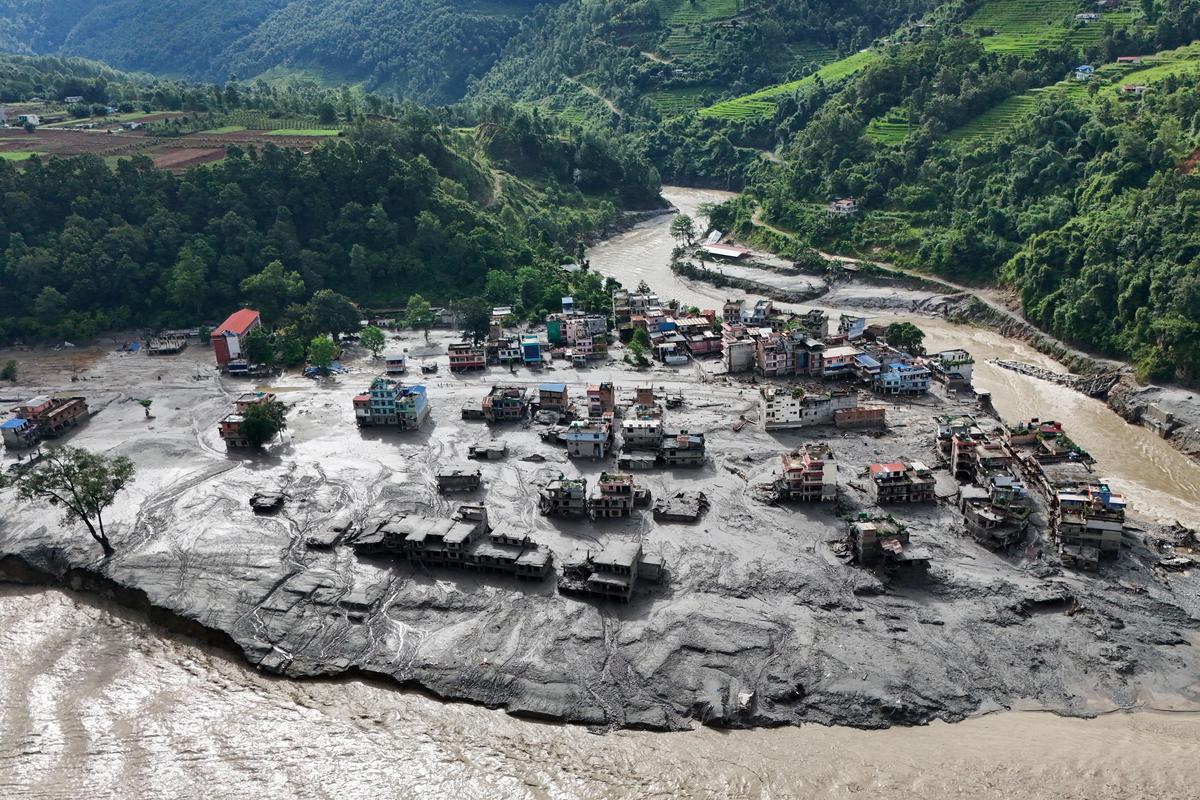
The flash flood struck the Rasuwa district near Nepal's border with China's Tibet before sending water and debris downstream through several communities.
By Wednesday evening, 95 deaths had been confirmed, according to Nepalese authorities, while large numbers of people remained unaccounted for. The toll was expected to change as search and recovery operations continued.
Among those reported missing were security personnel, hydropower workers and tourists.
The disaster also damaged roads, bridges and hydropower infrastructure, complicating rescue efforts in the mountainous terrain.
The International Centre for Integrated Mountain Development (ICIMOD) said the flood sent a powerful mixture of water, sediment and boulders through the Bhote Koshi and Trishuli river systems, raising concerns about further downstream impacts.
What caused the flood?
The cause of the disaster was initially unclear.
Early reports raised the possibility that a landslide or other mass of rock and mud had blocked a river before water suddenly broke through.
A seismic event was also detected around the time of the disaster, leading to initial speculation that an earthquake could have been involved. Subsequent reporting and scientific assessment have increasingly pointed towards a glacial or ice-rock collapse and landslide as the likely trigger, rather than a conventional earthquake alone.
That distinction matters because the Himalayan region is particularly vulnerable to sudden floods and landslides linked to unstable mountain slopes and changing glacial conditions.
The full sequence of events is still being investigated.
A disaster-prone country
Nepal's mountainous geography makes it vulnerable to floods, landslides and earthquakes, particularly during the monsoon season.
Kumal knows that danger first-hand.
As a teenager, he survived the devastating 2015 Nepal earthquake, which killed nearly 9,000 people.
This time, he survived another disaster by holding on to a tree.
Another survivor, 11-year-old Rihana Lamichhane, was returning from school when floodwater suddenly surged across her path.
She suffered injuries to her chest and leg.
“I am happy to be safe,” she said, according to Reuters. “I have no idea what happened to my friends.”
Her mother, Rita, rushed to look for her after receiving a call about the flooding.
For families across the affected region, however, the search is far from over.
Rescue effort continues
Nepalese security forces have been deployed to search for survivors and recover those missing.
The rugged terrain, damaged roads and disrupted communications have made the operation particularly difficult. Earlier reports said helicopters were being used to reach isolated areas and evacuate survivors.
The disaster has also affected communities and infrastructure along an important corridor linking Nepal with the Tibet border.
For Kumal, though, the catastrophe has been reduced to one extraordinary moment of survival.
A warning from his colleagues.
A wall of water.
A house disappearing before his eyes.
And one mango tree that happened to be in the right place.
As he recovers in Kathmandu, that tree has become more than part of the landscape. It is the reason he is alive.
Related Stories
- Kenya weather twist: Dry spell now, heavy El Niño rains later
- Nepal floods: 1,500 missing as rescuers race to find survivors
- Fact Check: Did elephants save people during Nepal’s floods?
Category: International
Related Explainer: Fact Check: Did elephants save people during Nepal’s floods?
About the Author
Maureen Onyango is a journalist passionate about storytelling, life coaching and spiritual lessons. She studied at the Kenya Institute of Management and enjoys telling stories that inform, inspire and empower communities.
 Facebook
 Twitter / X
 WhatsApp
 LinkedIn
 Telegram
 Reddit