
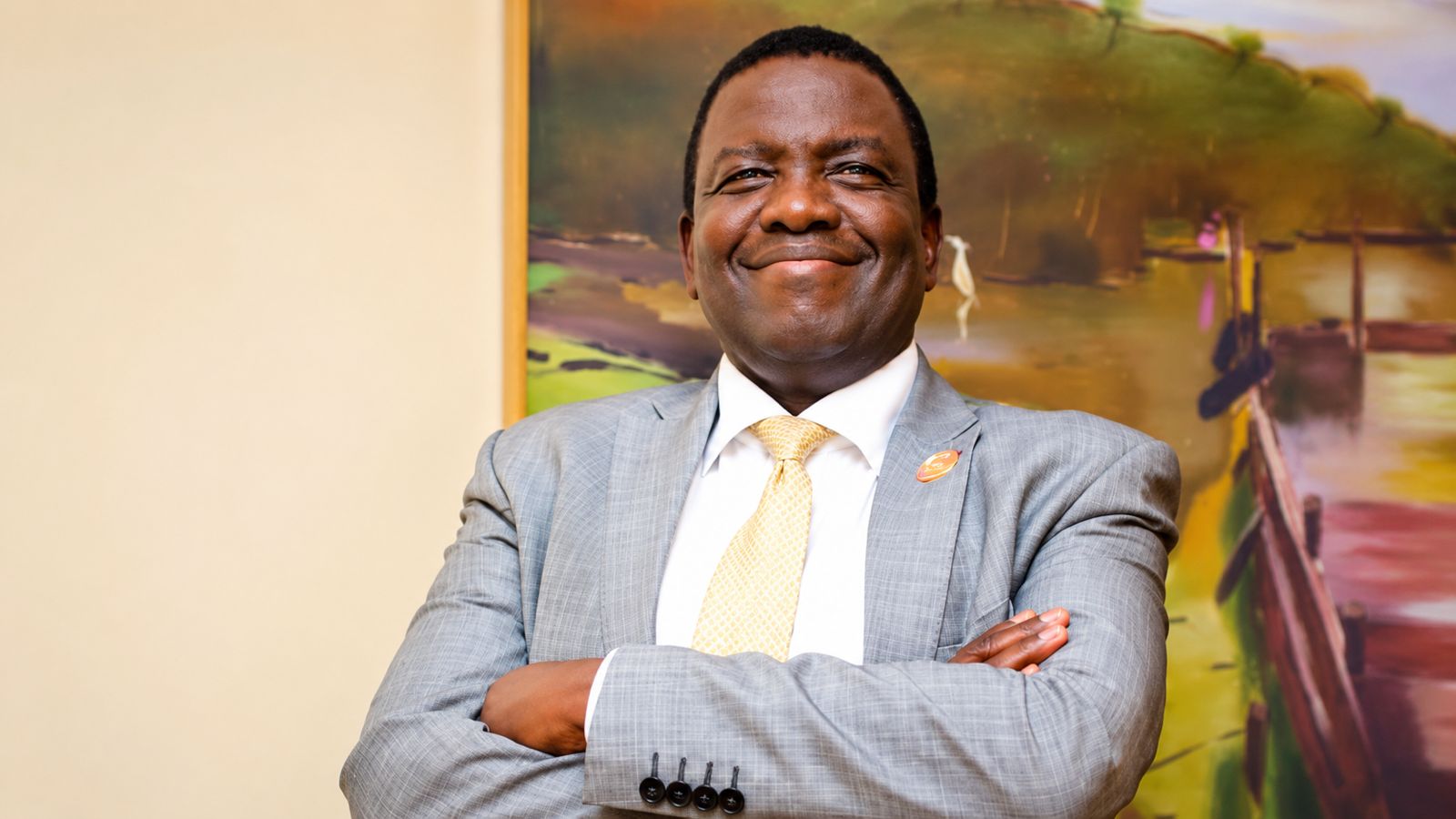
Long before Dr Julius Kipngetich became a prominent corporate executive, he learned an unusually simple lesson about money: if you want something of value, you have to work for it.
He grew up in a rural household where money was limited and shortcuts were frowned upon. His parents, he recalls, taught him that whatever he acquired had to be earned through hard work.
Decades later, that principle would underpin a career that took him from the classroom to some of Kenya's most challenging institutions — including the University of Nairobi, the Investment Promotion Centre, Kenya Wildlife Service (KWS), Equity Bank and Jubilee Holdings.
In a recent episode of the Financially Incorrect podcast, Kipngetich reflected on the career, decisions and investments that shaped his understanding of business, leadership and wealth.

His story is less about a single spectacular success than about repeatedly walking into organisations with problems and trying to work out what was stopping them from performing.
That is how, he says, he acquired the nickname “Mr Fix It.”
The rural boy who arrived in Nairobi
Kipngetich describes growing up in a rural area associated with Kenya's athletics tradition, although he jokes that he never became a runner himself.
His early experience with money was modest. Unlike today's children, who can start businesses using online platforms, he remembers a Kenya with limited media and communications infrastructure.
There was one television station, one radio station and owning a telephone was considered a privilege.
The biggest lesson from his parents was straightforward: money should come from hard work, not shortcuts.
That philosophy stayed with him as he moved into academia.
He became a lecturer and taught at institutions including the University of Nairobi, Strathmore and USIU. But teaching was only the beginning.
His first big test: fixing student welfare
At 31, Kipngetich was asked to take charge of student welfare at the University of Nairobi.
At the time, the university had about 10,000 residential students, and issues around food and accommodation regularly contributed to student unrest.
His approach was remarkably practical.
Rather than starting with elaborate reports, he walked through the university's halls of residence and looked at what needed fixing.
He began with the toilets.
When he asked how a householder would repaint a house, the answer was obvious: buy paint, hire a painter and get the job done.
So the university went directly to paint manufacturers and sourced painters.
The approach helped transform the halls of residence, while the university also addressed landscaping, lawns and broken equipment.
Kipngetich says the most important lesson was that management was not always about having more money.
“It was not so much money. It is what human beings can do to unleash their efforts.”
Money, in his view, becomes the enabler — buying the tools and resources people need to do their jobs.
The results were measured in an unconventional way: fewer student riots over food and accommodation.
From lecturer to ‘Mr Fix It’
His work at the university attracted attention beyond academia.
In 2002, he was appointed managing director of the Investment Promotion Centre, the institution that later became Kenya Investment Authority (KenInvest).
He found an organisation he described as neglected and struggling to fulfil its mandate of marketing Kenya as an investment destination.
His solution was to build capacity.
Kipngetich brought in students as interns, drawing on his connections with student organisations, while strengthening the existing team.
Within two years, he said, the organisation was operating more effectively and had become involved in major initiatives, including Kenya's first investment conference in 2004 and the country's Economic Recovery Strategy.
The experience reinforced another lesson: sometimes fixing an institution begins with fixing its people.
Then came KWS
From investment promotion, Kipngetich moved into an even bigger challenge — Kenya Wildlife Service.
He describes arriving at KWS to find weaknesses in governance, human-resource management and systems, alongside revenue leakages and an image problem.
One of the most revealing examples involved revenue collection.
A card system used at the time had allegedly become vulnerable to fraudulent loading, creating transactions that appeared to generate revenue without corresponding money reaching the bank.
Kipngetich said tackling the problem increased revenue by KSh300 million within three months.
When he arrived in 2004, he said KWS had about KSh1 billion in supplier debt. By the end of 2005, he had cleared it.
The turnaround restored confidence among suppliers, while the organisation was subsequently able to invest in vehicles and other infrastructure. By 2006, Kipngetich recalled going to Toyota to purchase 65 Land Cruisers.
But government, he admits, was a different environment.
The politics surrounding wildlife management could be intense, and some of his decisions were controversial.
He defended efforts to separate KWS's regulatory functions from activities that could create conflicts of interest, arguing that institutions work better when their mandates are clear.
The Monday after KWS
When Kipngetich left KWS, he did not spend much time deciding what came next.
He says he finished at KWS on a Friday and was at Equity Bank the following Monday.
He had already served on the bank's board during his KWS tenure and was invited to help run the institution as chief operating officer.
It was here that his understanding of business strategy met one of Kenya's most consequential banking stories.
According to Kipngetich, Equity's breakthrough was not simply about competing for existing bank customers.
It was about finding people the traditional banking system had overlooked.
How Equity targeted the unbanked
At the time, conventional banks often required minimum balances, with KSh5,000 being a significant barrier for many potential customers.
Equity changed the model.
Customers could open accounts without maintaining a minimum balance, and the bank deliberately made its branches feel less intimidating and formal.
Kipngetich says the strategy brought money that had been kept in households into the formal banking system.
Crucially, the bank was not simply taking customers from competitors — it was bringing previously unbanked people into banking.
He describes the alignment between Equity's strategy and government efforts to promote financial inclusion as a critical factor in the bank's rapid growth.
That experience left Kipngetich with a broader lesson about business: sometimes the biggest opportunity is not in fighting for an existing market, but in creating access to people nobody else is serving.
The investment that became his favourite money story
Perhaps the most striking part of the podcast is Kipngetich's account of one personal investment.
In 2006, he and his wife invested KSh1 million in Jubilee shares when the company was growing rapidly.
He describes it as a calculated risk rather than a guaranteed success.
The investment benefited from subsequent corporate actions, including a bonus share issue, while dividends also increased.
Kipngetich told the podcast that the original KSh1 million investment would be worth about KSh90 million at the market value he cited during the interview, while generating significant dividend income.
But he is careful not to present the outcome as a formula for instant wealth.
“Everything you do is a risk.”
His lesson for young investors is to look for companies with growth potential, a clear future and strong leadership — while recognising that not every investment will deliver the same outcome.
From fixing institutions to building longevity
At Jubilee, Kipngetich says one of his priorities has been balancing the interests of employees and shareholders.
During difficult periods such as the Covid-19 pandemic, he argues, companies must find a balance between rewarding employees and continuing to provide returns to shareholders.
For him, sustainability is ultimately about thinking beyond the next quarter.
He believes an organisation that maintains that balance can survive for generations.
That thinking reflects a recurring theme throughout his career.
Whether dealing with students, civil servants, wildlife managers, bankers or corporate executives, Kipngetich's approach has been to look for the system behind the problem.
That philosophy is captured in his explanation of General Systems Theory, which he says teaches that different systems often behave according to similar patterns.
For a manager, he argues, learning to observe those patterns can help make sense of seemingly unrelated organisations — whether a university, insurance company, bank or government agency.
The real lesson from his money story
Kipngetich's career offers a striking contrast to the popular image of wealth as simply the result of earning a large salary.
His story is about skills, systems, patience and calculated risk.
He moved from teaching to management because he was willing to solve practical problems. He entered government institutions and focused on people and systems. In banking, he saw an opportunity in customers others had overlooked. And as an investor, he backed a company he believed had long-term potential.
His most important financial lesson may therefore be less about the KSh1 million that grew dramatically in value and more about the thinking that preceded the investment.
Understand what you are buying. Look for long-term potential. Accept that risk is unavoidable. And, above all, do not confuse speed with success.
For a man who built a career being called “Mr Fix It”, perhaps the common thread is simple: before asking how much money an organisation has, ask whether its people, systems and ideas are working.
That is where Kipngetich believes transformation begins.
Related Stories
- Singapore’s Housing Model vs Ruto’s Affordable Housing Plan: Two Very Different Paths to Homeownership
- From Singapore to Kenya: Why Kinyanjui Kombani’s ‘Dear Mama’ Is Reaching a New Generation
- Nepal: A Country Shaped by Mountains, Monsoons and Repeated Flood Disasters
Category: Features
Related Explainer: Fact Check: Did elephants save people during Nepal’s floods?
 Facebook
 Twitter / X
 WhatsApp
 LinkedIn
 Telegram
 Reddit