

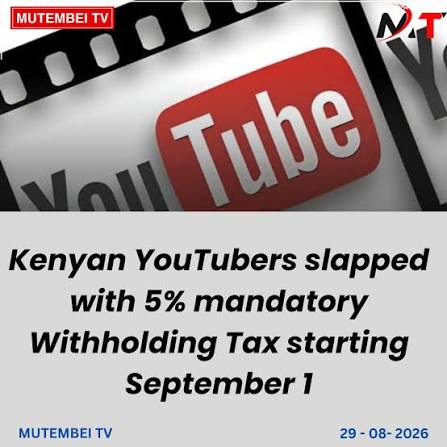
Google is set to begin withholding 5 per cent Kenyan tax from the YouTube earnings of creators whose AdSense for YouTube accounts are based in Kenya.
The company has told Kenyan creators to submit and verify their Kenya Revenue Authority (KRA) Personal Identification Numbers (PINs) in AdSense by October 1, 2026.
The first withholding will apply to September 2026 earnings paid out in October, according to Google's official tax guidance.
Google says it will withhold 5 per cent of creators' finalised YouTube earnings each month, alongside any applicable US tax.

For example, a creator with KSh100,000 in finalised YouTube earnings would have KSh5,000 withheld as Kenyan tax, leaving KSh95,000 before any other applicable deductions.
The deduction is withholding tax, not a new fee for using YouTube. Kenya's tax framework already provides for withholding tax on digital-content monetisation, with KRA currently listing a 5 per cent rate for resident recipients.
Kenyan creators react
The announcement has already triggered debate among Kenyan content creators, particularly those who depend on online platforms as a major source of income.
Media personality and YouTuber Oga Obinna shared Google's AdSense notification on Instagram on Saturday, drawing attention to the October deadline and the impending deduction. His post prompted a mixture of criticism, humour and support from Kenyans debating whether digital creators should be taxed.
Poet and activist Willie Oeba was also among creators who shared the Google notification after receiving it, helping bring the new requirement to the attention of his followers.
Some creators have questioned whether the government is doing enough to support the digital-creative industry as it expands its tax collection.
One creator criticised what they described as limited government support for digital creators, pointing to the cost of equipment and data while questioning the new deduction.
“Zero government support for digital creators. Zero subvention on heavy equipment imports. Zero relief on data costs yet, 5 per cent withholding tax on YouTube and content payouts,” the creator said.
The same creator argued that many young Kenyans had turned to content creation as an alternative source of employment and questioned whether taxing the sector without stronger industry support was fair.
The reaction is not entirely negative. Responses to Obinna's post included Kenyans arguing that anyone earning an income should contribute taxes, while others questioned the impact on creators who already face production and operating costs.
What happens if creators don't submit their PIN?
Google says creators must provide their 11-character Kenyan PIN through the tax-information section of AdSense for YouTube by October 1.
Those who fail to provide a verified PIN may have their payments held. Their earnings will continue to accumulate, but payments will not be released until the required tax information has been provided and verified. Google says tax details can take three to five business days to be reviewed.
Creators should also be aware that the 5 per cent Kenyan withholding is separate from any applicable US tax withholding. The final amount received may therefore vary depending on a creator's circumstances, including the source of their audience and their tax information.
Not a new tax — but a new collection mechanism for YouTube
The development marks an important change for Kenya's growing creator economy.
The 5 per cent withholding requirement for digital-content monetisation already exists under Kenyan tax law. What is changing for YouTube creators is that Google is now putting the mechanism in place to deduct and remit the Kenyan withholding tax from eligible YouTube earnings paid through Kenya-based AdSense accounts.
For creators, the immediate deadline is clear:
October 1, 2026.
And the first YouTube earnings affected will be those generated in September and paid in October.
Related Stories
- George Ruto Finally Meets Teacher Cillah at Westlands Primary School After Weeks of Viral Banter
- Abel Mutua and Phil Rethink Actor Royalties as Streaming Reshapes Kenya’s Film Industry
- Dolly Parton’s Family Announces Her Passing in Emotional Tribute
Category: Entertainment
Related Explainer: Fact Check: Did elephants save people during Nepal’s floods?
 Facebook
 Twitter / X
 WhatsApp
 LinkedIn
 Telegram
 Reddit