
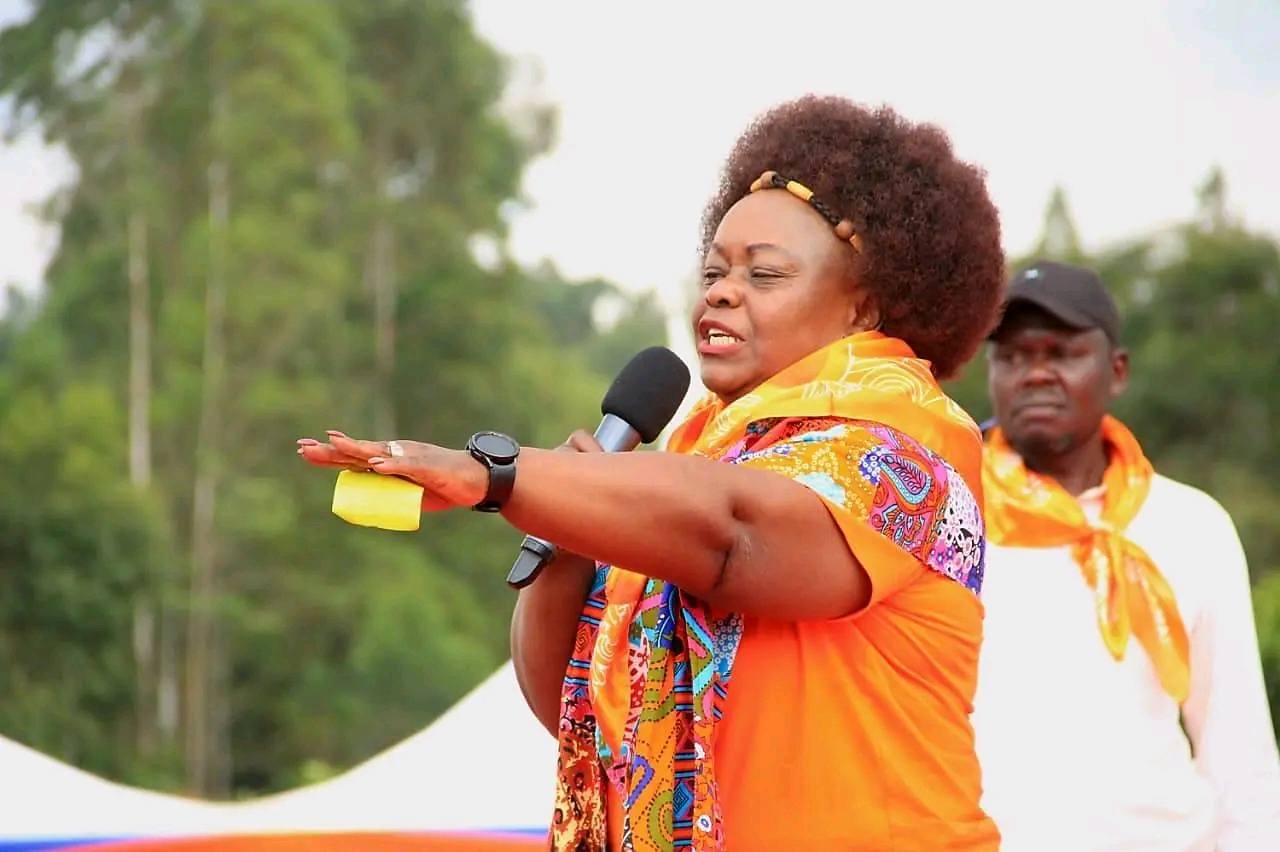
Suba North MP Millie Odhiambo has made a declaration that could put her at the centre of Kenya’s longer-term succession politics: she wants to be president in 2032.
Odhiambo made the announcement in Parliament while responding to remarks from another lawmaker, making it clear that she is not looking to join the crowded 2027 presidential race.
“You know that I will be the President in 2032. I leave the men to fight over now. That is their problem. But in 2032, I’m the President,” she said.
Her statement adds a different dimension to a political conversation that has largely been consumed by the 2027 contest.

Rather than fighting for space in the current field, Odhiambo is already looking beyond it.
Why 2032 matters
Kenya's 2027 race is becoming increasingly crowded.
President William Ruto is seeking a second term, while several opposition politicians have declared their ambitions or are positioning themselves for the contest.
The latest Infotrak Voice of the People poll illustrates the scale of the competition. Ruto led with 32 per cent, followed by Kalonzo Musyoka at 13 per cent. Nairobi Senator Edwin Sifuna and former Interior Cabinet Secretary Fred Matiang’i each had 12 per cent.
The poll also found that 18 per cent of respondents were undecided, underscoring how fluid the political landscape remains more than a year before the election. Infotrak surveyed 3,000 adults across the country between June 22 and 26, 2026.
Odhiambo is therefore choosing a different timetable.
Her announcement could be read as an attempt to move beyond the immediate succession battle and position herself for a future race in which she would have more time to build a national profile.
A crowded 2027 field
The 2027 contest already includes some of Kenya's best-known political figures.
Kalonzo Musyoka has been endorsed by his Wiper party as its presidential candidate. Fred Matiang’i has received the backing of Jubilee, while former Chief Justice David Maraga has also declared his intention to run.
Martha Karua has maintained her presidential ambitions, while former Deputy President Rigathi Gachagua, Eugene Wamalwa, Okiya Omtatah, Jimmy Wanjigi and Boniface Mwangi have also been linked to the race.
Babu Owino, meanwhile, has outlined a longer political plan of his own.
The Embakasi East MP has said he intends to seek the Nairobi governorship in 2027 before making a presidential bid in 2032.
That puts Owino and Odhiambo on the same broad political timeline, although neither has indicated that they intend to work together.
Odhiambo's long political career
Odhiambo is not a newcomer testing the waters.
She has been in Parliament since 2008, initially entering the House as a nominated MP before becoming the elected representative for Suba North. Parliament's official profile lists her constituency as Suba North and records her legal training at the University of Nairobi and New York University.
She has built her political profile around issues including women's and children's rights, governance and access to justice.
Her longevity in Parliament gives her something many first-time presidential hopefuls lack: years of legislative experience and an established political network.
But a presidential race requires a much broader coalition.
Kenya's presidential elections are national contests. A candidate must win a majority of votes nationally and meet the constitutional threshold of at least 25 per cent of the vote in more than half of the counties.
That makes national reach, coalition-building and regional support crucial.
The numbers show the challenge
Odhiambo's declaration comes against a political landscape in which no challenger has yet consolidated the opposition vote.
Infotrak's latest figures show Ruto leading at 32 per cent, but the combined support for several opposition figures is spread across a number of candidates. Kalonzo has 13 per cent, while Sifuna and Matiang’i have 12 per cent each.
The poll also shows important regional differences.
Ruto's strongest support was recorded in North Eastern, at 59 per cent, followed by Rift Valley at 46 per cent and Nyanza at 40 per cent. Kalonzo was strongest in Eastern at 40 per cent, while Sifuna recorded 26 per cent in Western.
The figures are only a snapshot, not a forecast of the 2027 result. But they illustrate the scale of the task facing anyone hoping to build a national presidential coalition.
For Odhiambo, the advantage of looking to 2032 is time.
The disadvantage is that she would have to turn a parliamentary political career into a national movement capable of competing across all regions.
A race that is already looking beyond 2027
Odhiambo's declaration is also a reminder that Kenya's political succession battles rarely begin when the ballot boxes are opened.
Politicians often spend years building alliances, establishing regional networks and testing their national appeal before formally entering a presidential race.
For now, the immediate political fight remains 2027.
But Odhiambo has made her preference clear.
While others are positioning themselves for the next election, she is already asking Kenyans to look one election further.
Related Stories
- Who Was Gloria Sekeiyan Khalwale? A Mother of Eight Remembered After Sudden Death
- Mudavadi urges Kenyans to distinguish popular leaders from populists
- DCP Claims Gachagua Convoy Attacked in Nakuru as Political Tensions Rise
Category: Politics · Related Topic: William Ruto
About the Author
Maureen Onyango is a journalist passionate about storytelling, life coaching and spiritual lessons. She studied at the Kenya Institute of Management and enjoys telling stories that inform, inspire and empower communities.
 Facebook
 Twitter / X
 WhatsApp
 LinkedIn
 Telegram
 Reddit