
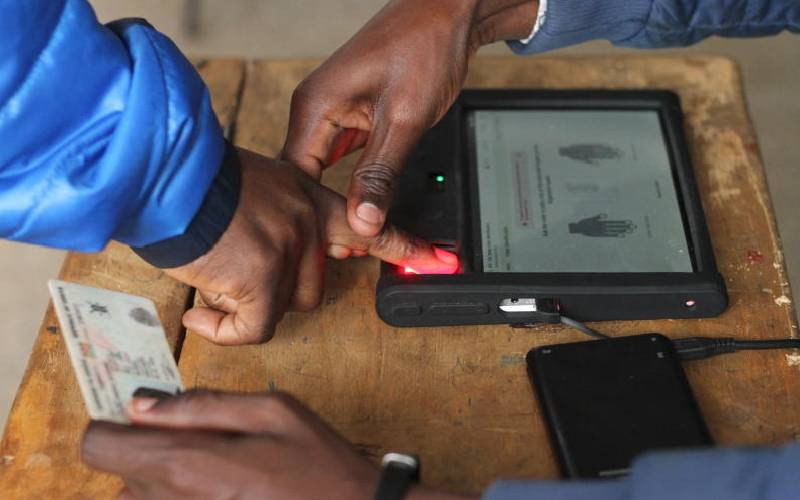
Kenya's election technology tender has already been ordered back for correction. The next question is bigger than who wins the contract: what exactly will taxpayers own, how will the system be tested, and what happens if it fails on election day?
The Public Procurement Administrative Review Board (PPARB) has ordered the Independent Electoral and Boundaries Commission (IEBC) to correct and republish parts of its tender for the Integrated Elections Management System (IEMS) ahead of the August 2027 General Election.
The Board found deficiencies involving technical standards, evaluation criteria, international tenderers, key personnel, post-qualification requirements and hardware and technology ownership. It ordered IEBC to issue a compliant document and give bidders at least seven days to respond.
LiveNow Africa has already reported the procurement dispute. The more important issue now is what Kenyans should look for when the revised tender appears.
Kenya’s 2027 Election Technology: Five Questions IEBC Must Answer Befo...
- IEBC opens 2027 election technology race as scrutiny over supplier mounts
- Kenya’s 2027 Election Faces a Funding and Technology Race Against Time
- Wetang’ula tells opposition to keep off IEBC as 2027 election race heats up
- Moses Kuria Claims Sifuna Is Being ‘Fattened for Slaughter’ as Kalonzo Emerges in 2027 Opposition Plan

1. Who will actually own the technology?
This is no longer a theoretical question.
PPARB specifically identified uncertainty around hardware and technology ownership among the deficiencies requiring correction.
IEBC therefore needs to make clear what belongs to the commission and what remains proprietary to the supplier.
For a system central to a national election, taxpayers should be able to understand whether Kenya is purchasing technology it can control and maintain or becoming dependent on a vendor for future elections.
2. Will the new system work with existing election equipment?
Compatibility is another critical issue.
The company that challenged the procurement, Galadirel Investment Limited, argued that the original tender did not adequately explain compatibility and interoperability between existing biometric equipment and the proposed new system.
PPARB ultimately found that complaints concerning compatibility and interoperability had not been proved.
But operationally, IEBC will still have to demonstrate that the final system works reliably across its election infrastructure.
3. How much testing will happen before August 2027?
Procurement is only the beginning.
After selecting a supplier, IEBC must install and configure the system, integrate equipment, test it, train election officials and demonstrate that it can operate at national scale.
The original tender covers supply, installation, testing, commissioning, support and maintenance — meaning the successful bidder's job extends well beyond delivering equipment.
With less than a year before the election, the timetable for testing is becoming as important as the procurement itself.
4. What happens if the system fails?
Election technology requires contingency planning.
IEBC will need to explain how voting proceeds if biometric identification equipment fails, connectivity is disrupted or other technical problems occur.
That includes backup procedures, technical support and recovery arrangements.
The revised procurement should therefore be examined not simply for what the system promises when everything works, but for what happens when something goes wrong.
5. Can the public independently trust the system?
This may ultimately be the biggest question.
Election technology operates in an environment where technical performance and public confidence are inseparable.
The procurement challenge did not establish allegations that the tender had been tailored for Miru Systems. PPARB found that complaint, along with several others, had not been proved.
But it did find genuine deficiencies in the tender document.
That distinction matters.
The next test for IEBC is therefore not merely correcting wording sufficiently to comply with the Board's ruling.
It is demonstrating that the eventual system can be scrutinised, tested and trusted before millions of Kenyans depend on it on election day.
The revised tender will provide the first opportunity to see whether those lessons have been absorbed.
For Kenya's 2027 election, the question is no longer simply who supplies the technology. It is whether the country can verify that the technology works before voting begins.
Subscribe to our newsletter
Get the latest updates and stories from LiveNow Africa, delivered to your inbox.
Choose your news updates
Select the stories you care about and how often you want them delivered.You may also like
Category: News · Related Topic: 2027 Elections
Related Video: Dolly Parton’s Family Announces Her Passing in Emotional Tribute
 Facebook
 Twitter / X
 WhatsApp
 LinkedIn
 Telegram
 Reddit