
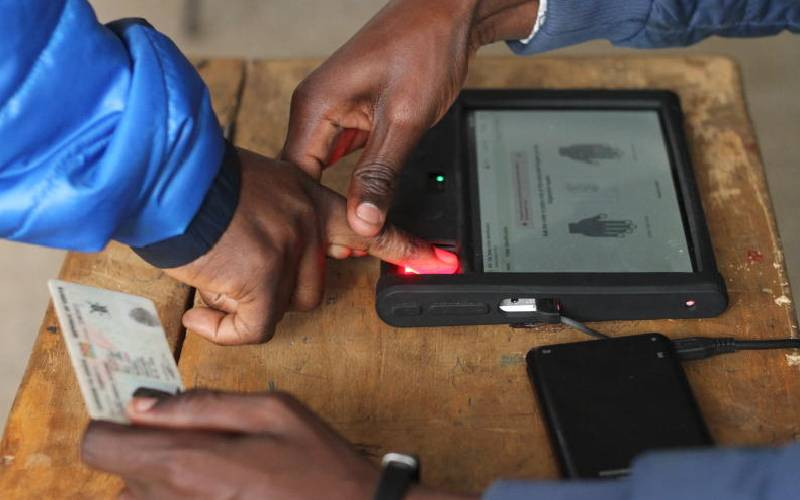
The Independent Electoral and Boundaries Commission (IEBC) has opened a major international tender for the technology that will support Kenya’s 2027 General Election, setting in motion one of the most sensitive procurement processes ahead of the polls.
With exactly one year to go before the scheduled August 10, 2027 election, the commission is seeking a contractor to supply, install, test, commission, support and maintain an Integrated Elections Management System (IEMS), together with the hardware and accessories required to run it.
The procurement comes as the credibility, security and independence of Kenya’s election technology face renewed political scrutiny.
The IEBC has also opened a separate tender for ballot papers, tactile folders, the Register of Voters and statutory election-result declaration forms.

The commission has listed the tenders on its official procurement portal. The IEMS tender is referenced as IEBC/OIT/01/2026-2027, with bids due on September 1, 2026.
Multi-billion election technology procurement
The technology tender covers the infrastructure required to support the electronic management of the electoral process.
The system will sit at the heart of voter identification and other election-management functions, making the procurement one of the most consequential decisions the new IEBC leadership will make before 2027.
IEBC has opened the process to qualified local and international firms through an international competitive procurement process.
Bidders for the technology contract are required to provide a Sh30 million tender security, while the separate ballot-materials tender carries a Sh40 million security requirement.
The IEMS pre-bid conference is scheduled for August 18, while bidders must submit their tenders physically at the IEBC offices at Anniversary Towers in Nairobi by September 1.
Electronic submissions will not be accepted.
Ballot papers also up for tender
In a second procurement, IEBC is seeking suppliers for ballot papers, tactile folders for voters with visual impairments, the Register of Voters and statutory election-result declaration forms.
The materials will be supplied on an “as and when required” basis during a three-year contract period covering the 2027 election cycle and other electoral requirements.
Bidders have until September 1 to submit their offers, with the tender requiring a Sh40 million security.
The commission's procurement timetable marks an important shift towards early preparations for the 2027 election.
IEBC says it is planning for a significantly expanded electoral operation, including more than 55,000 polling stations. The commission has projected a total 2027 election budget of Sh61.7 billion spread across three financial years.
Why the technology tender matters
The procurement is taking place against the backdrop of past problems with election technology in Kenya.
During previous elections, biometric identification systems experienced failures in some polling stations, forcing officials to use alternative verification procedures and, in some cases, creating long queues for voters.
The 2022 presidential election also exposed the intense legal and political scrutiny surrounding the technology used to transmit and manage election information.
Smartmatic, which supplied election technology to IEBC for the 2017 and 2022 elections, became a major subject of controversy during and after the 2022 election.
Following the presidential election petition, questions were raised about access to election servers and the technology underpinning the electronic results-management process.
The Supreme Court's 2022 presidential-election judgment examined several issues surrounding KIEMS and the electronic transmission of results, including allegations concerning the system's implementation.
Smartmatic controversy remains part of the debate
Smartmatic's previous role means its name remains part of the political debate around Kenya's election technology.
In 2022, the company declined to provide unrestricted access to its servers, citing security and intellectual-property concerns, after questions arose during the presidential election petition. Contemporary reporting documented the dispute over access to the servers.
The issue is important because election technology suppliers do not simply provide ordinary hardware. They can be involved in software, systems integration, maintenance and technical support that can affect how electoral information is processed.
That makes procurement transparency, cybersecurity, ownership structures, data protection and independent testing critical considerations.
Smartmatic has maintained that its systems are designed to support electoral processes and has disputed allegations of wrongdoing.
Questions over foreign suppliers
The new procurement is therefore likely to attract close attention from political parties, civil society groups and election observers.
One of the key questions will be whether IEBC conducts comprehensive due diligence on prospective suppliers, including their ownership structures, cybersecurity record, technical capacity and previous election contracts.
Another will be whether the commission provides enough opportunity for political parties and independent experts to scrutinise the technology before it is deployed.
The IEBC's own procurement process is already being watched closely by politicians.
Former Cabinet Secretary and Democratic Party leader Justin Muturi has previously criticised what he described as a lack of transparency around the commission's preparations, arguing that election systems must be transparent and verifiable.
The Venezuela question
Claims about Smartmatic's historical links to Venezuela have also featured in international debates over the company.
However, allegations circulating about election manipulation must be treated carefully.
Smartmatic itself has previously challenged allegations of electoral wrongdoing, while its relationship with Venezuela changed significantly after the company publicly disputed the official turnout figures announced during Venezuela's 2017 Constituent Assembly election.
Reuters reported at the time that Smartmatic said the official turnout had been inflated by at least one million votes.
Those international controversies do not, by themselves, establish that Kenya's elections were manipulated.
For Kenya, the more immediate issue is whether the IEBC's procurement and deployment processes provide sufficient safeguards to guarantee that the technology used in 2027 is secure, independently auditable and trusted by competing political players.
A fresh start for IEBC
The tendering process gives the Erastus Ethekon-led IEBC an opportunity to address one of the biggest weaknesses that has dogged Kenya's elections: public distrust of electoral technology.
The commission has already projected a Sh61.7 billion budget for the 2027 election and begun procurement of critical infrastructure.
But procurement alone will not determine whether the technology is trusted.
IEBC will also have to demonstrate that the systems are independently tested, securely configured, properly audited and accessible for legitimate scrutiny without compromising voter data or system security.
The commission will face pressure to publish sufficient information about the winning supplier, the technology architecture, cybersecurity safeguards, data-protection arrangements and independent testing.
One year to prove the system
The clock is now ticking.
IEBC has less than a year to procure, configure, test and deploy the technology that will support the 2027 election.
The procurement process will therefore be about much more than choosing a technology vendor.
It will be a test of whether Kenya can build an electoral system that voters, political parties and observers can trust before a single ballot is cast.
For IEBC, the challenge is clear: the technology must not only work—it must be demonstrably secure, transparent and verifiable.
And with memories of previous election technology controversies still fresh, Kenyans are likely to scrutinise every step of the procurement process.
You may also like
Category: Politics · Related Topic: 2027 Elections
Related Video: Dolly Parton’s Family Announces Her Passing in Emotional Tribute
Related Explainer: EXPLAINER: Why Kenya’s aviation workers are striking — and what travellers need to know
 Facebook
 Twitter / X
 WhatsApp
 LinkedIn
 Telegram
 Reddit