

The decision to bury former KCB senior manager Rosemary Chemutai Koech-Kimwatu at night has raised questions across Kenya, particularly because her death was reported as suicide and the burial came amid a legal dispute involving her family and husband.
Rosemary, 40, who served as KCB's Head of Data Protection, died on August 21, 2026. She was buried at her parents' home in Chepseon, Kericho County, at about 7.30pm on Friday, August 28.
Her family has now explained why the burial was conducted at night.
Why Rosemary was buried at night


According to the family, the decision was rooted in Kalenjin cultural practice.
Clan chairman Samwel Keter told Nation that Rosemary's death was a suicide and that, according to their culture, a person who dies in such circumstances should not remain unburied for more than a few days.
“We did that according to the Kalenjin culture, not just Kipkendek culture,” Keter said.
Joseph Towett Kalyasoi, a member of the Kipsigis Community Clans Organisation, similarly said there was nothing unusual about an evening burial.
He told Nation that night burials were part of older Kipsigis traditions and that the practice of conducting final rites late in the evening has continued among some members of the community.
This means the timing of Rosemary's burial cannot be attributed solely to her death by suicide. The family says it was both connected to the circumstances of her death and consistent with cultural traditions concerning funerals.
There was also a court battle
The burial took place only hours after the Milimani Commercial Magistrate's Court issued interim orders concerning Rosemary's remains.
Her husband, Kevin Migwe Kimwatu, had moved to court after saying he had been excluded from the funeral arrangements.
On Friday, Senior Principal Magistrate Agnes Mwangi ordered that Rosemary's remains should not be removed from Lee Funeral Home or buried without her husband's involvement and consent.
Despite the order, the burial proceeded that evening.
Capital FM reported that the family proceeded with the burial and that reports indicated the court order had not been served on them before the interment. The matter is scheduled to return to court on August 31.
The family's explanation of the night burial is therefore important: it says the decision was based on cultural considerations, rather than an attempt to make the burial secret.
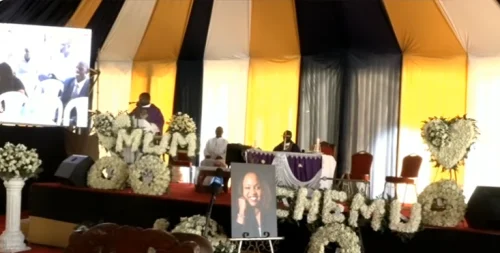
Why are some suicide victims buried at night?
Night burial of people who die by suicide is not a practice followed by all African communities, and it should not be presented as a universal African tradition.

However, researchers have documented the practice among several communities, including some Kenyan communities.
A recent study published in Evolution, Medicine, and Public Health, examining mourning rituals among the Luhya people of Kenya, found that suicide deaths have traditionally been treated differently from deaths considered natural.
The research documents night burials, restrictions on who can participate and the suspension of some normal funeral rituals. In some traditions, the practices are intended to prevent what the community perceives as the harmful spiritual consequences of suicide or the possibility of similar deaths occurring within the family.
Another study examining suicide in Kenya's Coast region found reports of atypical burial practices, including burying suicide victims at night or outside the family compound. Researchers found that some communities viewed suicide as an unnatural or socially disruptive death.
Similar beliefs have been documented outside Kenya. Research on the Akan of Ghana, for example, found that traditional attitudes towards suicide historically included condemnation of the act and the denial or alteration of conventional funeral rites.
What does the night symbolise?
There is no single explanation across African cultures.
But researchers have identified several recurring ideas:
1. Separating an “unnatural” death from ordinary deaths
Some traditions distinguish suicide from deaths regarded as natural and therefore prescribe different funeral rituals.
2. Fear of spiritual consequences
In some communities, suicide is believed to carry spiritual consequences for the deceased, family or wider community. Night burial can form part of rituals intended to prevent the deceased's spirit from returning or causing further harm.
3. Preventing the perceived repetition of suicide
The Luhya research records beliefs that failing to follow prescribed burial rituals could contribute to another suicide occurring within the community. Researchers describe this as one way communities historically sought to regulate behaviour and protect the group.
4. Shame and stigma
Historically, suicide has carried significant stigma in many societies. Some night-burial practices therefore served to limit public mourning or exposure of the death. Researchers studying Luhya traditions describe this explicitly as a form of social distancing and, in some cases, an attempt to make the death forgotten.
But culture is changing
These traditions are not static.
Christianity, Islam, modern medicine, mental-health awareness and changing attitudes towards suicide have altered funeral practices in many African communities.
Importantly, modern mental-health understanding does not regard suicide as a moral failing or evidence of spiritual contamination. Suicide is a complex phenomenon associated with multiple psychological, social and other factors.
That is why experts increasingly emphasise compassion rather than stigma when discussing people who die by suicide and the families they leave behind.
In Rosemary's case, her family's explanation provides an important cultural context for understanding the night burial.
But the story also illustrates something bigger: African funeral traditions are diverse, and practices surrounding suicide can carry meanings that are difficult to understand without listening to the communities themselves.
For Rosemary's family, the night burial was described as part of their culture.
For researchers, such practices reveal how communities have historically tried to make sense of suicide, protect families and respond to a death considered different from the ordinary.
And for modern Kenya, the continuing debate raises another question: how can cultural traditions coexist with a growing understanding of suicide as a serious public-health and mental-health issue rather than a source of shame?
Related Stories
- 5 Things You Must Know This Morning — Sunday, August 30, 2026
- Detectives Arrest Suspect in Derrick Omanga Murder Probe Eight Months After Death
- 5 Things You Must Know This Morning — Saturday, August 29, 2026
Category: News
Related Explainer: Fact Check: Did elephants save people during Nepal’s floods?
 Facebook
 Twitter / X
 WhatsApp
 LinkedIn
 Telegram
 Reddit