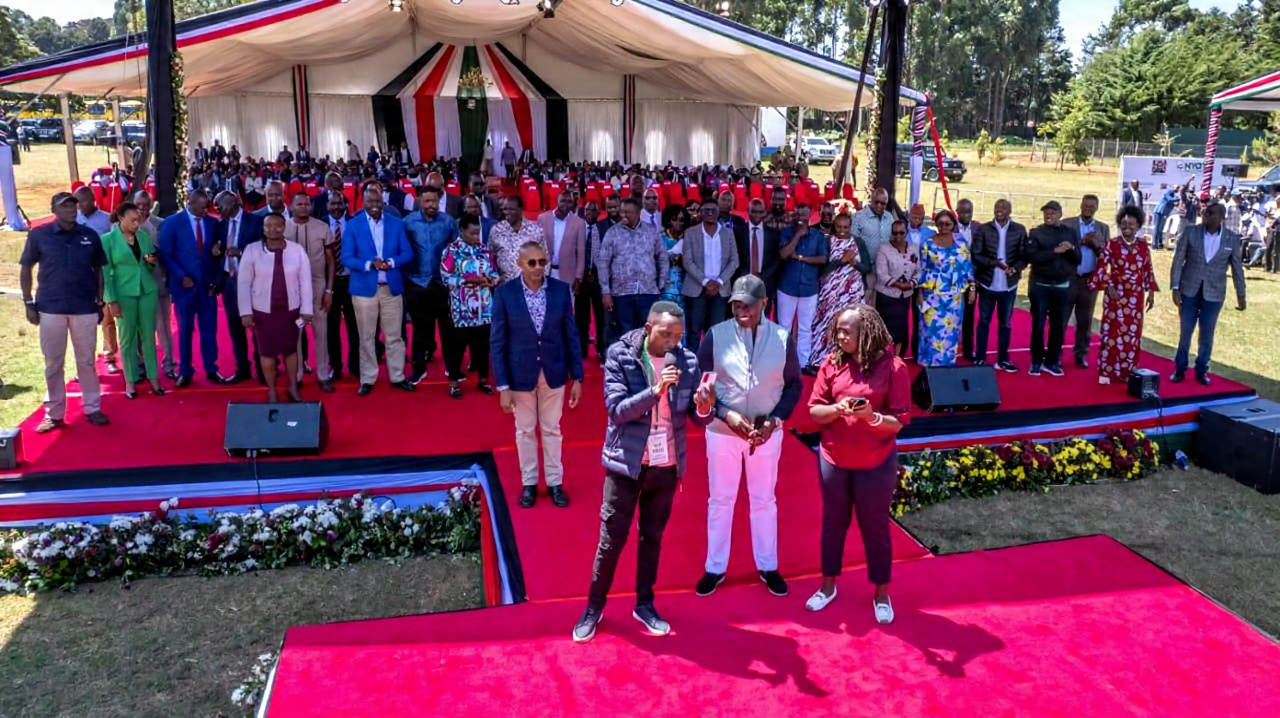
🔥 President Ruto's Direct Message to the Youth, a Challenge to Leaders, and Disbursement of Nyota Funds to the Youth!
News in Brief by Gerald K. Paul – Writer/Producer, LiveNow Africa
President Ruto’s message went beyond money — and this is the part many headlines quietly skip.
He issued a clear warning to young people:
👉🏽 Do not allow yourselves to be trapped by tribal politics.
👉🏽 Do not let drugs and substance abuse steal your future.
👉🏽 Do not waste resources — be wise and responsible in managing finances.
This was not a casual remark. It was a recognition of three forces that have silently destroyed generations of potential — ethnic manipulation, self-destructive habits, and irresponsible financial decisions.
But the President did not stop there.
In an equally sharp turn, he challenged leaders across the country to stop hiding behind slogans, noise, and populist rhetoric — and instead present real plans, measurable achievements, and tangible results for the people.
He implied that leadership must be judged by outcomes — not ethnicity, not volume, not promises.
This moment reframed the NYOTA conversation:
Youth empowerment is not just about funding — it is about mindset, discipline, responsibility, and accountable leadership.
Why NYOTA Matters
Youth unemployment remains one of Kenya’s biggest challenges. Programmes like NYOTA aim to bridge the gap between potential and opportunity by combining capital, skills, and accountability.
While KSh22,000 may not solve every challenge, paired with training and discipline, it can become a meaningful starting point — especially when rolled out at national scale.
The long-term impact of NYOTA will depend not only on government systems, but also on how responsibly the funds are used and how consistently skills are applied.
The Bigger Picture
NYOTA reflects a broader national shift toward:
- Skills-based empowerment
- Financial inclusion
- Practical job creation
- Accountability in public programmes
It is a reminder that development is not instant, and empowerment is not only about receiving — but also about how opportunity is handled.
🧾 What the NYOTA Disbursement Means
Under this phase of the programme, each of the 9,500 beneficiaries received KSh22,000 directly into their NYOTA Pochi la Biashara mobile wallet — funds intended as startup capital for young entrepreneurs. An additional KSh3,000 was credited to each youth’s savings account with the National Social Security Fund (NSSF), designed to encourage financial discipline and long-term savings.
The total allocation of KSh250 million is part of a broader KSh5 billion World Bank-supported initiative that aims to benefit 100,000 youth across Kenya.
📌 President Ruto’s Message
During the event, President William Ruto highlighted the importance of accountability and purpose in using the funds. Reliable reporting confirms that he emphasized:
- The programme is a key pillar of the government’s economic empowerment strategy for young people.
- NYOTA is designed with high standards of accountability and transparency, urging beneficiaries to use the startup capital strictly for business purposes.
- He linked the initiative to skills development, market access, and broader economic reforms, including affordable housing, structured internships, and digital jobs.
This reflects a growing government narrative that opportunity must be paired with responsibility — a message aimed as much at young entrepreneurs as at the wider economy.
📊 What NYOTA Includes
The NYOTA Project goes beyond cash transfers. It has multiple components to support youth holistically:
🌟 Core Components
- Business Start-Up Capital: Initial KSh22,000 grants plus KSh3,000 savings per beneficiary.
- On-the-Job Training: Youth attached to master craftsmen/women for skills transfer, stipends, and certification.
- Recognition of Prior Learning (RPL): Certification for informal or vocational skills to boost employability.
- Procurement Training: Skills to access government and private sector procurement opportunities.
🔹 Beyond Start-Up Capital: Skills & Market Access
President Ruto explained that NYOTA is more than just cash — it includes three extra components to equip youth with skills and market access:
- On-the-Job Training: 90,000 youth attached to master craftsmen/women for skills transfer, receiving Sh6,000/month for six months. The government also pays the masters and covers certification.
- Recognition of Prior Learning (RPL): Certifying 20,000 youth with vocational or informal skills.
- Procurement Training: Training 600,000 youth on how to access government contracts.
He also urged youth to leverage the government’s broader employment and empowerment programmes, including affordable housing, Kazi Majuu, and digital jobs initiatives. So far:
- 600,000 youth in affordable housing projects
- 500,000 youth employed abroad since 2023
- 200,000 youth engaged in digital work
Takeaway: NYOTA is not just startup capital — it’s skills, certification, and market opportunities designed for long-term growth.
📈 Why This Matters
🔹 Youth Employment & Enterprise Growth
Programmes like NYOTA provide capital, training, and mentorship — helping young entrepreneurs bridge the gap between ambition and sustainable business.
🔹 Financial Inclusion
Digital wallets and savings accounts promote a culture of financial responsibility, a foundational step toward long-term resilience.
🔹 Nationwide Implementation
NYOTA is being rolled out in clusters, with similar disbursements across other counties including Nairobi, Kiambu, and Kitui.
🧠 A Call for Responsibility and Accountability
While the government provides support, leadership emphasizes the responsibility on youth to use funds wisely — for business growth rather than short-term consumption. County officials reinforce discipline, urging avoidance of non-business spending until ventures stabilize.
In this context, NYOTA aims not just to distribute money — but to foster purpose-driven entrepreneurship and personal accountability.
📝 Conclusion: A Bold Step with Real Expectations
The disbursement of KSh250 million under NYOTA is more than a headline — it’s a strategic push to equip Kenyan youth with tools for enterprise and economic participation.
With transparency measures and complementary components like training and savings, the government is positioning NYOTA as a holistic youth empowerment model.
But the long-term success depends on how funds are used, how skills are applied, and whether supportive ecosystems for markets and mentorship are strengthened.
🔥 Your Thoughts
👉 Do you think NYOTA will transform youth enterprise in Kenya?
👉 Can KSh22,000 be enough to kickstart a real business if paired with training and mentorship?
Share your views below and let’s spark the conversation that matters.

 Facebook
 Twitter / X
 WhatsApp
 LinkedIn
 Telegram
 Reddit