NAIROBI — The standoff in Kenya’s public universities has entered its fourth week, with the lecturers’ union accusing the government of dishonesty and neglect.
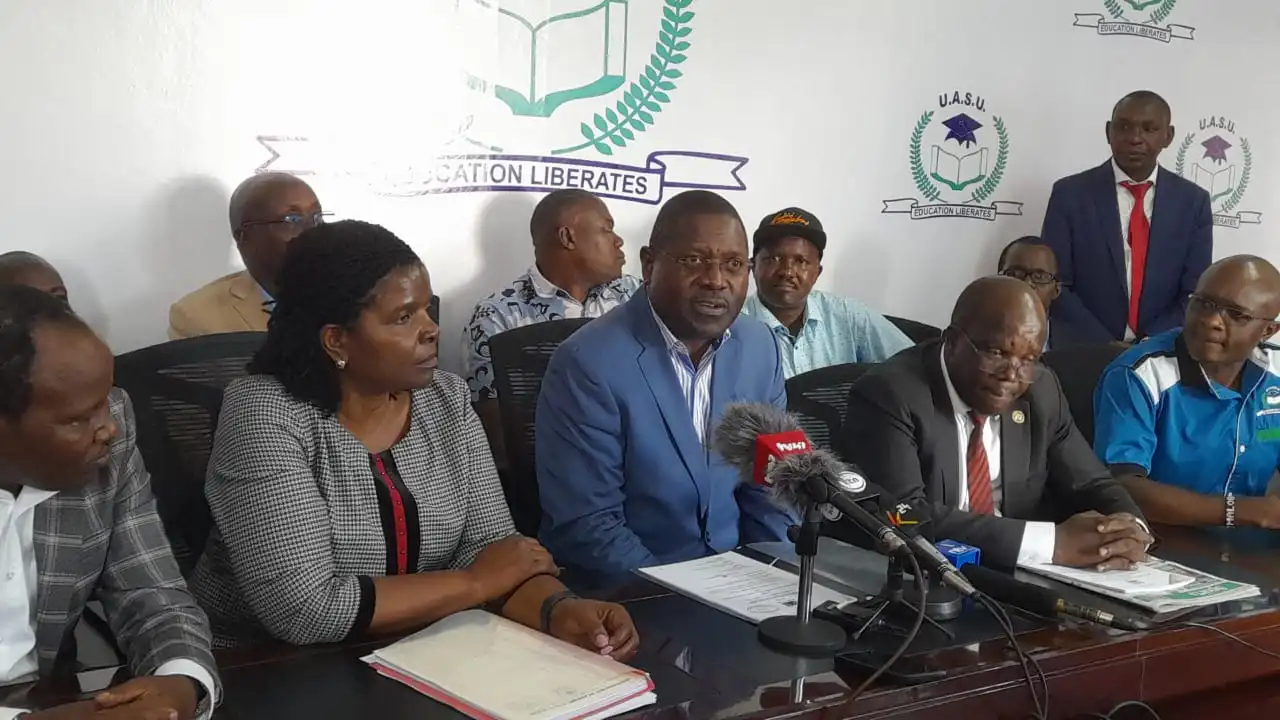
Kenya Universities Staff Union (KUSU) Secretary-General Charles Mukhwaya on Tuesday accused the Ministry of Education and the Salaries and Remuneration Commission (SRC) of failing to engage union leaders in genuine dialogue.
“We need to sit with all the stakeholders involved in this matter,” Mukhwaya said. “SRC and the Vice Chancellors will only tell the government what they want to hear. But for us, we have not been called by the CS or the PS.”
His remarks came amid growing frustration from thousands of lecturers and students as learning remains paralysed in all public universities. The ongoing strike has forced students to return home and triggered protests on several campuses.
Education Cabinet Secretary Julius Ogamba had earlier claimed that talks were progressing and nearing a resolution, a statement Mukhwaya sharply rejected.
“Nothing is going to come out. We are where we started. The strike has just begun,” he said.
The Money Dispute
At the core of the dispute is the implementation of the 2017–2021 Collective Bargaining Agreement (CBA). The unions insist the government owes lecturers Sh7.9 billion in arrears. The SRC, however, disputes this, claiming only Sh600 million remains unpaid.
“Regardless of any meetings or audits, the figures never lie,” Mukhwaya said. “We will still come back to the Sh7.9 billion. So who is wrong? It cannot be us.”
Principal Secretary for Higher Education Beatrice Inyangala said the ministry will rely on SRC’s directive in determining the final settlement.
Government’s Position
On Monday, Education CS Ogamba struck a more optimistic tone, saying the government and the University Academic Staff Union (UASU) were “nearing a deal” to end the impasse.
“We met with the university union over the weekend in Machakos to work out the issues of the 2017–2021 CBA,” Ogamba said. “They are also negotiating for the 2025–2029 cycle.”
According to him, the government has already paid Sh7.2 billion, leaving a balance of Sh624 million. He said a final report would determine the next steps.
Impact on Students
Meanwhile, students across the country are bearing the brunt of the crisis. Many have run out of upkeep funds, while others fear delayed graduations.
At the University of Nairobi, students took to the streets on Tuesday, demanding swift resolution of the dispute.
“This back-and-forth keeps hurting us,” said one protester. “We just want classes to resume.”
A Familiar Crisis
This is not the first time Kenya’s higher education sector has ground to a halt. Strikes in 2017, 2018, and 2021 disrupted academic calendars and examinations, with similar grievances over unpaid CBAs.
The 2017–2021 agreement was designed to improve pay and allowances for both academic and non-teaching staff. However, its implementation has been bogged down by budget shortfalls, conflicting figures, and delayed remittances.
As both sides hold firm, uncertainty hangs over universities nationwide. For many, it feels like history repeating itself — a cycle of promises, protests, and paralysis.