
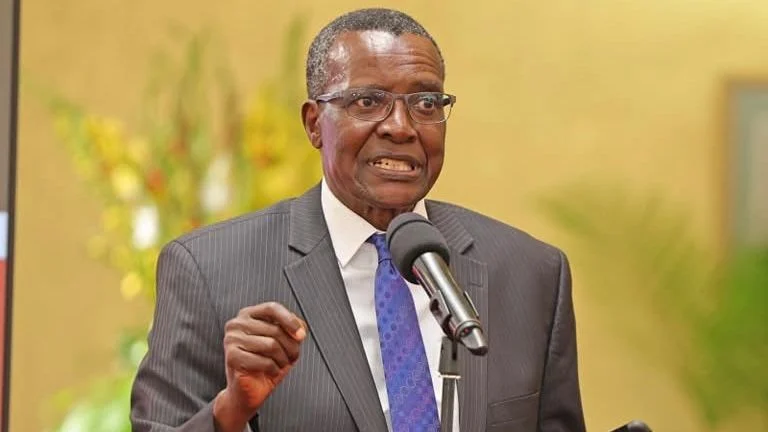
Former Chief Justice David Maraga has issued a blistering rebuke of Kenya’s Parliament, accusing it of shirking its duty by failing to initiate impeachment proceedings against President William Ruto.
Speaking on Citizen TV on Tuesday evening, Maraga argued that widespread calls for President Ruto’s resignation should have already prompted legal action through the country’s constitutional mechanisms.
“If Parliament were doing its work, the President would not be in office today,” Maraga said bluntly. “He has violated countless provisions of the Constitution.”
Maraga, who has recently stepped into the political arena with plans to challenge Ruto in the 2027 elections, claimed the legislative arm of government had been captured by the executive.
“Parliament has the power to impeach the President. But it won’t, because it’s under his control,” he added.
Impeachment or Resignation?
With pressure mounting on Ruto from opposition leaders and civil society groups, Maraga said Kenyans had only two constitutional paths to remove a sitting president before the end of his term—voluntary resignation or impeachment.
“What people are saying when they talk about ‘Wantam’ is that Ruto must resign,” he said, referring to the trending social media slogan calling for the President to step down. “But if he won’t resign, Parliament, are you listening? Impeach this President and get him out.”
What the Constitution Says
Kenya’s 2010 Constitution provides a clear framework for presidential impeachment under Article 145. The process begins in the National Assembly and requires substantial political will to carry through.
A motion for impeachment must be backed by at least one-third of MPs—117 out of 349. If it passes an initial vote and secures a two-thirds majority, the matter proceeds to the Senate.
The Senate can either debate the charges directly or appoint an 11-member committee to investigate. During this time, the President continues in office but is expected to defend against the allegations—either personally or through legal counsel.
If two-thirds of the Senate back any single charge, the President is removed from office.
Ruto Pushes Back
President Ruto has repeatedly dismissed growing calls for his resignation or removal, framing the movement as dangerous and destabilising.
Speaking last week at a public function in Eldoret, he said: “Those calling for my removal are playing with fire. This country has laws, and I was elected by millions of Kenyans.”
He has insisted he will be on the ballot in 2027, casting impeachment talk as a distraction from urgent national issues such as economic recovery and public sector reform.
Maraga Steps into the Ring
Maraga’s comments come at a moment of political realignment in Kenya. Once regarded as a principled jurist who stood up to executive power—most notably annulling the 2017 presidential election—he is now positioning himself as a reformist challenger.
His blunt warning to Parliament raises the stakes, both for lawmakers accused of political inaction and for Ruto, whose administration is facing heightened scrutiny over governance, cost of living, and police conduct during recent protests.
As frustration simmers across the country, the former Chief Justice has made it clear: the Constitution provides tools for accountability, but only if Parliament has the courage to use them.
 Facebook
 Twitter / X
 WhatsApp
 LinkedIn
 Telegram
 Reddit