
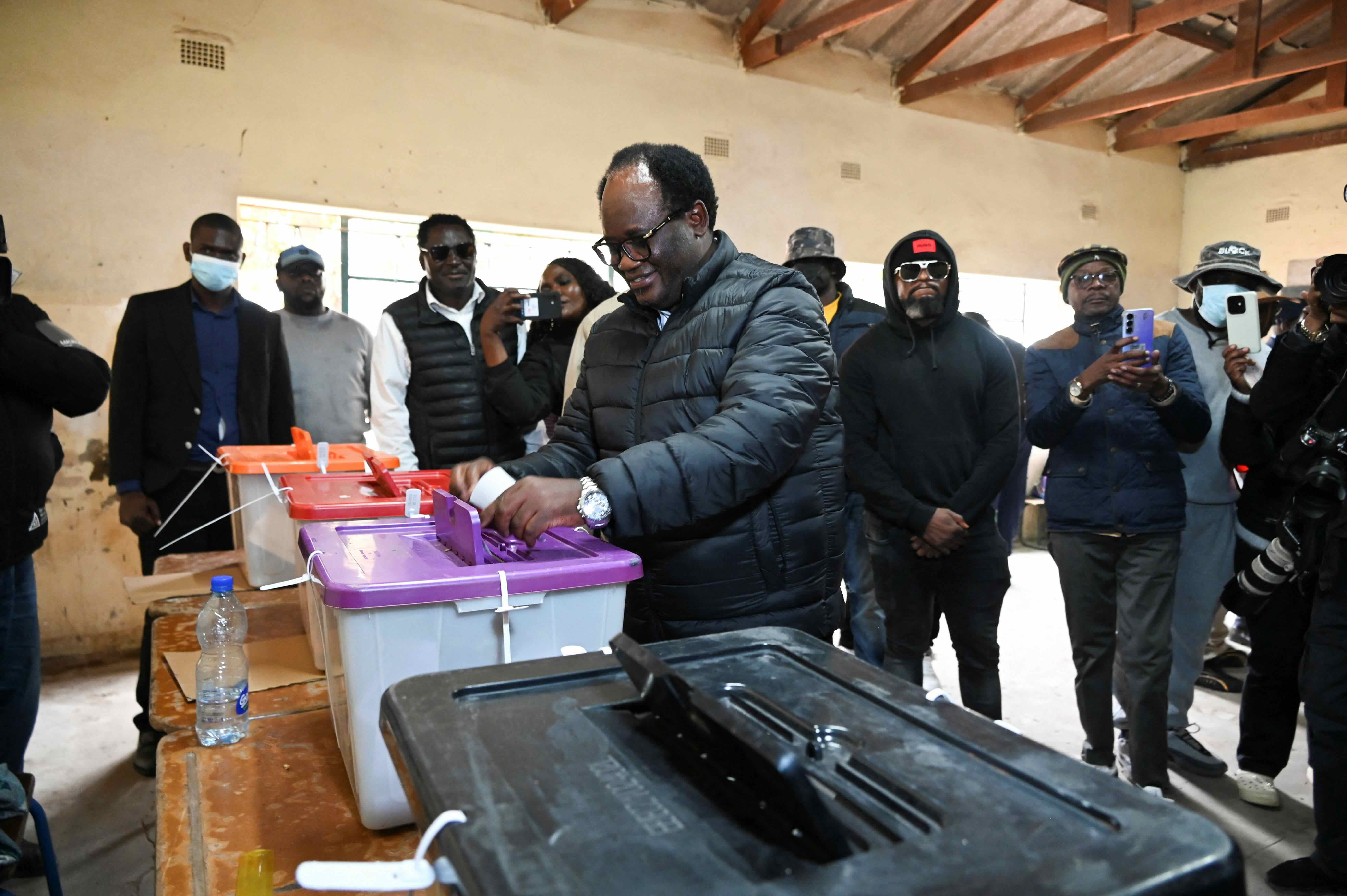
LUSAKA — Zambia's post-election dispute has entered a critical phase after the country's highest courts were closed on Monday, the final day available for opposition leader Brian Mundubile to challenge President Hakainde Hichilema's re-election.
The judiciary said staff should not report to work because of security concerns, while police were deployed around court premises in Lusaka. The closure came as Mundubile's opposition alliance prepared to challenge the August 13 presidential election results.
The timing has intensified concerns about whether the opposition will be able to use the courts to contest an election it says was affected by serious irregularities.
Mundubile finished second with about 38% of the vote, while Hichilema won roughly 60% and was declared the winner by the Electoral Commission of Zambia.

Hichilema has denied allegations of electoral fraud.
Why the court closure matters
The immediate issue is the deadline.

Under Zambia's constitutional framework, a presidential election challenge must be filed within seven days of the declaration of the result. Hichilema was formally declared the winner on August 18, putting the opposition's window to challenge the result under intense time pressure.
Monday was therefore not an ordinary court day.
It was potentially the final opportunity for the opposition to begin the legal process of challenging the election.
Reuters reported that the Constitutional Court and Supreme Court premises were closed and that police were present. A judiciary memorandum cited security reasons for keeping staff away from the courts.
The opposition says it is still trying to file its petition.
What is the opposition alleging?
Mundubile has said he intends to challenge the election results, alleging serious irregularities in the electoral process.
The controversy began before the final results were announced.
The Electoral Commission temporarily suspended vote counting after reports of violence and ballot theft. International observers also raised concerns about aspects of the process, including delays and procedural problems during vote tabulation.
The European Union observer mission also raised concerns about the campaign environment and restrictions affecting political competition.
But those concerns do not, by themselves, establish that the presidential result was fraudulent.
That distinction will ultimately matter if the opposition gets its case before the Constitutional Court.
Hichilema's side rejects the allegations
Hichilema has rejected claims that his victory was achieved through fraud.
His government has defended the election and said the opposition has access to legal channels for challenging the result.
The president's re-election nevertheless comes at a politically sensitive moment.
His first term brought improvements in Zambia's macroeconomic position and progress on debt restructuring, while his government has promoted investment in the mining sector.
But many Zambians continue to face economic pressures, including a high cost of living and energy challenges. Hichilema's strongest challenger was able to tap into some of that frustration during the campaign.
The election therefore was not simply a referendum on Hichilema's economic record.
It was also a test of whether his government could maintain Zambia's reputation for competitive multiparty politics.
Opposition arrests add to the tension
The court dispute comes against a backdrop of increasing tension between the government and opposition.
Several opposition figures were arrested following a police raid in which gunfire was exchanged. Authorities said those arrested were linked to threats to national security, while the opposition rejected the allegations.
Mundubile was subsequently summoned by police for questioning over alleged national-security threats.
He has described the allegations as fabricated and has reportedly gone into hiding because of concerns for his safety.
The United Nations human rights chief has expressed concern about the arrests and called on Zambia to ensure that due process and human rights protections are respected.
Why this matters beyond Zambia
Zambia has long been viewed as one of Africa's more stable multiparty democracies.
That reputation makes the current dispute particularly important.
The question is no longer only whether Hichilema won the election.
It is whether an opposition candidate who believes the election was flawed can effectively challenge the result through independent institutions.
That is a much bigger test of democracy.
An election can be peaceful on voting day and still face questions about the strength of institutions afterwards.
Courts, electoral commissions, police and political parties all play a role in determining whether losing candidates have a credible route to challenge results.
If the courts are inaccessible precisely when an electoral petition must be filed, concerns about the fairness of the process can grow—even if the closure itself is officially justified on security grounds.
Zambia's economic stakes are also high
The political dispute comes as Zambia tries to consolidate an economic recovery.
The country is one of Africa's major copper producers, and Hichilema has made mining investment and increased copper production central to his economic strategy.
Zambia's copper industry is becoming increasingly important to the global race for minerals needed for electric vehicles, renewable energy and other technologies.
That makes political stability particularly valuable.
International investors want predictable rules, functioning institutions and confidence that disputes can be resolved through established legal channels.
A prolonged political crisis could therefore create economic costs even if it does not overturn the election result.
What happens next?
The immediate question is whether Mundubile and his allies can successfully lodge their election petition before the legal deadline.
Opposition officials say they are trying to do so despite the court closures.
If the petition is filed, Zambia's Constitutional Court will have to determine whether the opposition has presented sufficient grounds to challenge the result.
If it is not filed, Hichilema's victory will become considerably harder to contest through the courts.
Either way, the events of the coming days will shape how Zambia's second Hichilema term begins.
The president has secured another five-year mandate.
The bigger test now is whether Zambia's institutions can convince both supporters and opponents that the mandate was won—and can be challenged—within a credible democratic system.
That is the story Africa and international investors will be watching.
Related Stories
- Europe puts another €6.1 billion behind Ukraine as defence spending accelerates
- Congo ceasefire monitors deploy as peace deal faces its first major test
- Nigeria mosque kidnapping: Video appears to show hundreds of worshippers held captive
Category: International
Related Explainer: Kenya’s inflation holds near 30-month high as transport and food costs squeeze households
 Facebook
 Twitter / X
 WhatsApp
 LinkedIn
 Telegram
 Reddit