
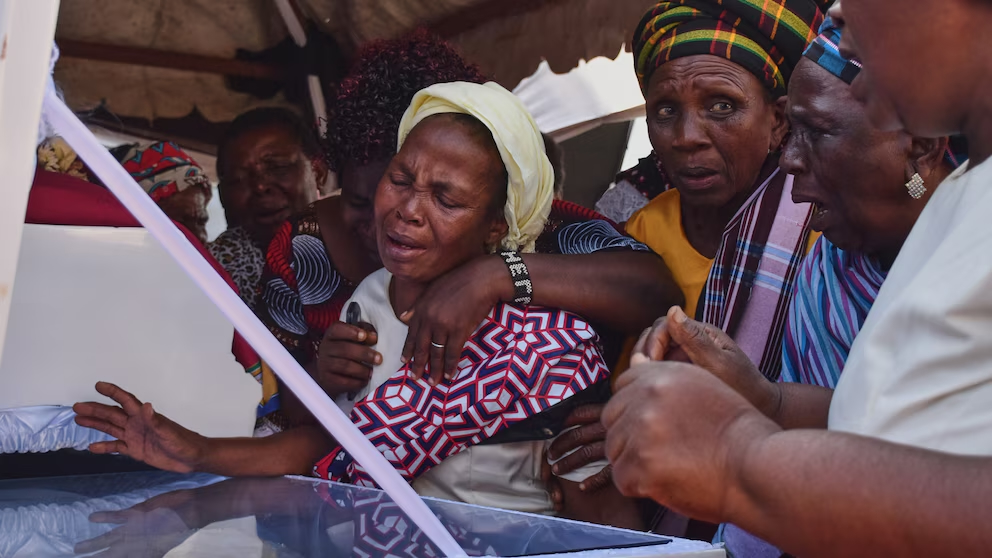
When 29-year-old Penina Zawadi was wheeled into an operating theatre for a Caesarean section, she handed her jewellery to her mother for safekeeping and reassured her that she would deliver safely.
About an hour later, her mother, Esther Bendera, was handed her newborn grandson.
Her daughter did not return.
Zawadi, a mother from Kenya's coastal Kilifi County, suffered severe bleeding after giving birth and later underwent another operation in which her uterus was removed in an attempt to stop the haemorrhage, according to the Associated Press.

She spent several days in intensive care before dying on 23 June.
Her death has drawn renewed attention to maternal mortality in Kenya and the persistent inequalities affecting women's access to timely emergency obstetric care, particularly in poorer and rural communities.
Four-hour wait for referral
Zawadi's family said she had been healthy throughout her pregnancy.
But Bendera told AP that her daughter spent about four hours bleeding at Malindi Hospital while awaiting referral to Kilifi County Referral Hospital, about an hour away.
“She was bleeding so much, you would think it was water gushing out,” Bendera told AP.
According to her family, Zawadi never regained consciousness after the second operation.
Her father, Nixon Charo, has called for hospitals to be adequately equipped to deal with childbirth emergencies and for families to receive clearer information when complications occur.
The Kilifi County government did not respond to AP's questions about Zawadi's death or the county's maternal mortality rate.
A death every two minutes
Zawadi's case is part of a much wider global health challenge.
An estimated 260,000 women died from causes related to pregnancy and childbirth in 2023, according to the latest estimates produced by the World Health Organization, UNICEF, UNFPA, World Bank Group and UN Population Division.
That is more than 700 women every day — or approximately one maternal death every two minutes.
Most of those deaths were preventable.
Sub-Saharan Africa continues to carry by far the heaviest burden. The region accounted for nearly 70% of global maternal deaths in 2023, with an estimated 182,000 deaths.
Kilifi's maternal mortality burden
The disparities are also visible within Kenya.
Kilifi recorded an estimated 532 maternal deaths for every 100,000 live births, according to government data from 2022 cited by AP.
Kenya's nationally reported maternal mortality ratio stands at 355 deaths per 100,000 live births, based on the 2019 Kenya Population and Housing Census.
While the figures come from different reporting periods and should therefore be compared cautiously, they illustrate the significant maternal health burden facing Kilifi.
The Kenya Ministry of Health says postpartum haemorrhage — severe bleeding following childbirth — remains one of the country's major maternal health threats and accounts for an estimated 25% to 45% of maternal deaths.
Other major causes include hypertensive disorders such as pre-eclampsia, infections and complications during childbirth.
Many maternal deaths can be prevented when complications are detected early and women have rapid access to skilled health professionals, medicines, blood transfusion services, appropriate equipment and emergency obstetric care.
Distance, shortages and delays
For many women, however, getting that treatment remains difficult.
Shortages of medical equipment, medicines and healthcare workers, as well as inadequate transport and long distances between health facilities, can delay potentially life-saving treatment.
AP reported that some clinics in rural Kilifi remain poorly equipped, while patients requiring more advanced treatment may have to travel considerable distances to larger hospitals.
These barriers disproportionately affect poorer households, where paying for transport or seeking treatment at a private facility may not be an option.
Kenya has nevertheless made progress in expanding access to skilled maternity care.
According to Ministry of Health data, the proportion of births attended by skilled health professionals increased from 62% in 2014 to 89% in 2022.
But access to a health facility does not necessarily guarantee that emergency care will be available quickly enough when complications develop.
Global progress, but still too slow
Maternal mortality has declined substantially worldwide over the past two decades.
UN inter-agency estimates show that the global maternal mortality ratio fell by about 40% between 2000 and 2023 — from 328 to 197 deaths per 100,000 live births.
That represents an average annual reduction of about 2.2%.
But progress has slowed considerably in recent years.
The world remains far from the Sustainable Development Goal of reducing maternal mortality to fewer than 70 deaths per 100,000 live births by 2030.
For Zawadi's family, however, the debate over maternal mortality is no longer about percentages, ratios or global targets.
It is about a 29-year-old mother who went to hospital expecting to return home with her newborn child.
Her baby survived.
She did not.
And her death leaves behind a question confronting health systems in Kenya and across sub-Saharan Africa: how many women are still dying from childbirth complications that timely and adequately equipped healthcare could prevent?
Related Stories
- The Hidden Cost Of Nairobi Traffic
- Cyrus Jirongo: Even in death, the deals, debts and drama follow him
- Singapore’s Housing Model vs Ruto’s Affordable Housing Plan: Two Very Different Paths to Homeownership
Category: Features
Related Explainer: EXPLAINER: Why Kenya’s aviation workers are striking — and what travellers need to know
About the Author
Angel Wairimu is a media specialist and Communication and Multimedia graduate with a passion for digital media and content creation. Her areas of interest include scriptwriting, voice-over, content production, anchoring, videography and graphic design. She is passionate about using her creative skills to tell engaging stories while continuously learning and growing in the media industry. Email: angelicawairimumaina@gmail.com LinkedIn: Angel Wairimu
 Facebook
 Twitter / X
 WhatsApp
 LinkedIn
 Telegram
 Reddit