
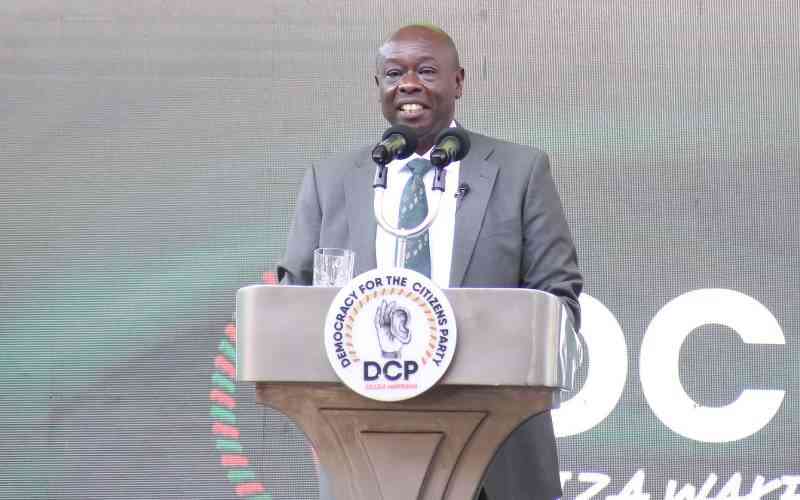
Former Deputy President Rigathi Gachagua has delivered his most detailed indictment yet of President William Ruto’s administration, accusing the Kenya Kwanza government of failing on its campaign promises and presiding over rising public debt, higher taxes, alleged corruption, human rights violations and what he described as the capture of State institutions.
In a lengthy address at the Democracy for the Citizens Party (DCP) headquarters in Nairobi on Tuesday, August 11, Gachagua presented what he called a four-year scorecard of the Ruto administration.
His verdict was blunt: the Kenya Kwanza plan has failed.
Gachagua, who fell out with Ruto after serving as his deputy between 2022 and 2024, used the address to attack virtually every major pillar of the President’s administration, from the economy and housing to agriculture, governance, policing and the management of public assets.

He also accused the government of repeatedly announcing new plans instead of explaining what happened to previous promises.
“The plan has failed. It is hollow and deceptive,” Gachagua declared in his concluding remarks.
The address effectively positioned the DCP leader as one of the most aggressive challengers to Ruto ahead of the August 2027 General Election.
‘BETA failed, NADCO failed, Ten-Point Agenda failed’
Gachagua began by challenging the government's record against the promises made during the 2022 presidential campaign.
He argued that the Bottom-Up Economic Transformation Agenda (BETA) had failed to deliver the economic transformation promised to Kenyans.
He then turned to the National Dialogue Committee, commonly known as NADCO, saying its recommendations had similarly failed to deliver the promised reforms and national unity.
The government's Ten-Point Agenda, he said, had become another unfulfilled roadmap.
Gachagua questioned why Kenyans should believe another development plan when earlier programmes had not produced the promised results.
His central argument was that the government was moving the goalposts by continually presenting new targets instead of accounting for previous commitments.
Cost of living becomes central attack
The former Deputy President devoted significant attention to household finances.
He argued that Kenya Kwanza's promise to put more money into people's pockets had produced the opposite result.
As an example, he cited a teacher earning a gross salary of Sh50,000, claiming that the employee's take-home pay had fallen from about Sh42,000 in 2022 to roughly Sh38,000 while the cost of food, transport, electricity and other essentials had increased.
He argued that increased statutory deductions and taxation had reduced disposable income.
“The Kenya Kwanza covenant to put money into people's pocket is nothing but a pipedream,” Gachagua said, according to the transcript of his address.
He renewed his call for the government to suspend the Affordable Housing Levy and reduce the PAYE burden as part of measures to cushion workers.
He also called for a review of taxes imposed on petroleum products, arguing that fuel taxation contributes directly to higher transport and food prices.
Debt: Gachagua's biggest economic attack
Gachagua devoted a major portion of his speech to Kenya's public debt.
He claimed Kenya's debt had risen from about Sh8.6 trillion when Ruto assumed office in August 2022 to Sh13.02 trillion.
He further claimed the government had borrowed more than Sh5 trillion during its first four years and was borrowing at an average rate of about Sh1.4 trillion annually.
Gachagua contrasted that with previous administrations, claiming the Grand Coalition government borrowed an average of Sh200 billion annually and the Jubilee administration about Sh700 billion.
He then translated the debt into an individual burden, claiming every Kenyan effectively carried a debt of about Sh221,000.
The debt figures and per-capita calculation are political claims and should be read alongside official National Treasury debt statistics and the size of Kenya's population.
Gachagua also accused the government of borrowing to finance recurrent expenditure and questioned whether Kenya's debt-management practices comply with constitutional and statutory requirements.
His argument was that borrowing should translate into visible development and productive investment rather than simply finance government operations.
State House budget comes under fire
One of Gachagua's most politically potent attacks focused on State House expenditure.
He claimed the State House budget had increased from approximately Sh8 billion to Sh18 billion and questioned why such resources were being spent while ordinary Kenyans faced rising food, fuel and household costs.
“State House does not need Sh18 billion for 12 months,” he said, arguing that some of the money could instead be used to subsidise food and fuel or provide water infrastructure in arid and semi-arid areas.
The broader State House budget debate is supported by official budget documents, although the precise figure depends on the financial year and whether supplementary allocations are included.
Treasury's 2025/26 supplementary estimates revised State House's approved budget from Sh8.6 billion to Sh17 billion. For 2026/27, the approved allocation was about Sh13.64 billion after a proposed Sh20 billion request was reduced.
Gachagua's criticism comes amid growing public debate over President Ruto's frequent State House meetings with large delegations.
Corruption and ‘State capture’
Gachagua accused the government of abandoning its pledge to fight corruption and instead using public institutions and procurement systems to benefit politically connected individuals.
He alleged that the administration had centralised control over independent commissions, State corporations and procurement.
He also accused government-linked businesses of benefiting from public contracts.
Among his claims was that Western Hotel, which he alleged was linked to Ruto, had received dozens of government hospitality and catering contracts.
These are serious allegations and were not independently established by the speech itself. The individuals and entities named would be entitled to respond to the claims.
Gachagua also accused the President of becoming wealthier since taking office, alleging that Ruto had become a US-dollar billionaire through corruption.
That allegation was presented as part of Gachagua's political attack and should not be treated as an established finding without documentary evidence.
E-Citizen and public funds
The DCP leader also raised concerns over financial management of the E-Citizen platform.
He cited what he described as findings by the Auditor-General concerning billions of shillings in collections whose documentation or routing raised questions.
He presented the issue as evidence of weaknesses in government financial controls.
The allegation requires assessment against the specific Auditor-General reports and the government's response before any conclusion can be drawn about loss or misappropriation of funds.
Safaricom, Kenya Pipeline and State assets
Gachagua broadened his attack to the management of State assets.
He questioned decisions surrounding Kenya Pipeline and the government's handling of strategic national infrastructure.
He also criticised the government's transaction involving its stake in Safaricom, alleging that the shares were undervalued and arguing that Kenyan cooperatives and SACCOs should have been given a greater opportunity to participate.
Gachagua claimed the transaction involved approximately Sh204 billion and argued that the shares were sold at about Sh34 each.
He questioned why an open price-discovery mechanism was not used.
He also raised concerns about the future of New KCC, Kenya Ports Authority and Kenya Airways, alleging that strategic national assets were being prepared for disposal.
His central argument was that Kenya should not sell assets built through decades of public investment without demonstrating clear long-term economic benefits.
Housing levy and a controversial banking allegation
The Affordable Housing Programme received particularly heavy criticism.
Gachagua argued that the housing levy was placing an additional burden on workers while questioning the management and investment of the money collected.
He made allegations concerning Cydian Bank, claiming it had benefited from deposits associated with government institutions and the Affordable Housing Fund.
He further alleged that the bank's financial position had dramatically improved since 2022.
These claims require verification against the bank's audited financial statements, ownership records and regulatory disclosures.
Gachagua's broader argument was that public programmes should not create preferential financial advantages for politically connected businesses.
Agriculture: farmers still waiting for promised transformation
Agriculture was another major front in Gachagua's attack.
He accused the government of failing smallholder farmers despite its promise to transform agriculture and increase incomes.
He cited problems facing sugarcane, tea, coffee and dairy farmers.
According to Gachagua, sugar farmers were still waiting for payments, milk farmers had experienced delayed payments and tea farmers were facing reduced earnings.
He also criticised the reduction in funding for the National Agricultural Value Chain Development Project.
The 2026/27 budget estimates show an allocation of Sh4.7 billion to the National Agricultural Value Chain Development Project, down from Sh10.2 billion cited in the previous financial year.
Gachagua said the reduction represented a direct assault on agricultural value chains.
He contrasted the current situation with his tenure as Deputy President, claiming he had initiated reforms in tea, coffee and dairy and helped negotiate an Sh8 billion debt waiver for coffee farmers.
He promised that a future DCP government would revive agricultural financing and improve returns to farmers.
Sugar, tea and dairy under pressure
Gachagua argued that the government's agricultural transformation agenda had not translated into meaningful improvements at farm level.
He cited sugar farmers in western Kenya, tea farmers and dairy producers as examples.
He also claimed that some farmers supplying New KCC had gone for months without payment.
For farmers, the issue is particularly significant because agricultural income remains a major source of livelihoods across Kenya.
The political message from Gachagua was clear: the government cannot claim economic transformation while farmers remain unable to make a sustainable income from their crops and livestock.
Health and social protection
Gachagua also criticised changes in healthcare financing.
He argued that the transition from previous health programmes had increased the burden on ordinary households.
He specifically mentioned the discontinuation of programmes such as Linda Mama and Edu Afya and argued that the changes had increased costs for families.
He also criticised the government's management of the Social Health Authority and called for greater accountability in public healthcare spending.
Human rights and alleged abductions
Perhaps the most explosive part of the speech was Gachagua's attack on the government's human rights record.
He accused State security agencies of involvement in abductions, extrajudicial killings and enforced disappearances.
He cited several alleged cases involving activists and government critics.
He also referred to the deaths and disappearances surrounding the 2024 Gen Z protests and demanded investigations into unresolved cases.
Gachagua called for greater independence in investigating deaths involving security agencies and pointed to proposed changes concerning the Coroners Service.
He said the government had promised to reform the system for investigating suspicious deaths but had failed to complete the process.
Dr Victoria Mutiso murder
Gachagua also invoked recent high-profile killings, including the murder of Dr Victoria Nthunya Mutiso, in his broader criticism of security agencies.
He alleged links between the killings and rogue police officers and demanded deeper investigations.
However, the claims made in the speech should not be confused with the ongoing criminal investigations.
Kenyan authorities are separately investigating Dr Mutiso's killing, and suspects have already been placed in custody as detectives pursue further leads.
Gachagua's broader demand was for public scrutiny of unresolved deaths and what he described as suspicious killings during the Ruto presidency.
Journalists and media freedom
Gachagua accused the government of targeting journalists and media organisations through online attacks and disinformation campaigns.
He referred to violence against journalists during the 2024 Gen Z demonstrations and accused State actors of creating an increasingly hostile environment for the media.
His criticism comes amid wider concerns raised by rights organisations about press freedom and the treatment of journalists during protests.
Church and religious organisations
The former Deputy President also accused Ruto of abandoning commitments made to churches during the 2022 campaign.
He criticised proposed regulation of religious organisations and argued that the government had interfered too heavily in religious affairs.
He cited attacks on churches and the murder of religious leaders as examples of what he described as a deterioration in security.
Public service under pressure
Gachagua argued that the Kenyan public service had become increasingly politicised.
He accused the President of centralising decision-making and sidelining professional civil servants.
According to Gachagua, this has contributed to repeated launches and rebranding of government programmes without meaningful implementation.
His criticism was directed at what he described as an administration increasingly driven by political rather than professional considerations.
The 2027 message
Beyond the individual allegations, Gachagua's speech was clearly aimed at the 2027 political contest.
He presented himself and the DCP as an alternative to the Kenya Kwanza administration.
The former Deputy President ended his address by arguing that the government had failed its central promises on the economy, governance, security and public accountability.
He promised that a DCP government would reverse what he described as four years of economic and institutional decline.
The speech therefore serves two purposes: it is both an indictment of Ruto's first four years and an early manifesto for Gachagua's 2027 campaign.
Ruto allies fire back
Gachagua's attack immediately triggered a political response from the Kenya Kwanza camp.
Treasury Cabinet Secretary John Mbadi defended the government's economic record and accused opposition leaders of failing to acknowledge improvements made since Ruto took office.
Mbadi argued that the administration inherited an economy facing serious challenges and said the government had stabilised it.
More than 50 Kenya Kwanza MPs also reportedly left Parliament's afternoon proceedings to respond to Gachagua's remarks, accusing him of making inflammatory attacks against the government.
The confrontation demonstrates how quickly the political temperature is rising as Kenya moves towards the 2027 election.
A scorecard that sets the stage for 2027
Gachagua's speech was not simply a criticism of one government programme.
It was an attempt to build a comprehensive political case against the Ruto presidency.
He attacked the administration on five broad fronts: the cost of living, public debt, corruption and State capture, human rights and the management of national assets.
But the speech also raises a second question: whether the DCP and Gachagua can convert these criticisms into a credible alternative programme capable of attracting voters across Kenya.
For Ruto, the challenge is equally significant.
The President will have to defend his administration's record on the economy, demonstrate that government borrowing is translating into productive investment and convince voters that major programmes such as housing, healthcare and agricultural transformation are delivering tangible benefits.
For Gachagua, simply attacking Ruto may not be enough.
With the 2027 election approaching, Kenyans will increasingly demand something more concrete: What would he do differently?
That may ultimately be the real test of Gachagua's scorecard.
For now, his verdict on the Ruto presidency is unequivocal: the plan has failed.
The political battle over whether Kenyans agree is only beginning.
You may also like
Category: Politics · Related Topic: William Ruto
Related Video: Human Ladder Reaches Dangerous Heights as Climbers Keep Going
Related Explainer: EXPLAINER: Why Kenya’s aviation workers are striking — and what travellers need to know
About the Author
Gladys Owano is a Kenyan creative and aspiring filmmaker pursuing Film Production and Animation from Multimedia University of Kenya. She is passionate about storytelling, cinematography, editing, animation and visual arts.
 Facebook
 Twitter / X
 WhatsApp
 LinkedIn
 Telegram
 Reddit