
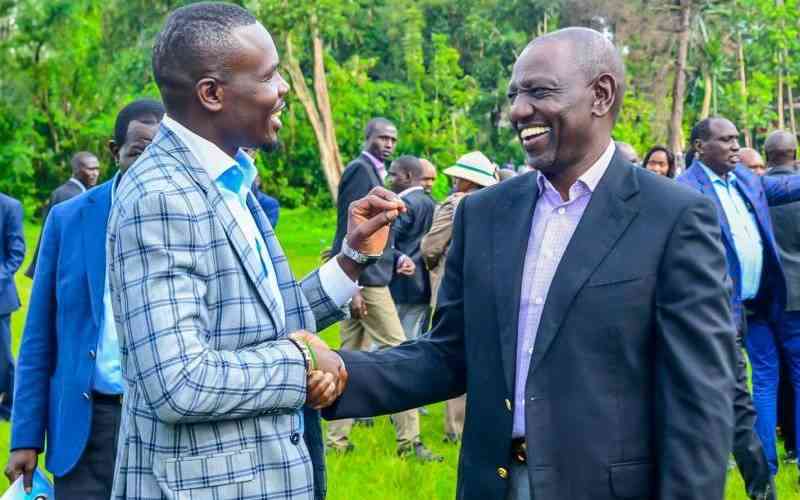
National Assembly Majority Whip and South Mugirango MP Sylvanus Osoro has delivered a blunt assessment of Kenya’s emerging 2027 presidential race, arguing that former Interior Cabinet Secretary Fred Matiang’i lacks the political structures, resources and sustained grassroots mobilisation required to mount a serious challenge for the presidency.
Speaking during an interview with Herman Manyora on A Conversation with Manyora, Osoro said Matiang’i’s reputation as a powerful Cabinet secretary should not be confused with the political machinery required to win a presidential election. He argued that the image Matiang’i built while serving in government is different from the political reality he faces outside office.
Osoro’s assessment is particularly striking because he described Matiang’i as a close relative and friend, saying the two come from the same area and that Matiang’i’s mother is related to his father. Despite that personal connection, Osoro insisted that politics must be judged by political realities rather than family ties.
‘Politics is about structures’
At the centre of Osoro’s argument is the importance of political organisation.
He said politicians who joined Matiang’i’s camp were initially swept up by what he described as national “euphoria”, believing that the former Cabinet secretary could quickly become a formidable presidential contender. But, according to Osoro, the excitement began to fade when the practical demands of political mobilisation became apparent.
“Politics is about structures. Be gradual. Don’t rush,” Osoro said, arguing that presidential campaigns cannot be built simply around public excitement or favourable opinion.
He claimed that some politicians who had abandoned their previous parties to associate with Matiang’i eventually became frustrated by what they saw as insufficient political activity and mobilisation. Osoro said some subsequently moved towards other political formations after the initial enthusiasm surrounding Matiang’i weakened.
For Osoro, the lesson extends beyond Matiang’i. He warned younger politicians against mistaking political excitement for an organised electoral movement.
“No politician grows to become president or anything because of euphoria,” he argued, pointing to previous instances where Kenyans became excited about potential leaders before eventually moving on to another figure.
Matiang’i’s biggest problem is not ability, Osoro says
Osoro was careful to distinguish between Matiang’i’s capacity as an administrator and his prospects as a presidential candidate.
He argued that Matiang’i could perform effectively if given a specific government assignment, but maintained that the presidency requires a much broader political skill set.
“Presidency is not just about work,” Osoro said. “Presidency has politics in it.” He added that a president must be capable of managing politicians, political interests, security concerns and the many competing expectations that come with occupying State House.
In Osoro’s view, experience in government administration therefore does not automatically translate into presidential political capacity.
He also criticised Matiang’i’s approach to grassroots politics, arguing that a national aspirant cannot remain concentrated in one political base and expect that support to automatically translate into votes across Kenya.
Osoro said that when he himself began his political journey, he ignored discouragement from his local community and deliberately moved beyond his immediate area to build support. He believes Matiang’i made the opposite mistake by allowing local political expectations to shape his early national campaign.
Money, organisation and the presidential campaign machine
Osoro also offered a stark description of the financial and organisational demands of a presidential campaign.
He argued that a serious presidential candidate needs a functioning secretariat, communications and research teams, logistics, media operations, nationwide mobilisation and polling-day agents.
According to Osoro, even establishing a credible campaign secretariat requires substantial resources. He contrasted that requirement with the reported fundraising associated with Matiang’i, saying that the resources available would not be sufficient to build a presidential-scale political operation.
He further argued that campaigns cannot be judged simply by the size of rallies. A presidential candidate needs a permanent political operation capable of reaching voters before, during and after campaign events.
Osoro cited the need for tens of thousands of polling agents as another indication of the scale of organisation required. He said Kenya’s electoral map demands structures that operate at grassroots level rather than a campaign dependent on large rallies and public appearances.
Osoro backs Ruto’s re-election prospects
The Majority Whip was equally confident about President William Ruto’s prospects for the 2027 election.
Osoro rejected suggestions that political excitement around opposition figures necessarily translates into an electoral threat to an incumbent. He pointed to Kenya’s political history to argue that moments of public enthusiasm can quickly disappear, while well-organised political structures can remain.
He said Ruto is not panicking and argued that the President’s continued engagement with Kenyans should be viewed as part of the work of an incumbent rather than evidence of electoral anxiety.
Osoro went further, describing 2027 as potentially one of the easiest elections for Ruto, although that remains his political assessment rather than an established electoral fact.
His argument is built largely around organisation. He recalled how, before the 2022 election, Ruto focused on building political structures rather than relying solely on meetings with political leaders. Osoro said that structure-building extended to the grassroots and to the people responsible for getting voters to polling stations.
Opposition faces a unity problem
Osoro also questioned whether Kenya’s opposition can successfully unite behind a single presidential candidate.
He characterised the opposition as politically fragmented and made the striking claim that opposition leaders are not necessarily preparing to win the presidency themselves. Instead, he alleged that some are positioning their MPs to negotiate with Ruto if he wins in 2027.
He dismissed the possibility of a completely united opposition as unlikely, although he acknowledged the need to consider the scenario hypothetically.
For Osoro, the opposition’s challenge is therefore not simply identifying a popular presidential candidate. It is building the political machinery capable of converting popularity into votes.
That distinction, he argued, is often missed in Kenya’s political debate.
The ‘six million’ question
Osoro also challenged the assumption that political blocs automatically deliver fixed numbers of votes.
Discussing the Mt Kenya region, he rejected the idea that it represents a guaranteed six-million-vote bloc and argued that a significant portion of the region’s political sentiment is driven by opposition to Ruto rather than unconditional loyalty to a particular opposition leader.
His argument was that political hostility towards an incumbent does not automatically translate into support for an alternative candidate.
That distinction could become important as the 2027 campaign takes shape, particularly if opposition parties attempt to assemble a coalition around an anti-Ruto platform without resolving the question of who can convert that coalition into a nationwide electoral machine.
A warning to Kenya’s political class
Beyond his assessment of individual candidates, Osoro used the interview to make a broader argument about the nature of Kenyan politics.
He repeatedly returned to the importance of structures, organisation and political experience, warning against the assumption that rallies, social-media popularity or public excitement can substitute for sustained mobilisation.
He also argued that politicians should understand the difference between public enthusiasm and actual electoral support. In his view, a crowd at a rally does not necessarily translate into votes on election day.
That is perhaps the central message from Osoro’s intervention: 2027, in his telling, will not be won by political hype alone. It will be won by whoever can build the deepest and most disciplined electoral machinery.
For Matiang’i, Osoro’s verdict is unequivocal: the former Interior CS may possess administrative experience and name recognition, but he has yet to demonstrate the nationwide political organisation, resources and sustained campaign energy that Osoro considers essential for a presidential bid.
For Ruto, Osoro sees the advantage in the structures already built by the Kenya Kwanza establishment.
And for the opposition, the challenge is much bigger than agreeing on a candidate. It is translating anti-government sentiment into a coherent national movement capable of surviving the long road to the ballot.
With the 2027 contest still taking shape, Osoro’s remarks offer a revealing glimpse into how one of Ruto’s senior parliamentary allies views the emerging battle: not as a contest of popularity alone, but as a war of political structures, resources, alliances and endurance.
Related Stories
- Ndindi Nyoro Takes His 2027 Campaign Nationwide
- KENYA'S 2027 STORM: Old Wounds, New Alliances and a Country on Edge
- Kenya at a Crossroads: Old Rivalries, New Alliances and the Pressure of 2027
Category: Opinion · Related Topic: William Ruto
Related Video: Gachagua’s explosive Ruto scorecard: Debt, taxes, State capture and a government ‘that has failed’
 Facebook
 Twitter / X
 WhatsApp
 LinkedIn
 Telegram
 Reddit