
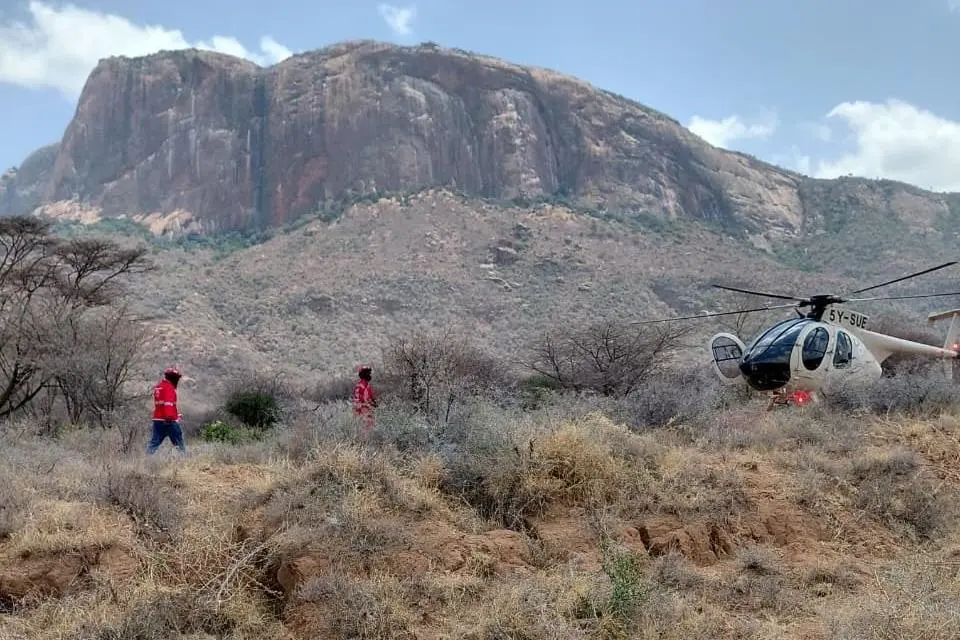
Seven people are dead after a helicopter crashed near Mt Ololokwe in Samburu County, turning a routine flight through one of Kenya's most spectacular tourism regions into a tragedy that has now drawn international investigators.
Five of those killed were American citizens. Among the passengers was Michele Sensi-Contugi, Ecuador's intelligence chief, who was travelling with his wife, Stephany Hollihan Vásconez.
Now, as Kenyan investigators examine the circumstances surrounding the crash, American and French aviation experts have joined the investigation, adding a new international dimension to the search for answers.
The cause of the crash has not yet been established.

What happened?
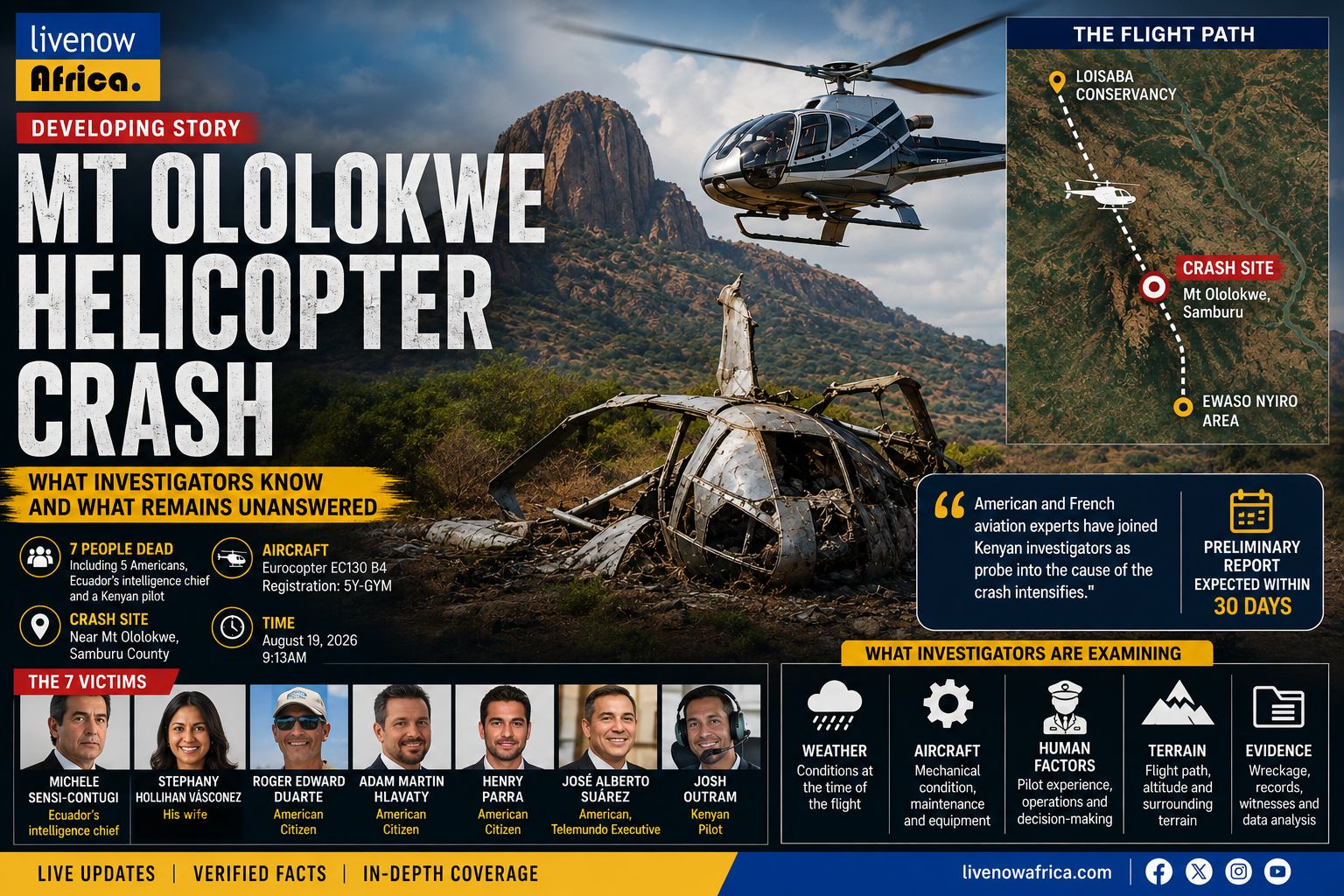
The helicopter, identified as a Eurocopter EC130 B4, registration 5Y-GYM, was carrying six passengers and a Kenyan pilot when it crashed in the Mt Ololokwe area on Wednesday morning, August 19.
The aircraft had been travelling from the Loisaba Conservancy toward the Ewaso Nyiro area when it went down at approximately 9:13am, according to reports citing Kenyan aviation authorities.
All seven people aboard were killed.
The crash occurred in rugged terrain, creating additional challenges for emergency and recovery teams.
Who were the seven people killed?
The victims included five Americans, Ecuador's intelligence chief and his wife, and the Kenyan pilot.
Those identified in reports include:
-
Michele Sensi-Contugi, Ecuador's intelligence chief
-
Stephany Hollihan Vásconez, his wife
-
Roger Edward Duarte
-
Adam Martin Hlavaty
-
Henry Parra
-
José Alberto Suárez, a Telemundo executive
-
Josh Outram, the Kenyan pilot
The deaths have prompted condolences from authorities and organisations in Kenya, Ecuador and the United States.
American and French experts join investigation
The investigation has now moved beyond the initial recovery operation.
American and French experts have joined Kenyan investigators as authorities attempt to reconstruct the helicopter's final moments.
The involvement of foreign aviation specialists reflects the international significance of the crash, given the nationalities of several victims and the aircraft involved.
Investigators are expected to examine the wreckage, aircraft records, maintenance history, flight information, weather conditions and the pilot's operational history before drawing conclusions.
A preliminary report is expected within 30 days.
What could have caused the crash?
At this stage, there is no confirmed cause.
Investigators are examining several possible factors, including weather, human factors and equipment or mechanical issues.
Weather
Conditions around mountainous terrain can change quickly.
Investigators will examine weather observations around the time of the crash and determine whether visibility, wind, turbulence or other atmospheric conditions played any role.
However, there is currently no basis for saying weather caused the crash.
The helicopter
The EC130 B4 will undergo detailed technical examination.
Investigators will want to establish the aircraft's maintenance history, inspection records and mechanical condition before the crash.
Any component failure or technical anomaly will need to be established through evidence rather than speculation.
The pilot and human factors
Investigators will also examine the pilot's qualifications, experience, recent flying history and familiarity with the aircraft and terrain.
That does not mean the pilot was responsible.
Human factors are routinely examined in aviation accident investigations alongside mechanical, environmental and operational issues.
Terrain and flight path
Mt Ololokwe is an imposing landmark surrounded by remote and rugged terrain.
Understanding the helicopter's exact route, altitude and position in the moments before the crash will therefore be a key part of the investigation.
Flight records, witness accounts and physical evidence from the crash site could help investigators reconstruct the aircraft's final movements.
How safe are safari helicopter flights in Kenya?
The crash is likely to raise uncomfortable questions about helicopter operations in Kenya's tourism industry.
Helicopters are an important part of safari and remote-area tourism, allowing visitors to travel quickly between conservancies, lodges and otherwise difficult-to-reach destinations.
But the accident raises questions that aviation authorities and tourism operators will need to answer:
-
How frequently are safari helicopters inspected?
-
What qualifications and experience are required of pilots?
-
What additional procedures apply to flights over remote terrain?
-
How quickly can emergency teams reach a crash site?
-
How many helicopter accidents and serious incidents has Kenya recorded in recent years?
-
Are there lessons from previous accidents that could prevent another tragedy?
Those questions should be answered using official aviation data rather than assumptions based on a single crash.
Why the Ecuador connection matters
The presence of Ecuador's intelligence chief among the passengers has attracted international attention.
But there is currently no evidence that the crash was connected to his government position.
Reports indicate that Sensi-Contugi was in Kenya in connection with tourism.
The circumstances of his trip, however, are likely to receive additional international attention because of his senior position in Ecuador.
What happens next?
The investigation will now focus on collecting and analysing evidence.
That process is likely to include:
-
Examination of the crash site and wreckage.
-
Analysis of the aircraft's mechanical components.
-
Review of maintenance and inspection records.
-
Examination of weather conditions.
-
Review of the flight route and operational records.
-
Examination of the pilot's qualifications and experience.
-
Interviews with witnesses and other relevant personnel.
-
Preparation of a preliminary report.
-
A longer investigation before any final conclusions are reached.
The most important point for the public is that an early preliminary finding should not automatically be treated as the final cause of the accident.
The questions still unanswered
Several major questions remain.
Why did the helicopter crash?
That is the central question investigators are trying to answer.
Other questions include whether the aircraft experienced a mechanical problem, whether weather or terrain played a role, what happened during the final moments of the flight and whether there were any warning signs before the crash.
Until investigators complete their work, those questions remain open.
LiveNow Africa will continue tracking the investigation
The Mt Ololokwe crash is more than a tragic aviation accident. It has implications for Kenya's tourism industry, aviation safety and international visitors travelling to the country's remote safari destinations.
As investigators release verified findings, LiveNow Africa will update this story with what is known, what has changed and what the evidence shows.
For now, the cause remains under investigation
Related Stories
- Kenya’s tech policy community mourns Rosemary Koech-Kimwatu
- Murkomen Dismisses Security Concerns as ‘Crisis’ Narrative, Raising Questions Over State Response to Political Violence
- 2027 election countdown begins as IEBC sets dates for parties and candidates
Category: News
 Facebook
 Twitter / X
 WhatsApp
 LinkedIn
 Telegram
 Reddit