
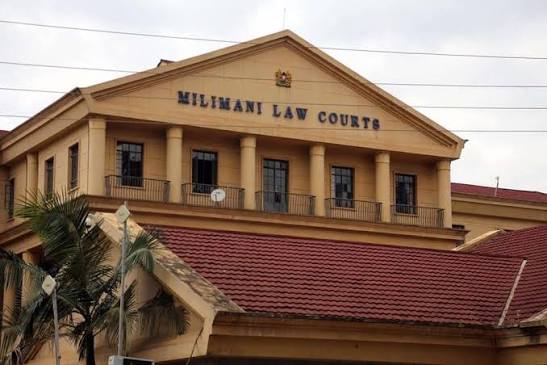
A University of Nairobi graduate is set to receive Sh3 million after the High Court found that the institution violated her rights by dropping her name from the graduation list without warning.
What should have been one of the proudest days of Marceline Murono’s life instead became a painful public humiliation.
Murono had been cleared to graduate. She had received her graduation gown and attended the official rehearsal the day before the ceremony.
But on the morning of December 15, 2023, she discovered that her name was missing from the graduation booklet.

She did not receive a prior explanation.
Justice Lawrence Mugambi has now ruled that the University of Nairobi’s handling of the matter violated Murono’s constitutional rights to fair administrative action and human dignity.
The judge awarded her Sh3 million in compensation, plus Sh24,000 in special damages.
The university has also been ordered to issue her with an unqualified apology within 30 days.
If it fails to do so, the compensation will increase by another Sh1 million.
A graduation she had prepared for
The court heard that Murono had gone through the steps required to graduate and had every reason to believe she would be among the students receiving their degrees.
She had been issued with a graduation gown and attended the rehearsal on December 14.
Justice Mugambi said the evidence showed the university had effectively cleared her to participate in the ceremony.
“It is crystal clear from the record that for purposes of complying with the process of graduation, the respondent (UON) and for all purposes cleared the way for the petitioner to graduate on the 15th of December 2023,” the judge said.
The problem emerged only hours before the ceremony.
Murono learnt that her name had disappeared from the final graduation booklet after an electronic copy was shared in a class WhatsApp group.
There had been no earlier communication from the university telling her that she would not graduate.
For the court, that omission was central to the case.
“There had been no prior communication of any kind as to this outcome which, to say the least, is an actual disregard of the legitimate expectation principle,” Justice Mugambi ruled.
University blamed a payment and clearance error
The University of Nairobi argued that Murono had not followed the correct clearance procedure.
It told the court that she had used an incorrect form and had paid money into the wrong university account.
But the judge found that the explanation did not adequately account for the evidence before the court.
The case showed that Murono had contacted a university finance officer on November 22, 2023, and provided her registration details while trying to resolve the payment issue.
That communication became important in establishing that the university was aware of the problem before the graduation date.
The court therefore found that the university should not have proceeded to exclude her from the graduation ceremony without giving her notice and an opportunity to respond.
Why the court treated the incident seriously
The judgment goes beyond a dispute over a graduation list.
Justice Mugambi found that the university's conduct breached Article 47 of the Constitution, which requires public bodies to provide administrative action that is lawful, reasonable, efficient and procedurally fair.
The judge also found violations of Murono’s constitutional protection of human dignity and protection against cruel, inhuman or degrading treatment.
The circumstances surrounding the incident were particularly significant.
Murono had invited relatives, friends and colleagues to celebrate her graduation. Those preparations went ahead even though she would ultimately not appear among the graduates.
The judge said the experience caused profound embarrassment.
“The enormous shame and embarrassment she was put through in the eyes of her own family and friends of having to meet and eat in celebration of nothing was an anticlimax that had a serious dent on her inherent dignity,” Justice Mugambi said.
He added: “The totality of what the petitioner came to endure is enough to break even the strongest of spirits.”
Court rejects argument over internal remedies
The university also argued that Murono should first have pursued its internal mechanisms for resolving disputes before going to court.
Justice Mugambi rejected that argument.
While acknowledging that internal procedures existed, he found that they did not provide an effective remedy in the circumstances.
“In my view, the respondents' claim to the existence of alternative remedies in the circumstances of this case only exists on paper,” the judge said.
“Factually, they collapse on evidence.”
The ruling therefore serves as a wider reminder to public institutions that having an internal complaints process is not enough if that process cannot offer a meaningful avenue for resolving a dispute.
UoN given time to decide whether to appeal
The University of Nairobi has been given 30 days to comply with the judgment, although the court has granted a temporary stay of execution.
The university’s lawyer told the court that he needed time to obtain instructions on whether the institution would appeal.
For Murono, however, the case has already turned an intensely personal experience into a wider legal question about how universities and other public institutions treat people when making administrative decisions.
The judgment does not suggest that universities cannot correct errors in graduation clearance.
Rather, it underscores the importance of notice, fairness and an opportunity to be heard before a decision with serious consequences is taken.
For Murono, the issue was not simply missing a graduation ceremony.
It was being told, in effect, at the last possible moment, that a milestone she had spent years working towards would not happen — after she had already been led to believe that she had been cleared.
The High Court has now put a price on the harm it found she suffered.
Sh3 million — and an apology from the institution that was supposed to be celebrating with her.
Related Stories
- Seven killed in helicopter crash at Mt Ololokwe in Samburu
- Nyoro’s NSSF plan: Cut pension contributions, redirect KSh40bn to healthcare
- Sharon Otieno family asks court for compensation after eight-year ordeal
Category: News
About the Author
Maureen Onyango is a journalist passionate about storytelling, life coaching and spiritual lessons. She studied at the Kenya Institute of Management and enjoys telling stories that inform, inspire and empower communities.
 Facebook
 Twitter / X
 WhatsApp
 LinkedIn
 Telegram
 Reddit