
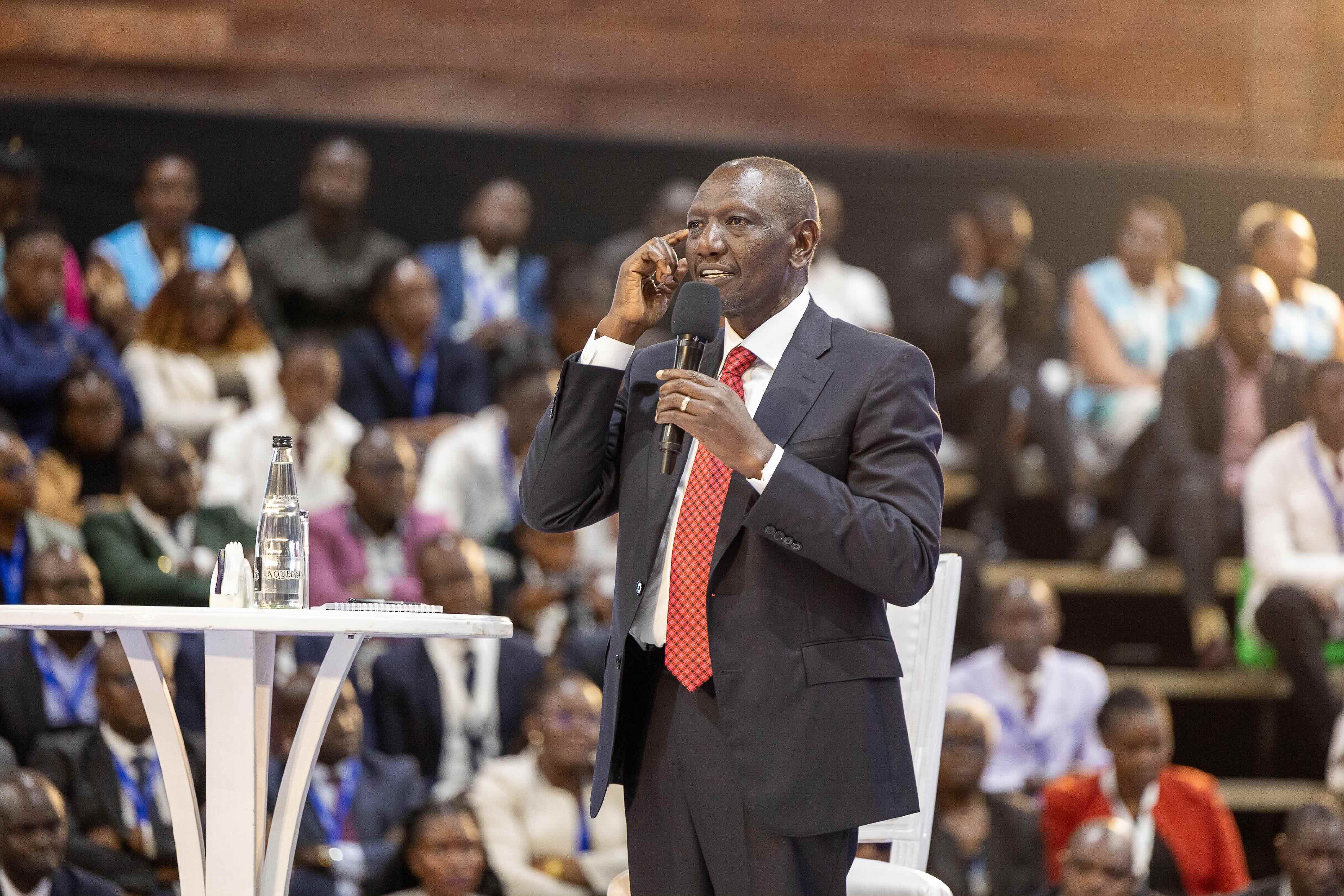
President William Ruto on Tuesday evening put Kenya's health reforms under the spotlight, using a presidential town-hall meeting at the Kenyatta International Convention Centre (KICC) to challenge health officials, county representatives and facility managers to demonstrate what has changed since the rollout of the Social Health Authority (SHA).
The town hall was held on the sidelines of the Presidential National Health Summit, which brought together national and county government officials, healthcare workers, health-facility managers, patients and other stakeholders to assess the country's progress towards Universal Health Coverage.
Unlike a conventional presidential address, the evening session was structured around questions and answers.
The President repeatedly called on officials from different parts of the country to explain how the reforms were working on the ground, while senior health officials supplied figures and operational data.

The discussion touched on SHA registration and financing, primary healthcare, medicines, health workers, digital health, emergency treatment, maternal healthcare, cancer care and the autonomy of public health facilities.
At one point, the President directly asked an Embu health official whether SHA was making a difference in the county.
The response offered one of the clearest examples of the government's argument that the new financing system is changing healthcare delivery.
The official said Embu County had experienced increased health-facility revenue, fewer medicine stock-outs and pharmaceutical refill rates of more than 80 percent. The official also said the county's pharmaceutical dispensing rate had reached 72 percent, meaning that 72 percent of patients were receiving their full prescriptions at the facility.
These figures were presented during the town hall and should be understood as claims from the county health administration rather than independently audited national statistics.
A health-facility manager from Nairobi similarly told the President that her facility had moved from receiving relatively limited funding to claiming more than KSh7 million under SHA, allowing it to purchase laboratory equipment and expand services.
Ruto's SHA defence

President Ruto said more than 32.3 million Kenyans were registered on the SHA platform, describing the system as a fulfilment of one of the commitments he made during the 2022 presidential campaign.
He said the government was also paying health contributions for 560,000 indigent households, representing about 2.2 million people, while teenage mothers were also being covered by the state.
The President linked the reforms to his original pledge that people unable to afford health insurance would have their costs covered by government.
He also defended the decision to replace the previous NHIF contribution structure with a system based on a percentage of income.
According to Ruto, Kenyans currently contribute 2.75 percent of salary or income under the new system.
He argued that the arrangement was more equitable because contributions were tied to ability to pay rather than a uniform fixed contribution.
From dispensaries to referral hospitals
A major theme of the town hall was the government's attempt to strengthen healthcare from the lowest level upwards.
Ruto said the reform programme was designed around the principle that dispensaries and health centres must function effectively if higher-level hospitals are to work efficiently.
He said health facilities at the lower levels were being given management structures and reimbursed for patients treated through SHA.
The government presented the Facilities Improvement Financing Act as another major component of the reforms.
Under the previous system, officials said, money was channelled through counties, leaving decisions about which facilities received funding for improvements to county-level structures.
Under the new model, facilities receive reimbursements directly, giving them greater autonomy over investments in medicines, equipment and infrastructure.
The town hall therefore presented a broader argument: that healthcare reform is not only about insurance but also about changing how money moves through the health system.
A digital health system at the centre of the reform
One of the most contentious exchanges involved Kenya's digital health infrastructure.
The President was asked about reports alleging a KSh104 billion digital-health contract.
Ruto rejected the characterisation, saying there was no KSh104 billion contract to purchase a digital-health system.
He said the government had instead adopted a model in which private-sector companies invest in technology and the government pays for services under agreed regulations.
The CEO of the Digital Health Authority told the President that the system involved a digital-health “superhighway” comprising 43 systems designed to support healthcare delivery.
He said the system includes patient identification, facility systems, health-worker verification, shared health records, logistics management, drug tracking, telemedicine and analytics.
The official said 42,327 digital devices had been supplied to health facilities, with the facilities themselves not paying for the devices.
He also said SHA had paid approximately KSh500 million for technology services over two years, rather than the much larger figure alleged in some reports.
These figures were government statements made during the town hall and would require independent verification before being presented as independently established facts.
Technology and SHA's claims-processing capacity
The Digital Health Authority also presented technology as a major explanation for the government's claimed efficiency gains.
Officials said the SHA inherited an organisation with approximately 1,737 employees but now operates with an establishment of about 815 workers.
The CEO said the Authority receives approximately 26,000 claims a day, amounting to close to one million claims a month, and that a claims-management team of about 35 people can process the claims using the digital system.
The official also said the digital system allows SHA to track individual claims, identify licensed facilities and health professionals, maintain shared health records and monitor potential fraud.
He said the AfyaYangu platform enables patients to view information such as claims, prescriptions and doctors through their phones.
The claims about efficiency and fraud reduction were made by the Digital Health Authority during the presidential session and should be independently tested before being treated as definitive evidence of system performance.
Emergency care without waiting for insurance status
Another significant announcement concerned emergency healthcare.
Ruto said the government had established the Emergency, Chronic and Critical Illness Fund and that emergency treatment would not be dependent on whether a patient was registered with SHA.
He said an emergency patient could receive treatment for the first 24 hours without first having to establish insurance membership.
Council of Governors' health committee chair Abdulswamad Shariff Nassir further explained that the emergency package was designed to cover treatment during the initial emergency period, after which patients would move into the appropriate SHA benefit arrangements.
The issue is particularly important in Kenya, where inability to pay has historically been associated with delays in accessing emergency care.
Maternal healthcare payments increased
Maternal healthcare was another major focus.
Ruto acknowledged that one of his 2022 commitments — providing diapers to mothers after delivery — had not yet been fully implemented.
However, he said the government had changed the maternity financing model and increased payments to facilities.
According to the President, normal deliveries that were previously reimbursed at lower rates would now attract KSh10,000, while Caesarean deliveries would attract KSh30,000 across public, private and faith-based facilities.
He said the intention was to equalise the reimbursement framework regardless of whether a mother delivered in a public, private or faith-based facility.
The President later gave a more specific timeline on the diapers pledge.
He said the benefit package under review was expected to incorporate diapers, with the review expected to be completed by the end of October.
Ruto said the government considered the diapers commitment among the final outstanding elements of its health pledges.
The diapers promise is still unfinished
The exchange over diapers became one of the most revealing moments of the town hall because the issue originated from Ruto's own 2022 campaign promises.
When moderator Dr Massi Kuro referred to the commitment and noted that she had not personally benefited from it after giving birth, Ruto acknowledged that the promise remained outstanding.
Later, he gave a clearer explanation, saying the provision of diapers would be incorporated into the revised health benefit package.
The President said the government had delivered 11 of 13 health commitments, with the remaining commitments still being addressed.
He said diapers would become part of the package covering mothers, children and households once the benefit-package review was completed.
That provides a much stronger story than simply saying Ruto “promised diapers”.
The actual news is that the President acknowledged the promise had not yet been fulfilled and gave a timeline for incorporating it into SHA's benefit package.
Counties report gains — but implementation remains uneven
County officials at the town hall offered varying experiences of the reforms.
Embu officials reported improved facility revenue, medicine availability and prescription fulfilment.
Mombasa Governor Abdulswamad Shariff Nassir said the county's SHA registration had reached 84 percent, correcting an earlier figure of 82 percent given during the discussion. He said the county considered this a major step towards universal health coverage.
Nairobi officials reported billions of shillings in SHA payments across public, private and faith-based facilities.
But the discussion also acknowledged that the system remains a work in progress.
Council of Governors representatives referred to transition problems and issues involving health-worker payments, while acknowledging that SHA had changed how county health facilities were financed.
The message emerging from the session was therefore more complicated than simply “SHA works” or “SHA does not work”.
The government presented evidence of increased registration, facility payments and digital processing, while county and health officials also acknowledged outstanding implementation challenges.
The bigger test
For the administration, the town hall provided an opportunity to argue that healthcare reform is moving from policy to implementation.
For Kenyans, however, the real test remains what happens at the facility level.
Can patients find medicines?
Can health facilities process claims quickly?
Can emergency patients receive treatment without first proving their ability to pay?
Can women access affordable maternity services?
Can cancer and chronic-disease patients obtain treatment without catastrophic financial costs?
And can the new digital infrastructure make healthcare more transparent without creating new barriers for patients?
Those questions remain at the heart of Kenya's Universal Health Coverage debate.
The President ended the session by arguing that leaders should be judged against the commitments they make and the results they deliver.
For the health reforms introduced under his administration, Tuesday night's town hall provided both a government scorecard and a list of promises still awaiting delivery.
Related Stories
- Ruto Challenges Claims of SHA Payment Delays at Karen Hospital, Orders Live Check of Claims
- Why Are More Kenyans Dying Suddenly From Heart Problems?
- Fake Postinor-2 alert: PPB warns women over suspect batch
Category: Health · Related Topic: William Ruto
About the Author
Angel Wairimu is a media specialist and Communication and Multimedia graduate with a passion for digital media and content creation. Her areas of interest include scriptwriting, voice-over, content production, anchoring, videography and graphic design. She is passionate about using her creative skills to tell engaging stories while continuously learning and growing in the media industry. Email: angelicawairimumaina@gmail.com LinkedIn: Angel Wairimu
 Facebook
 Twitter / X
 WhatsApp
 LinkedIn
 Telegram
 Reddit