
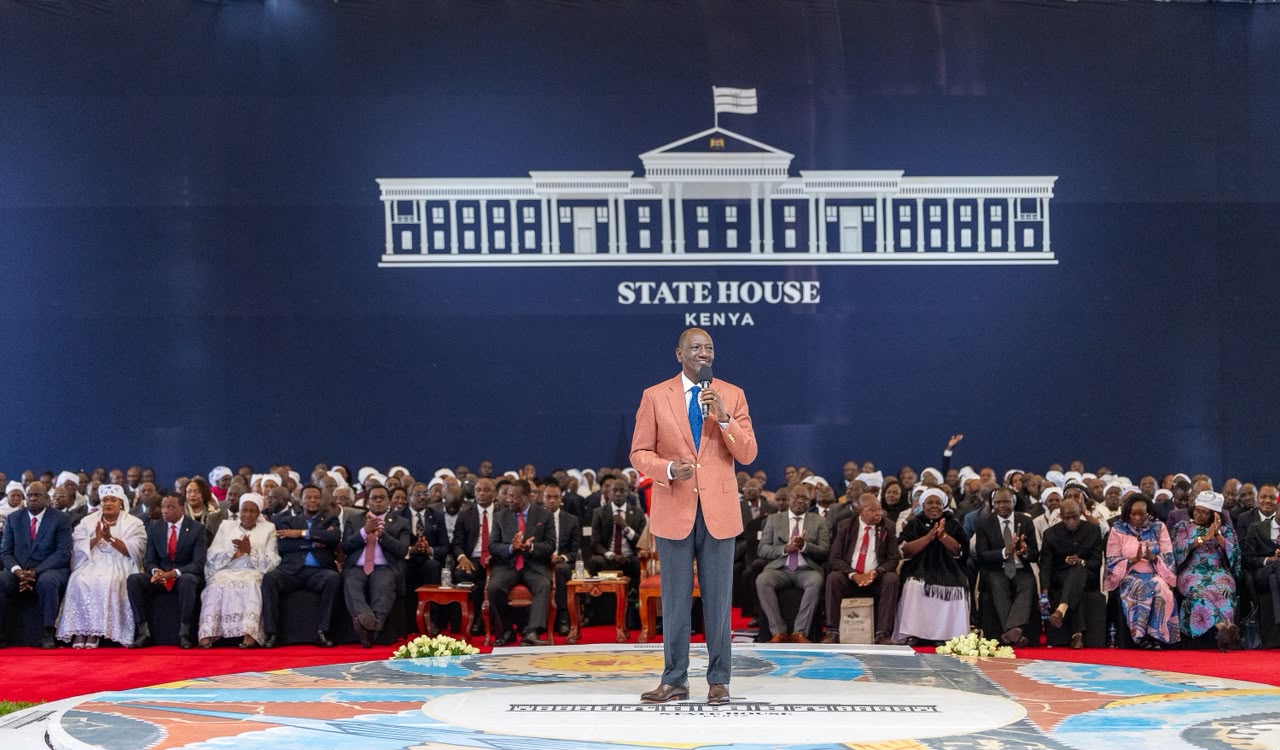
NAIROBI, Kenya — The relationship between Kenya's Government and the Friends Church could be entering a new phase after thousands of Quakers from across the country and abroad gathered at State House, Nairobi, for a high-level meeting with President William Ruto.
The August 3 gathering brought together more than 6,000 members of the Friends Church, commonly known as Quakers, according to organisers and officials quoted in reports about the event. More than 200 buses reportedly transported members from different parts of Kenya, alongside representatives from the international Friends community.
Beyond the symbolism of bringing a major faith community to the seat of government, the meeting placed renewed attention on the role of faith-based organisations in Kenya's national development.
The central question now is whether Monday's engagement will translate into concrete partnerships—or remain primarily a symbolic show of goodwill.

The Government and the Friends Church said the meeting would provide a basis for closer cooperation in areas including peacebuilding, education, social development, youth empowerment and community service.
Why the State House meeting matters
The Friends Church has maintained a long presence in Kenya and has established institutions and programmes in sectors that extend beyond religious worship.
Its contribution has included work in education, healthcare, humanitarian assistance and peacebuilding, making the Church an important actor in communities where government services may not always reach effectively.
The State House meeting therefore carries significance beyond the gathering itself.
For the Government, working with established faith-based organisations offers a potential avenue for reaching communities through trusted local networks. For the Church, direct engagement with the Presidency provides an opportunity to raise issues affecting its members and the wider communities in which it operates.
The challenge will be moving from broad declarations of partnership to measurable programmes with clear responsibilities, funding and timelines.
Mudavadi: Government sees Church as a partner in nation-building
Prime Cabinet Secretary and Cabinet Secretary for Foreign and Diaspora Affairs Musalia Mudavadi, who described himself as a lifelong and proud Quaker, welcomed the delegation to State House.
Mudavadi said the meeting reflected the importance of cooperation between government institutions and faith communities in addressing national challenges.
He highlighted the Friends Church's values, captured in the acronym SPICES—Simplicity, Peace, Integrity, Community, Equality and Stewardship—as principles that can contribute to ethical leadership and responsible public service.
The Prime Cabinet Secretary also pointed to the Church's role in praying for the country, advising leaders and promoting reconciliation, justice and peace.
He said the Government's development priorities, including job creation, food security, universal healthcare, affordable housing, digital innovation and the empowerment of young people, women and entrepreneurs, could benefit from continued collaboration with faith-based organisations.
But the meeting did not announce specific new projects, funding commitments or formal agreements in the material available for this report.
That leaves the next phase of the relationship to be defined by what follows.
From symbolism to action: What happens next?
The immediate significance of the meeting will likely be measured by whether the Government and the Friends Church establish practical mechanisms for continued engagement.
Potential areas of cooperation identified during the meeting include:
-
Education: Strengthening access to learning and supporting institutions serving communities across Kenya.
-
Healthcare: Expanding community-level health initiatives and outreach.
-
Peacebuilding: Supporting dialogue, reconciliation and conflict prevention.
-
Youth empowerment: Creating opportunities for skills development, entrepreneurship and employment.
-
Social development: Working with communities on poverty reduction and social welfare.
-
Ethical leadership: Promoting integrity, accountability and peaceful coexistence.
The Government's engagement with faith-based organisations also comes at a time when religious institutions continue to play an influential role in public life, from social services to peace campaigns and national conversations.
The effectiveness of this partnership will ultimately depend on whether future engagements produce specific programmes and outcomes that can be independently assessed.
The Quaker connection to Kenya's public life
The Friends Church has a particularly deep historical footprint in Kenya.
Quaker missionaries arrived in the country in the early 20th century, and the movement subsequently became associated with the establishment of schools and other institutions, particularly in western Kenya.
Over the decades, Friends organisations have expanded their work beyond evangelism into education, healthcare, development and humanitarian activities.
That history helps explain why the Church remains an important institution in many Kenyan communities.
The Quaker tradition is also known for values including peace, equality, integrity and community service. These principles featured prominently in the message delivered at State House, where the Government presented the Church as a partner in efforts to strengthen social cohesion and national development.
A meeting with a wider political and social message
The State House engagement also carries a broader message about the relationship between government and organised religion.
Kenya's faith communities have historically been involved in peacebuilding and public-interest initiatives, particularly during periods of political tension and social conflict.
The Government's decision to engage the Friends Church at State House can therefore be viewed as part of a wider effort to maintain dialogue with influential social institutions.
However, such relationships can also raise questions about the independence of religious organisations and the need to ensure that partnerships with government remain focused on public interest rather than partisan politics.
For the Friends Church, the opportunity will be to maintain its identity and values while contributing constructively to national development.
For the Government, the test will be whether the engagement leads to practical cooperation that benefits communities beyond the symbolism of a State House gathering.
Unity takes centre stage
The meeting ended with prayers for Kenya and calls for national unity.
Quoting Psalm 133:1, Mudavadi urged Kenyans to embrace unity as the country pursues its development ambitions.
The message was consistent with the central theme of the gathering: that national development cannot be achieved by government alone.
The next chapter, however, will depend on what happens after the cameras leave State House.
If the Government and the Friends Church establish structured programmes in education, peacebuilding, healthcare, youth empowerment and community development, Monday's gathering could become the beginning of a lasting institutional partnership.
If not, it may be remembered primarily for its symbolism.
For now, the meeting has opened the door. The real measure of its significance will be the work that follows.
Related Stories
- Queenter Mbori Appointed to Global Cyber Safety Advisory Council
- Kenyan man detained by ICE after church service: What the video reveals about his US immigration case
- Rosemary Koech death: Autopsy confirms suicide as family reveals she faced personal and financial difficulties
Category: News · Related Topic: William Ruto
Related Video: Gachagua’s explosive Ruto scorecard: Debt, taxes, State capture and a government ‘that has failed’
Related Explainer: Kenya’s inflation holds near 30-month high as transport and food costs squeeze households
About the Author
Eugene Stephen Were, popularly known as Steve O’clock, is a Kenyan journalist, digital media specialist and multimedia storyteller. He holds a Bachelor of Arts in Journalism and Digital Media from Murang’a University of Technology, with expertise in news reporting, environmental journalism, digital content, photography, videography and film production. Contact & Social Media: Phone: +24795699374 | Facebook: https://www.facebook.com/share/1BhhxUAYmk/ | Instagram: https://www.instagram.com/steve_oclock__mwenyewe | TikTok: https://www.tiktok.com/@oclockcityc.e.o?_r=1&_t=ZS-98czWCBnRxg
 Facebook
 Twitter / X
 WhatsApp
 LinkedIn
 Telegram
 Reddit