
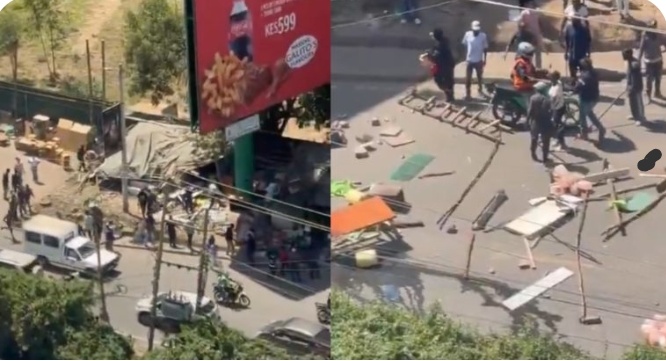
NAIROBI, Kenya — Traffic along Argwings Kodhek Road in Kilimani was disrupted on Tuesday after traders protested the demolition of temporary shops and structures near Chaka Place by Nairobi City County enforcement officers.
The demolition operation triggered a confrontation with traders, who moved onto the road and barricaded sections of the busy route with metal structures and burning tyres. The disruption left motorists and motorcycle riders stranded on both sides of the road as tensions escalated.
Footage published by Kenyans.co.ke showed a large number of county officers demolishing the structures, with several arrests also being made during the operation. Those arrested were seen being placed in a county truck as the demolition continued.
Police vehicles were later deployed to the area as security officers sought to contain the protests and restore traffic flow.

The incident has now raised a wider question about how Nairobi is enforcing regulations against informal businesses, and whether affected traders are being given adequate notice and alternative locations before their businesses are removed.
County says it is clearing illegal structures
The Argwings Kodhek operation comes as Nairobi County intensifies enforcement against temporary structures, unauthorised vending and businesses occupying spaces considered to be public or improperly used.
The county has previously carried out operations targeting hawkers, stalls and other structures along major streets, including Moi Avenue and Tom Mboya Street. The administration has also been targeting unregulated food kiosks and structures that officials say violate health, safety and public-space regulations.
But the latest confrontation illustrates the difficult balance facing City Hall.
For the county, clearing road reserves, walkways and other public spaces is part of urban management and enforcement. For traders, however, the structures being removed represent businesses and daily sources of income.
The immediate question emerging from Argwings Kodhek is therefore whether enforcement is being matched by a clear relocation or transition plan.
County points to new markets
The county's broader strategy reportedly includes the development of modern markets in areas such as Kasarani, Westlands and South B, which could provide formal trading spaces for some informal traders.
However, it remains unclear whether the traders whose businesses were demolished at Chaka Place had been offered specific alternative spaces before Tuesday's operation.
That distinction could prove important as Nairobi expands its enforcement campaign.
If traders are removed from illegal or unauthorised spaces without alternatives, the immediate effect may simply be to push informal businesses into other parts of the city. If relocation spaces are available but traders do not use them, the county's enforcement case becomes stronger.
For now, the circumstances surrounding notice, consultation and possible relocation at Chaka Place remain unclear.
A pattern beyond Argwings Kodhek
Tuesday's events are also part of a much larger pattern of demolitions affecting informal traders in Nairobi.
In February, the Kenya National Highways Authority (KeNHA) demolished kiosks and other structures along the Thika Superhighway in Githurai. The operation targeted structures erected on the road reserve and was accompanied by a police deployment after traders protested.
KeNHA subsequently moved to Roysambu, where roadside kiosks and stalls around the roundabout were demolished as part of efforts to reclaim road reserves and improve road safety and traffic movement.
The situation has also played out at Gikomba Market.
In March, a section of Gikomba was demolished as part of a wider operation involving structures near the Nairobi River. Traders protested after finding their stalls destroyed and goods scattered. In that case, authorities had linked the operation to riparian-land clearance and flood mitigation, while traders questioned aspects of the relocation plans.
The Gikomba case is particularly significant because it demonstrates that the dispute is not simply about roadside kiosks. It extends to some of Nairobi's largest informal trading centres, where thousands of people depend on daily commerce.
The bigger battle over Nairobi's informal economy
Nairobi's redevelopment and enforcement drive is increasingly bringing City Hall into direct conflict with the informal economy.
The county wants to reclaim public spaces, improve traffic flow, enforce planning rules and create a more organised city. Traders, meanwhile, argue that demolitions can destroy businesses overnight, particularly where alternative trading spaces are not readily accessible.
The two positions are not necessarily mutually exclusive.
The challenge is whether Nairobi can enforce its planning and public-space rules while giving traders a realistic path into the formal market system.
Tuesday's confrontation at Argwings Kodhek Road therefore leaves the county with questions beyond restoring traffic.
Where will the affected traders go? Were they given sufficient notice? Were alternative spaces offered? And what mechanisms exist for traders to challenge or appeal enforcement decisions before their businesses are demolished?
Those questions could determine whether the latest crackdown becomes another cycle of demolition, protest and displacement—or part of a more structured transition from informal roadside trading to regulated markets.
For now, the barricades on Argwings Kodhek Road may have been cleared, but the underlying dispute between urban regulation and the livelihoods of Nairobi's informal traders remains unresolved.
Related Stories
- Queenter Mbori Appointed to Global Cyber Safety Advisory Council
- Kenyan man detained by ICE after church service: What the video reveals about his US immigration case
- Rosemary Koech death: Autopsy confirms suicide as family reveals she faced personal and financial difficulties
Category: News
Related Explainer: Kenya’s inflation holds near 30-month high as transport and food costs squeeze households
About the Author
Angel Wairimu is a media specialist and Communication and Multimedia graduate with a passion for digital media and content creation. Her areas of interest include scriptwriting, voice-over, content production, anchoring, videography and graphic design. She is passionate about using her creative skills to tell engaging stories while continuously learning and growing in the media industry. Email: angelicawairimumaina@gmail.com LinkedIn: Angel Wairimu
 Facebook
 Twitter / X
 WhatsApp
 LinkedIn
 Telegram
 Reddit