
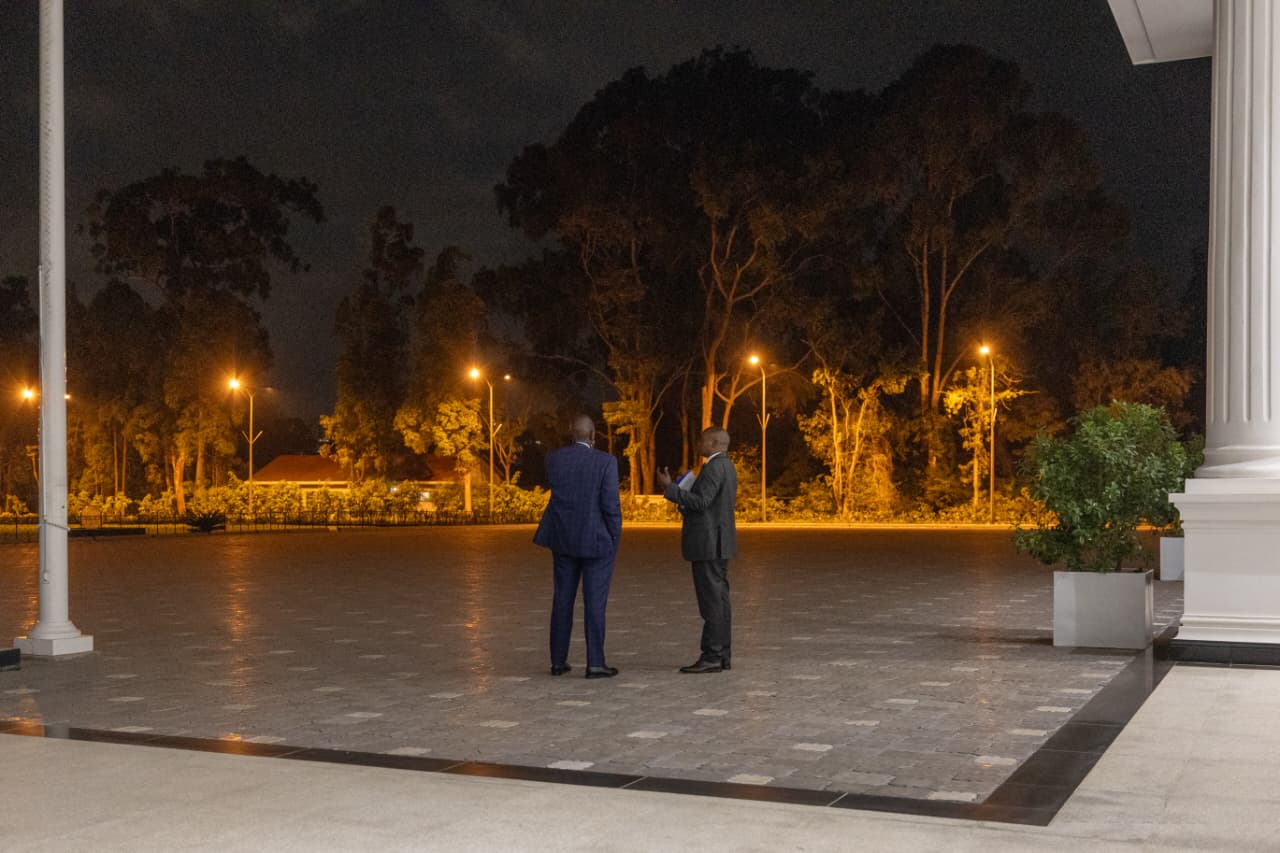
President William Ruto and his deputy, Kithure Kindiki, are facing renewed political scrutiny after a surprise State House meeting held on Tuesday night, coming just days after the ruling United Democratic Alliance (UDA) suffered a bruising defeat in the Ol Kalou parliamentary by-election.
Photographs released by State House showed the President and his deputy in discussions at State House, Nairobi. However, no official statement disclosed what the two leaders discussed. The images, widely circulated online, prompted intense political speculation, with some commentators focusing on what they described as restrained or serious body language between the two leaders. While such interpretations remain subjective and cannot establish the nature of the meeting, the timing has inevitably attracted attention amid growing political pressure.
The meeting comes against the backdrop of mounting reports in Kenyan media suggesting unease within the Kenya Kwanza administration following UDA's loss in Ol Kalou—an outcome many analysts view as a symbolic setback in the politically significant Mt Kenya region.
A by-election with national consequences
Ol Kalou was never just another parliamentary contest.
The seat became the first major electoral test of political influence in Mt Kenya since former Deputy President Rigathi Gachagua intensified efforts to consolidate support through his Democratic Change Party (DCP), positioning himself as President Ruto's principal challenger in the region ahead of the 2027 General Election.
Political analysts had framed the contest as a referendum on competing claims to Mt Kenya's political loyalty, with Deputy President Kindiki expected to play a central role in defending the government's standing in the region.
The defeat has therefore raised uncomfortable questions for the Kenya Kwanza administration—not only about UDA's electoral machinery but also about whether Kindiki has succeeded in filling the political vacuum left by Gachagua's departure from government.
Questions over Kindiki's political capital
Since assuming office as Deputy President in late 2024, Kindiki has sought to project himself as a unifying figure focused on development rather than political confrontation.
His appointment was widely viewed as President Ruto's strategy to retain influence in Mt Kenya after the impeachment of Rigathi Gachagua.
Yet the Ol Kalou result has reignited debate over whether administrative performance alone can translate into political mobilisation in one of Kenya's most influential voting blocs.
Several local media outlets have reported growing anxiety within sections of government over whether the Deputy President has been able to consolidate grassroots support quickly enough ahead of 2027.
Standard report points to growing tensions
The latest speculation follows an analysis by The Standard, which suggested Deputy President Kindiki has increasingly found himself navigating internal political headwinds while attempting to strengthen the government's position in Mt Kenya.
The report argues that the Ol Kalou defeat has intensified pressure within Kenya Kwanza, with some leaders privately questioning campaign strategy and regional political messaging.
Although neither State House nor the Deputy President's office has publicly acknowledged any disagreement between President Ruto and Kindiki, the absence of official details regarding Tuesday night's meeting has fuelled further speculation.
Silence from State House
State House released photographs of the meeting but offered no explanation of its agenda.
Such meetings between a President and Deputy President are routine and do not necessarily indicate political differences.
However, the decision not to issue even a brief summary has left room for competing political interpretations at a time when government leaders are under pressure to reassure supporters following the Ol Kalou defeat.
More than personalities
Beyond questions about the relationship between President Ruto and his deputy lies a broader political challenge.
The Ol Kalou outcome has strengthened perceptions that Mt Kenya is becoming a fiercely contested political battleground once again, with opposition figures sensing an opportunity to erode Kenya Kwanza's traditional support base.
Political observers note that by-elections often become indicators of shifting public sentiment rather than reliable predictors of general elections. Nevertheless, symbolic defeats can alter political momentum, reshape coalition calculations and embolden rivals.
Looking ahead
Whether Tuesday night's State House meeting was simply a routine consultation or part of a wider political recalibration remains unknown.
For now, there is no public evidence of a rupture between President Ruto and Deputy President Kindiki. Equally, there is little doubt that the Ol Kalou by-election has intensified political scrutiny of Kenya Kwanza's standing in Mt Kenya.
With less than two years before the 2027 General Election, every electoral setback is likely to be examined not merely for what it says about a single constituency, but for what it reveals about the changing balance of political power across Kenya.
 Facebook
 Twitter / X
 WhatsApp
 LinkedIn
 Telegram
 Reddit