
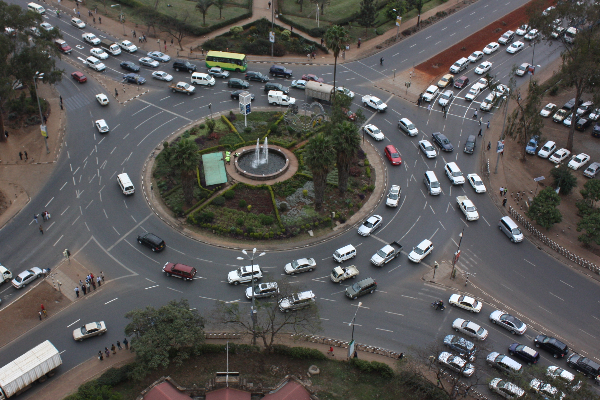
Nairobi is betting on technology — and South Korean backing — to ease its chronic traffic jams.
City officials say a new smart traffic management system will soon coordinate signals at 25 key junctions, marking the first phase of a wider plan to modernise how vehicles move through the capital.
The project includes the construction of a Traffic Management Centre and an Integrated Transport System headquarters. Samsung Construction will lead the works, integrating automated controls and digital monitoring tools.
“Samsung Construction is building a Traffic Management Centre as well as an Integrated Transport System headquarters that will coordinate traffic lights in 25 junctions across Nairobi,” the governor said following talks at City Hall.
The announcement came after a courtesy visit by South Korea’s Ambassador to Kenya, Kang Hyung-shik. The meeting focused on expanding bilateral cooperation, with transport taking centre stage.
A city under strain
Few issues unite Nairobi residents like traffic. Long queues at major junctions, especially during rush hour, can stretch for kilometres. Delays cost commuters hours each week and raise fuel bills in a city already grappling with high living costs.
Officials say the smart system will allow real-time monitoring of traffic flow and faster adjustments to signals. If successful, coverage will expand to 65 junctions in later phases.
The county government argues that better coordination could reduce congestion and improve road safety. Yet some urban planners caution that signal upgrades alone will not solve deeper challenges, including rapid urban growth and limited public transport options.
Beyond traffic lights
The transport upgrade is part of a broader partnership between Nairobi and Seoul.
South Korea is also expected to finance Line 5 of Nairobi’s Bus Rapid Transit (BRT) network, linking the city centre to Jomo Kenyatta International Airport, pending approval of the national budget. Officials say the line could ease pressure along Mombasa Road, one of the capital’s busiest corridors, and help address drainage problems that worsen flooding.
The two countries have deepened ties in recent years. At Konza Technopolis — often called Kenya’s “Silicon Savannah” — Korea has supported technology and innovation initiatives, including the establishment of offices for the International Vaccine Institute.
In agriculture, Korea has worked with the Kenya Agricultural and Livestock Research Organisation on the K-Rice project, introducing high-yield rice varieties such as Ukafasi 39 and ISRIS 6 and 7. The aim is to strengthen food security and adapt crops to local conditions.
Trade has also grown. Kenya exports coffee, titanium ore and scrap copper to Korea, while recent commercial agreements between the two countries have been valued at about Ksh 120 billion, according to government figures.
Looking ahead
Officials say the partnership aligns with Kenya’s Bottom-Up Economic Transformation Agenda, particularly in industrialisation and green growth.
For Nairobi residents, however, the immediate test will be simpler: whether traffic lights stay in sync, and whether the daily commute becomes less punishing.
If the first 25 junctions show results, the city’s streets may begin to move a little more freely.
 Facebook
 Twitter / X
 WhatsApp
 LinkedIn
 Telegram
 Reddit