
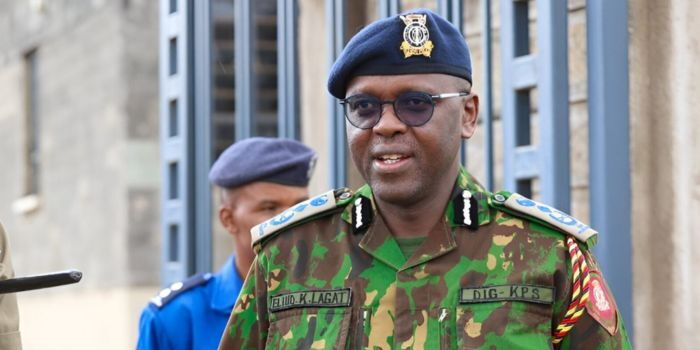
Kenya’s National Police Service Commission (NPSC) says it cannot suspend Deputy Inspector General of Police Eliud Lagat, arguing it lacks the legal authority to act without a formal request from the Inspector General.
This comes amid growing public pressure over Lagat’s connection to the death of teacher and blogger Albert Ojwang, who died in police custody last month.
In a court filing responding to a lawsuit by activist Eliud Matindi, NPSC CEO Peter Kiptanui Leley said Lagat, who also serves as a commissioner within the NPSC, falls under a separate legal framework.
“The DIGs are members of the National Police Service under the command of the IG,” Leley said, “but their command, control and administration powers are clearly outlined in Section 8A of the NPSC Act.”
He added that unless the Inspector General — currently Douglas Kanja — formally recommends disciplinary action, the commission has no legal ground to act.
Matindi is suing the commission for failing to suspend Lagat, who had reportedly stepped aside pending investigations into Ojwang’s death. Lagat, however, has denied stepping down and maintains he is simply on leave.
Ojwang died on 8 June while in custody at Central Police Station in Nairobi. He had been arrested by the Directorate of Criminal Investigations following a cyberbullying complaint allegedly filed by Lagat.
Leley, in the court documents, said the relevant sections of the law — particularly Sections 88 and 89 of the NPSC Act and the Service Standing Orders — define how discipline should be handled within the police service. However, he stressed that broader issues such as alleged abuse of police power could fall under criminal or civil proceedings rather than disciplinary action.
“The commission recognises that NPS officers serve within a national security organ. Where abuse of power is suspected but does not amount to a disciplinary offence, other mechanisms — including criminal investigation — may apply,” Leley said.
He noted that Parliament had already raised questions over Ojwang’s death, and that the NPSC was aware that official investigations were still ongoing.
“The commission is bound to wait for the relevant investigative bodies to conclude their work,” he added, “before making any decision on disciplinary action against any officer named.”
Leley also made it clear that under Section 10 of the NPSC Act, the commission itself is not authorised to conduct criminal investigations but can act on the findings of other oversight bodies, including the Internal Affairs Unit and the Independent Policing Oversight Authority (IPOA).
Until those investigations are complete, the commission insists its hands are tied. Still, the case has intensified scrutiny of police accountability in Kenya — especially when senior officers are involved.