
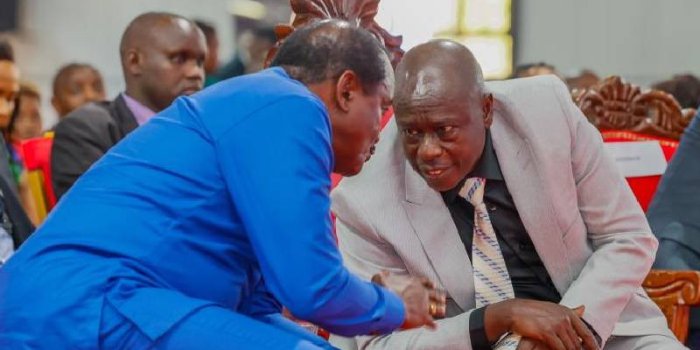
Former Deputy President Rigathi Gachagua is seeking to deepen his political alliance with Wiper leader Kalonzo Musyoka, in a move that could reshape opposition calculations ahead of Kenya’s 2027 presidential election.
Gachagua, who leads the Democracy for Citizens Party (DCP), called for a formal partnership between his party and Wiper Patriotic Front following talks with senior officials from the two parties at his Wamunyoro residence in Nyeri County.
Rather than negotiating separately within the wider United Opposition, Gachagua wants DCP and Wiper to first establish a common position.
“I propose DCP and Wiper to form a partnership first, then we talk to others,” he said.

The proposal comes as opposition parties face increasing pressure to settle on a single presidential candidate capable of challenging President William Ruto in 2027.
A new political equation
Gachagua's appeal to Kalonzo is part of a wider attempt to bring together communities from the Mount Kenya region and Ukambani under what he describes as a “cousins” movement.
The former deputy president argues that the Kamba, Kikuyu, Meru, Embu and Mbeere communities share historical and cultural links and could exercise greater political influence if they coordinate their voting power.
“This mountain family is coming together,” Gachagua told supporters, arguing that electoral success ultimately depends on numbers.
“To be president you must be elected. To be elected you must have majority votes. For you to have the majority, numbers have to be mobilised,” he said.
He described the emerging alliance as a potentially powerful political machine.
“My dream has come true. By coming together of Mt Kenya South and Mt Kenya East and West we now have a huge political machine that will shake and shape this country,” he said.
The strategy marks a significant shift in the political relationship between the Mount Kenya region and Kalonzo, a veteran opposition politician who has unsuccessfully sought the presidency in previous elections.
Why Kalonzo matters
Kalonzo's potential role in the emerging opposition alliance could be crucial.
The former vice-president has a substantial political base in Ukambani and has remained one of the better-known figures within the opposition camp.
Gachagua's public endorsement of Kalonzo also appears designed to strengthen his standing in negotiations over the United Opposition's presidential ticket.
“Tell Dr Kalonzo Musyoka we love him and we respect him very much,” Gachagua told the joint delegations.
Former Attorney General Justin Muturi has also indicated support for Kalonzo as a potential opposition presidential candidate if he does not secure the nomination himself.
That places Kalonzo in a stronger negotiating position as opposition parties attempt to agree on who should face Ruto.
The battle for Mount Kenya
The proposed alliance could also intensify competition within the Mount Kenya political landscape.
Gachagua has positioned himself as a leading figure in the opposition's efforts to consolidate the region's vote, while government-aligned politicians are attempting to maintain support for the Kenya Kwanza administration.
Deputy President Kithure Kindiki and Public Service Cabinet Secretary Geoffrey Ruku are among those seeking to strengthen the government's influence in the region.
The contest is particularly significant because Mount Kenya remains one of the country's largest voting blocs.
For Gachagua, however, the strategy extends beyond the Kikuyu heartland.
His “cousins” argument seeks to create a broader political constituency linking Mount Kenya West, Mount Kenya East and Ukambani.
From cultural identity to political strategy
The idea draws on historical and cultural links among the communities.
Gachagua has increasingly used the concept of shared ancestry to encourage political cooperation between the Kamba and the communities of Mount Kenya.
The political use of the “cousins” narrative has attracted attention because it transforms cultural connections into a potential electoral coalition.
But it also raises a fundamental question about the future of Kenyan politics: will regional alliances based on shared identity determine the 2027 contest, or will voters prioritise national policy, economic performance and individual leadership?
That question is likely to become more important as political parties begin formalising their alliances.
Opposition faces its biggest test
The emerging DCP-Wiper partnership comes at a difficult moment for the United Opposition.
Opposition leaders have been under growing pressure to identify their presidential candidate and running mate well before the campaign enters its final phase.
Yet disagreements remain over how the candidate should be selected, when the decision should be made and how the various parties will share political influence.
The emergence of a DCP-Wiper bloc could therefore complicate negotiations with other opposition parties and presidential hopefuls.
Among those who could be affected are former Cabinet Secretary Peter Munya of the Party of National Unity, former Attorney General Justin Muturi of the Democratic Party, Martha Karua's People's Liberation Party and former Cabinet Secretary Fred Matiang'i's Jubilee Party.
Each has interests in the broader opposition coalition and political constituencies that overlap with the emerging regional alliance.
One region, one party?
DCP has increasingly promoted the slogan of “one region, one party and one leader”, a strategy that has unsettled some political competitors.
The approach gained additional momentum following the party's victory in the Ol Kalou by-election, which Gachagua's supporters have portrayed as evidence of growing political influence.
But attempts to consolidate a region behind one political vehicle are likely to face resistance from rival parties and leaders who have their own ambitions for 2027.
The DCP-Wiper talks therefore represent more than an alliance between two parties.
They are part of a broader struggle over who will control the political arithmetic of Mount Kenya and Ukambani — and ultimately who will have the strongest bargaining position when the United Opposition chooses its presidential candidate.
For Gachagua, bringing Kalonzo closer could provide the bridge between two historically distinct political constituencies.
For Kalonzo, the partnership could offer a route to a stronger national coalition.
And for the wider opposition, it could either provide the foundations of a formidable electoral alliance or add another layer of complexity to an already crowded race for the 2027 ticket.
Related Stories
- From music to politics: Samidoh sets sights on Ol Joro Orok seat
- Owalo Pitches ‘Third Liberation’ as He Takes Aim at Tribal Politics and Kenya’s Old Political Order
- Eliud Owalo Condemns Political Violence, Calls for Protection of Constitutional Rights Ahead of 2027
Category: Politics · Related Topic: 2027 Elections
Related Video: Gachagua’s explosive Ruto scorecard: Debt, taxes, State capture and a government ‘that has failed’
 Facebook
 Twitter / X
 WhatsApp
 LinkedIn
 Telegram
 Reddit