
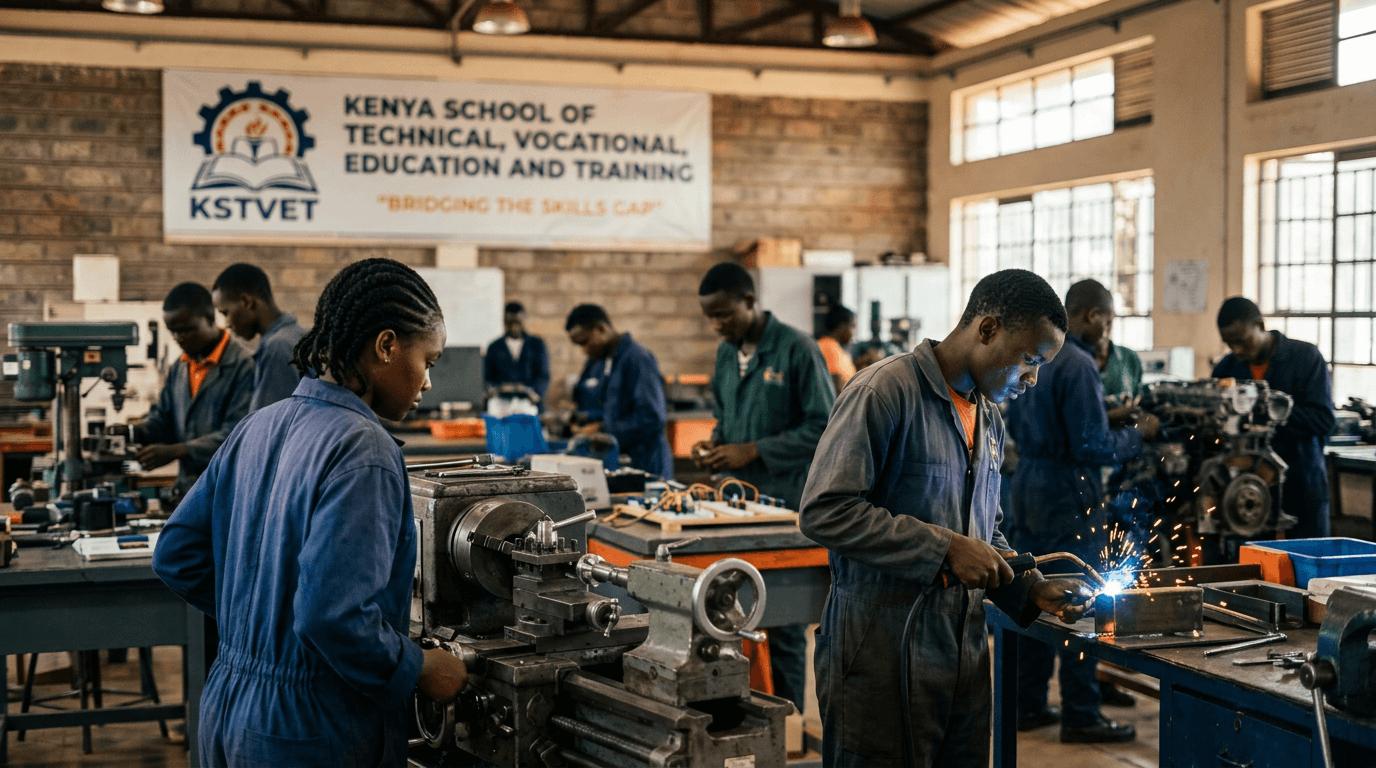
KAKAMEGA, Kenya — At the construction site of the new Matungu Technical and Vocational College, the promise of education is already reaching beyond the classroom.
The college is still being built. Yet for young people in the surrounding community, its economic impact has already begun.
Construction workers have found jobs at the site. Women are earning from preparing food for workers. Small traders are seeing more customers.
For residents, however, the bigger hope is what happens when the college opens its doors.

Joseph Odunga, a Form Four leaver from Matungu, says the institution could give young people an opportunity to pursue further training without having to leave their home county.
He says the construction has already created income for some residents, while the completed college could create a much wider pool of opportunities.
Courses in areas such as electrical engineering, catering and other technical disciplines could give young people skills they can take directly into the labour market — or use to start their own businesses.
That shift is increasingly important in a region where finishing school does not always guarantee a job.
A different route after secondary school
For years, academic qualifications have often been seen as the main route to a successful career.
But that picture is changing.
Technical and vocational education is offering another route. Learners can train in areas ranging from electrical and electronics technology to plumbing, motor vehicle mechanics, ICT, food processing and fashion design. The Technical and Vocational Education and Training Authority maintains a national register of approved institutions and courses.
Across Western Kenya, institutions such as Kitale National Polytechnic, Bungoma National Polytechnic, Sigalagala National Polytechnic and Kaimosi Friends National Polytechnic are part of a growing skills-training network.
The appeal is simple.
A young person does not necessarily have to wait for a white-collar job after graduation. A trained plumber can work independently. An electrician can build a client base. A mechanic can open a garage. A person trained in ICT can offer services locally or work remotely.
Godfrey Nyangule, a resident, believes this practical approach could help young people become more self-reliant.
He points to trades such as plumbing as examples of skills that can provide a livelihood without requiring a conventional office job.
The college effect can reach an entire community
The benefits of an education institution do not stop at its gates.
When a college opens, students and staff need food, accommodation, transport, banking and mobile-money services. They buy stationery, clothes and other goods.
That can create a small economy around the institution.
Nyangule expects the Matungu project to increase activity around Nambereka once the college becomes operational.
Shopkeepers and food vendors could gain new customers. M-Pesa businesses could see more transactions. Farmers could find a nearby market for milk, vegetables and other produce.
It is a reminder that education infrastructure can become economic infrastructure too.
A college may be built to train students, but the spending generated around it can support households that have never set foot inside a classroom.
Kenya’s TVET expansion is gathering pace
The Matungu project is part of a wider national push to expand technical and vocational training.
The Ministry of Education says the number of TVET institutions rose from 2,401 in the 2022/23 financial year to 2,969 in 2024/25. Over the same period, enrolment increased by 63.8 per cent to 565,842 trainees.
The government is now planning further investment in infrastructure, trainers, digital learning and links between colleges and industry.
That last part could prove critical.
Training young people is only half the equation. They also need opportunities to apply what they have learnt.
Kenya’s TVET authorities have been working with the International Labour Organisation on areas including industrial attachment, dual training, competency-based education and recognition of prior learning.
The aim is to make training more closely connected to the world of work.
The challenge is turning training into jobs
There is, however, a caution behind the optimism.
More colleges and more trainees do not automatically translate into employment.
The Ministry of Education's latest TVET sector report identifies persistent shortages of trainers, funding constraints and weak links between some institutions and industry. It says the trainer-to-trainee ratio in the sector remains well above the recommended level.
That means the success of projects such as Matungu will ultimately be measured by more than the number of classrooms constructed.
Young people will want to know what happens after graduation.
Can they find work? Can they access equipment and finance to start businesses? Are local employers willing to take them on? Can farmers, manufacturers and other businesses help shape the courses being taught?
Those questions will determine whether education investment becomes a lasting economic opportunity or simply another set of buildings.
Keeping opportunity closer to home
For families in Western Kenya, proximity matters.
A college in the local community can reduce the cost of accommodation and travel. It can allow young people to train while remaining close to their families. It can also make it easier for local businesses to benefit from a newly skilled workforce.
The wider education reforms are creating more pathways for learners, from conventional academic routes to competency-based and technical training.
For Western Kenya's young people, the opportunity is increasingly about choice.
The goal is not to make every learner follow the same path.
It is to ensure that a young person who wants to become an engineer, electrician, chef, mechanic, farmer, ICT specialist or entrepreneur has a realistic route to get there.
At Matungu, that future is still taking shape behind construction walls.
But for residents watching the college rise, the hope is already clear: education should not only prepare young people to look for opportunities elsewhere. It should help create opportunities where they live.

Related Stories
- Who Was Gloria Sekeiyan Khalwale? A Mother of Eight Remembered After Sudden Death
- Mudavadi urges Kenyans to distinguish popular leaders from populists
- AI, smartphones and survival: Inside Nairobi’s changing street photography business
Category: Education · Related Topic: Social Health Authority (SHA)
About the Author
Maureen Onyango is a journalist passionate about storytelling, life coaching and spiritual lessons. She studied at the Kenya Institute of Management and enjoys telling stories that inform, inspire and empower communities.
 Facebook
 Twitter / X
 WhatsApp
 LinkedIn
 Telegram
 Reddit