
NAIROBI, Kenya – A landmark High Court ruling has reignited debate over Kenya's constitutional election calendar after the court declared that the next presidential election ought to have been held in August 2026, not 2027. However, the court stopped short of ordering an immediate election, suspending the legal effect of its declaration to avoid plunging the country into a constitutional and administrative crisis.
The judgment, delivered by Justice Mugure Thande in Malindi on Friday, centres on the interpretation of Article 136(2)(a) of the Constitution, which provides that a presidential election shall be held on "the second Tuesday in August, in every fifth year."
The court held that the phrase "in the fifth year" means the election must take place during the fifth year following the previous presidential election—not after the fifth year has expired. Since the last General Election was held on August 9, 2022, the court concluded that the fifth year began on August 9, 2026, making Tuesday, August 11, 2026, the constitutionally prescribed election date.
Why the Court Still Declined to Order an Election
Although the court found that scheduling the next election in August 2027 is inconsistent with the Constitution, Justice Thande suspended the implementation of the declaration until after the next General Election.
The judge reasoned that compelling the Independent Electoral and Boundaries Commission (IEBC) to organise a nationwide election within days would be practically impossible. By the time the petition was heard, election preparations, voter expectations and institutional planning had already been aligned with the 2027 timetable. Ordering an immediate poll, the court said, would create uncertainty and risk serious national disruption.
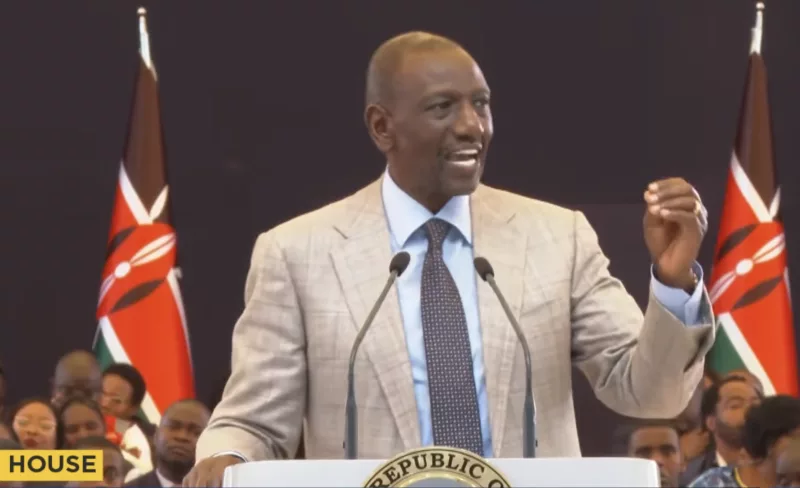
As a result, President William Ruto does not automatically cease to hold office because of the judgment. The court issued a constitutional interpretation but deliberately suspended its legal consequences to preserve stability while allowing the matter to proceed through the appellate process if necessary.
Constitutional Question at the Centre of the Case
The petition was filed by lawyers Dr. Owiso Osiwo, Ashioya Biko and governance activist Khelef Khalifa, who challenged the IEBC's election calendar.
Their argument was based primarily on Article 136(2)(a), which states that the presidential election shall be held on the second Tuesday in August in every fifth year. They maintained that the constitutional wording leaves no room for extending the election into a sixth calendar year.
Justice Thande agreed with that interpretation and further held that neither Article 142, which provides that a President holds office from the date of swearing-in until the next elected President is sworn in, nor any other constitutional provision expressly guarantees a fixed five-year presidential term. Instead, the judgment distinguishes between the constitutional election date and the period an office holder remains in office pending transition.
Why This Decision Matters
The ruling is significant because it addresses a constitutional question that has generated debate among lawyers since the promulgation of the 2010 Constitution.
Several constitutional scholars, including lawyer Willis Otieno, have argued that the wording of Article 136 creates uncertainty over whether presidential terms should be calculated from election day, declaration of results, the Supreme Court's determination of any election petition or the date of inauguration. The High Court has now offered its interpretation, although that position is likely to be tested in higher courts.
What Happens Next?
The decision does not automatically change Kenya's election timetable.
Instead, it establishes an important constitutional interpretation while suspending its immediate effect. The ruling is expected to be challenged before the Court of Appeal and could ultimately be determined by the Supreme Court because it concerns the interpretation of the Constitution and the timing of presidential elections.
Until a higher court reaches a different conclusion or Parliament amends the law where constitutionally permissible, the practical arrangements for the next General Election remain unchanged despite the High Court's declaration.
Key Takeaways
- The High Court interpreted Article 136(2)(a) to mean presidential elections should be held within the fifth year after the previous election.
- The court found that this places the election on August 11, 2026, rather than August 2027.
- Justice Mugure Thande suspended the effect of the ruling, meaning it does not trigger an immediate election or automatically end the President's tenure.
- The judgment is expected to face appeals, making the Court of Appeal and potentially the Supreme Court the final arbiters on the constitutional question.
Related Stories
- Ex-Auditor-General Deputy Director charged over alleged forged degree certificate linked to Sh28.4M in salaries
- Advocate implicated in Sh61.8M gold fraud released on bail
Category: Crime & Justice
Related Video: THE GENTS CONCLAVE
 Facebook
 Twitter / X
 WhatsApp
 LinkedIn
 Telegram
 Reddit