
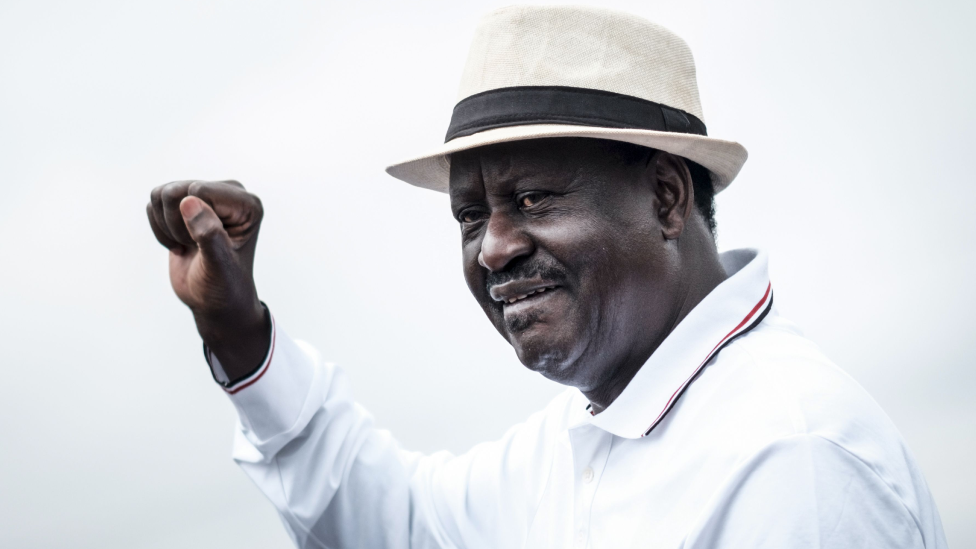
Raila Amolo Odinga’s life reads like the story of modern Kenya itself — a tale of courage, struggle, resilience, and unrelenting hope.
Born on January 7, 1945, in Maseno, Nyanza Province, he was the son of Jaramogi Oginga Odinga, Kenya’s first vice president and one of the nation’s founding fathers, and Mary Ajuma Odinga. From his earliest days, politics was part of his world. His father’s fiery nationalism — including his dramatic resignation from the Kenyatta government in 1966 — gave young Raila a front-row seat to the trials of leadership and dissent.
Early Years and Education
Odinga’s journey began in the mission schools of Nyanza, where he attended Kisumu Union Primary and later Maranda Primary. He moved to Maranda High School, a respected institution known for shaping Luo intellectuals.
At 17, he left Kenya for East Germany, studying at the Herder Institute in Leipzig before earning a Master’s degree in Mechanical Engineering from the Technical University of Magdeburg in 1970.
Raila’s years in Europe shaped his worldview. He later pursued additional courses in the UK and the US, specialising in quality control and standardisation.
Returning home, he worked as an assistant lecturer at the University of Nairobi and later as Deputy Director at the Kenya Bureau of Standards, where he oversaw product quality and compliance. He also co-founded engineering firms, including Spectre Ltd., building a bridge between industry and national development.
A Political Awakening
Odinga’s political career was born of resistance. His detention for nearly eight years after the failed 1982 coup attempt marked a turning point. When he emerged from prison, he was no longer just the son of Jaramogi — he was a man forged by struggle.
In 1992, he entered elective politics under FORD-Kenya, winning the Langata parliamentary seat. His fiery oratory and defiant spirit soon made him a central figure in Kenya’s reform movement.
He founded the National Development Party (NDP) and later joined KANU as Energy Minister, where he championed rural electrification. After falling out with the establishment, he co-founded the Liberal Democratic Party, which became part of the coalition that swept Mwai Kibaki to power in 2002.
As Roads Minister, he launched thousands of kilometres of new roads and became a visible symbol of post-Moi renewal. But it was his leadership in the 2005 “Orange” campaign — opposing a government-backed constitution — that cemented his political identity.
The Reluctant Premier
Raila’s first major presidential bid came in 2007 under the Orange Democratic Movement (ODM). His campaign electrified the nation, but the disputed result triggered post-election violence that left over 1,200 dead.
To end the bloodshed, Odinga entered a power-sharing agreement with President Kibaki, becoming Kenya’s second Prime Minister in 2008. The uneasy coalition nonetheless delivered key milestones, including the 2010 Constitution, which devolved power and strengthened civil rights.
He contested again in 2013, 2017, and 2022, each time narrowly losing. His supporters saw him as a reformist betrayed by the system; his detractors accused him of never accepting defeat. Yet, even in loss, Raila redefined opposition politics — disciplined, principled, and visionary.
In 2018, his unexpected “handshake” with President Uhuru Kenyatta stunned allies and foes alike. To some, it was betrayal; to others, a masterstroke of peace. It paved the way for the Building Bridges Initiative (BBI), an ambitious but controversial reform project struck down by the courts in 2021.
A Continental Visionary
In 2024, Odinga sought a new frontier — the African Union Commission chairmanship. Backed by President William Ruto, he toured capitals across Africa, pitching a vision for infrastructure and integration. He led early rounds of voting at the AU Summit in Addis Ababa in February 2025 but eventually lost to Djibouti’s Mahamoud Ali Youssouf.
True to form, Raila accepted defeat with grace. “When you go to a contest, there can only be two outcomes — you can win or you can lose,” he said, congratulating his rival and vowing to continue serving Africa.
The Final Chapter
In March 2025, he signed a historic Memorandum of Understanding with President Ruto’s government, pledging to advance reforms on youth unemployment, electoral justice, and devolution. It was a striking image: two former rivals shaking hands for Kenya’s future.
By mid-2025, he was still leading ODM, mentoring the next generation. “Agwambo” — as he was fondly known — had evolved from rebel to statesman, from agitator to unifier.
Raila Odinga died on October 15, 2025, in India at the age of 80.
Family and Legacy
Odinga married Ida Betty Oyoo in 1971. Together they raised four children — Fidel (deceased 2015), Rosemary, Raila Jr., and Winnie, who was elected to the East African Legislative Assembly in 2022.
Those who knew him best describe a man who balanced fire and warmth — fierce in debate, yet deeply devoted to his family.
Beyond politics, he was a businessman, engineer, and mentor. His company, East African Spectre, became one of Kenya’s leading gas cylinder manufacturers. His estimated net worth exceeded $30 million, but those close to him say his true wealth lay in the millions of hearts he inspired.
“Kenya is greater than any one individual,” he once said. “Our duty is to make her better than we found her.”
And that, perhaps, was Raila Odinga’s greatest legacy — not that he sought power, but that he believed power should serve the people.

Related Stories
- Interpol Report Reveals Why Kenya Is East Africa's Top Cybercrime Target
- High Court Halts LSK Boycott of Judges Pending September Hearing
- What John Kaguchia’s arrest means for Kenya’s 2027 political battle
Category: News · Related Topic: Kenya Politics
Author: Livenow Africa
 Facebook
 Twitter / X
 WhatsApp
 LinkedIn
 Telegram
 Reddit