
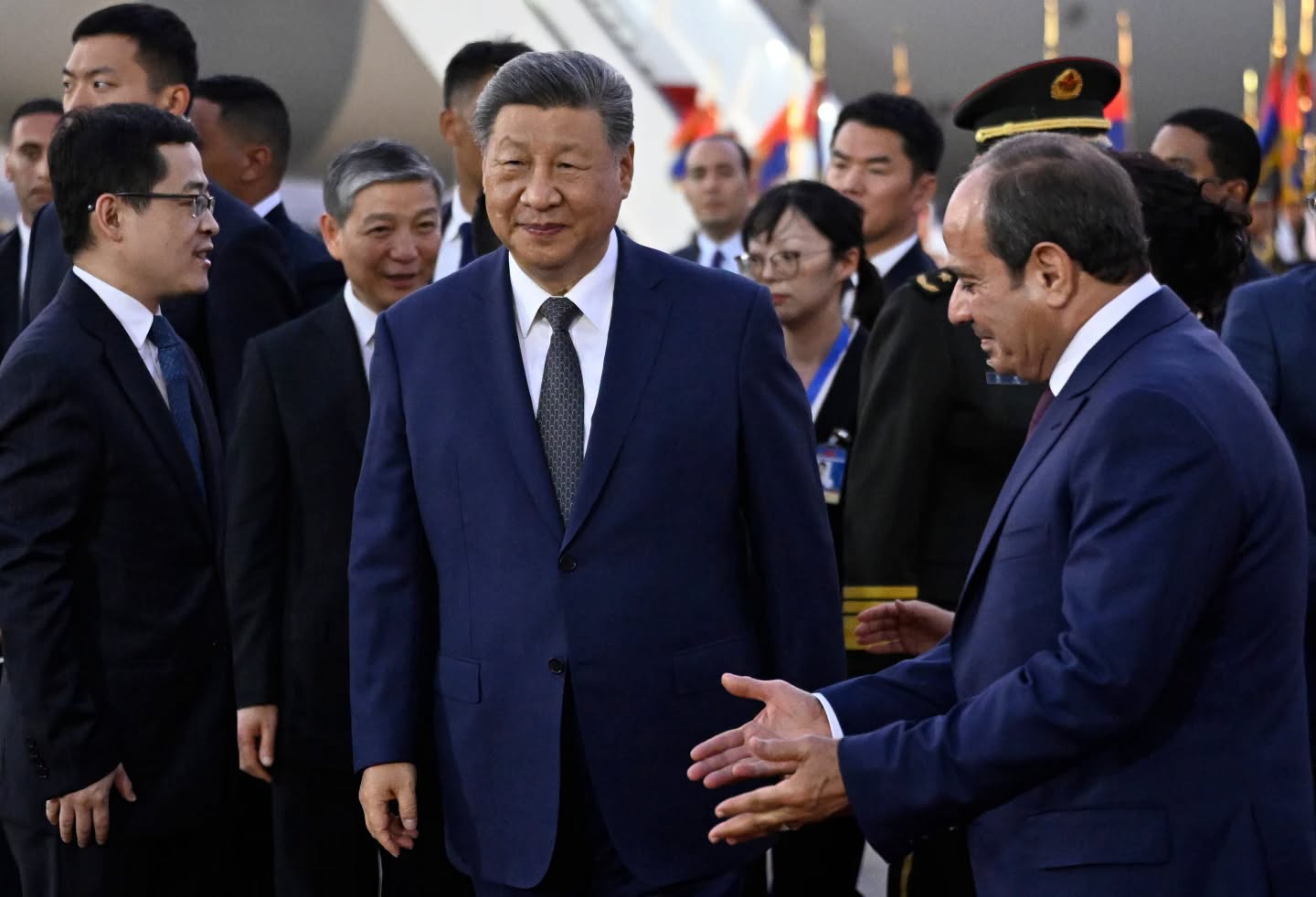
Chinese President Xi Jinping has called for a new security framework for the Middle East as Beijing moves to expand its diplomatic, economic and strategic influence in a region being reshaped by the US-Iran conflict.
Xi made the push during talks with Egyptian President Abdel Fattah al-Sisi in Cairo on Wednesday, in his first visit to Egypt in a decade.
The Chinese leader urged countries in the region to resist external interference and work towards a new approach to regional security, presenting Beijing as an alternative diplomatic and economic partner at a time of heightened instability.
The visit puts Egypt, one of the United States' most important Arab partners, at the centre of China's growing engagement with the Middle East and Africa.

China and Egypt deepen cooperation
Xi and Sisi agreed to strengthen cooperation in security and counterterrorism while expanding economic ties into strategic sectors including semiconductors and critical minerals.
The two countries are also looking at greater use of their own currencies in bilateral trade, according to Reuters.
The agreements illustrate how relations between Cairo and Beijing are moving beyond traditional infrastructure investment and trade.
Egypt has historically maintained close relations with Washington and remains a major recipient of US military assistance.
But Cairo has increasingly pursued what analysts describe as a strategy of balancing its relationships among major global powers.
China has become central to that strategy.
“China and Egypt should jointly oppose unilateralism and acts of bullying,” Xi said, according to China's state-run Xinhua news agency.
He also called for the two countries to work towards what Beijing describes as a more equitable global governance system.
Why Egypt matters to China
Egypt offers China something few countries can match: a strategic position connecting Africa, the Middle East, the Mediterranean and one of the world's most important shipping corridors.
The Suez Canal makes the country particularly important to Beijing's global trade ambitions.
China has invested billions of dollars in Egyptian infrastructure, manufacturing, renewable energy and projects linked to the Suez Canal Economic Zone.
Trade between China and Egypt has also expanded significantly, while Chinese companies have established a growing presence in the country.
For Egypt, Chinese investment provides another source of capital as Cairo seeks to attract foreign investment and strengthen an economy that has faced significant financial pressure.
For Beijing, Egypt provides both an economic gateway and political influence in the Arab and African worlds.
Military relationship growing
The relationship is increasingly extending into defence.
China and Egypt have conducted joint military exercises, including the “Eagles of Civilization” drills, highlighting a level of defence cooperation that would have been far less prominent several years ago.
The development is notable because Egypt's armed forces have historically maintained extensive military links with the United States.
Closer military cooperation with Beijing does not necessarily mean Cairo is abandoning Washington.
Instead, it illustrates Egypt's effort to diversify its international partnerships and reduce dependence on any single global power.
US-Iran conflict changes the equation
Xi's visit comes at an unusually sensitive moment.
The United States and Iran have renewed major military attacks, while instability around the Strait of Hormuz has disrupted shipping and increased concerns over global energy supplies.
China has sought to contrast its approach to the region with Washington's longstanding military involvement.
Beijing has generally portrayed itself as favouring diplomacy, economic partnerships and non-interference while simultaneously expanding its political and strategic footprint.
China already demonstrated its diplomatic ambitions in the region when it helped broker the restoration of diplomatic relations between Saudi Arabia and Iran in 2023.
The current instability provides Beijing with another opportunity to present itself as a potential diplomatic power broker.
A wider battle for influence
Xi's Egypt visit therefore goes beyond bilateral relations between Cairo and Beijing.
It reflects a wider contest over who will shape the political, economic and security architecture of the Middle East.
For decades, the United States has been the dominant external military and diplomatic power in the region.
China has largely avoided attempting to replicate America's extensive military presence.
Instead, Beijing has built influence through infrastructure, investment, trade, energy partnerships and increasingly diplomacy and security cooperation.
Egypt's deepening relationship with China demonstrates how countries traditionally aligned with Washington are increasingly seeking relationships with several major powers simultaneously.
The implications also extend into Africa.
Egypt sits at the intersection of several major African security and diplomatic issues, including Sudan and Libya, while its control of the Suez Canal gives it enormous importance to international trade.
Xi's visit consequently reinforces China's broader effort to strengthen its position across both Africa and the Middle East.
As conflict and uncertainty challenge the existing regional order, Beijing appears increasingly determined to ensure that China has a role in shaping whatever comes next.
Category: International
Related Video: Dolly Parton’s Family Announces Her Passing in Emotional Tribute
 Facebook
 Twitter / X
 WhatsApp
 LinkedIn
 Telegram
 Reddit